The tradition & historical record
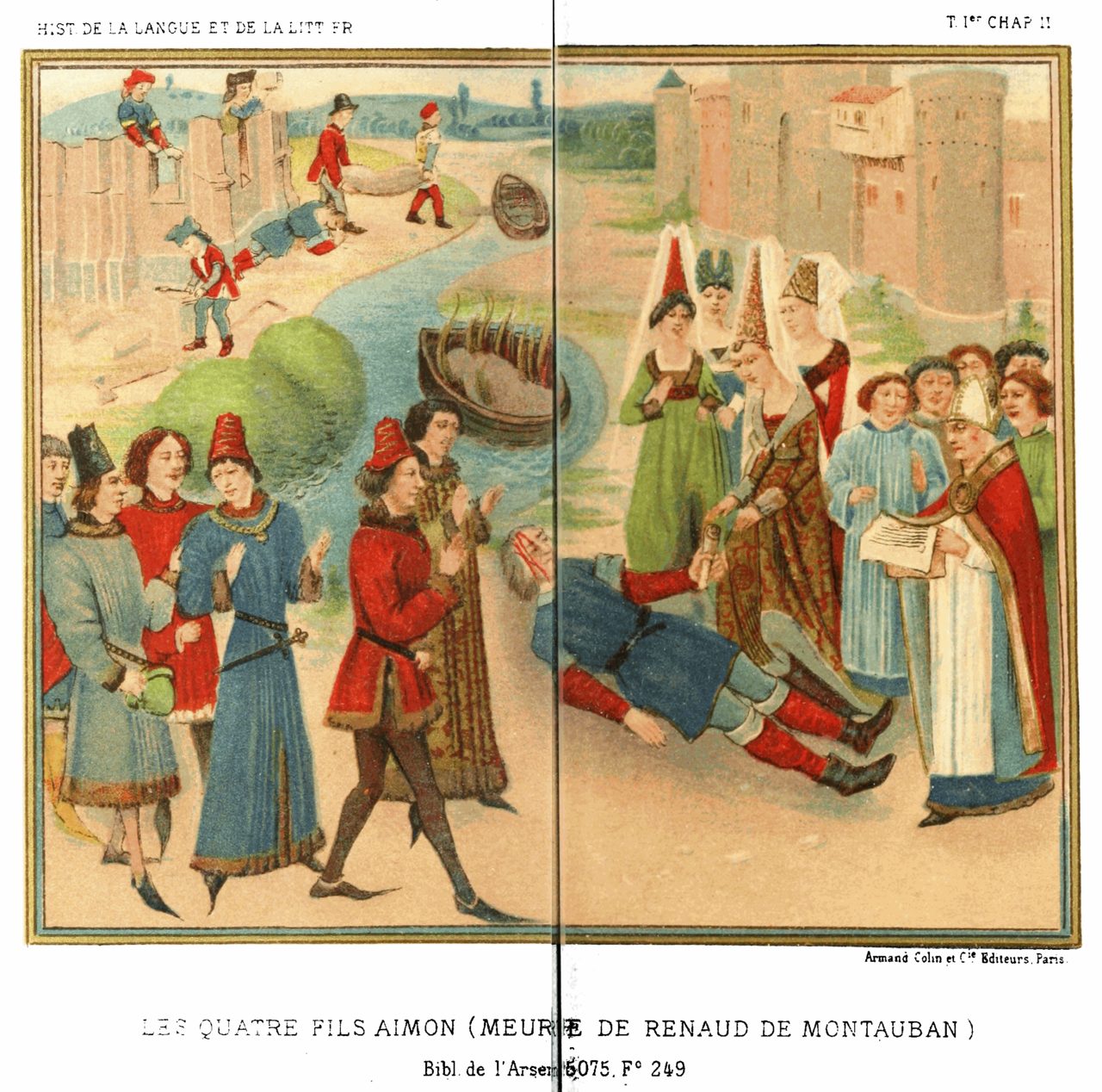
5 min read · 2 sourcesRenaud (or Renaut or Renault) de Montauban (Modern French: [ʁəno d(ə) mɔ̃tobɑ̃]; German: Reinhold von Montalban; Italian: Rinaldo di Montalbano; Dutch: Reinout van Montalban or Montalbaen) was a legendary hero and knight who appeared in a 12th-century Old French chanson de geste known as The Four Sons of Aymon. The four sons of Duke Aymon are Renaud, Richard, Alard and Guiscard, and their cousin is the magician Maugris (French: Maugis; Italian: Malagi or Malagigi). Renaud possesses the magical horse Bayard and the sword Froberge (French: Flamberge; Italian: Fusberta or Frusberta). The story of Renaud was popular across Europe. The tale was adapted into Dutch, German, Italian and English versions throughout the Middle Ages, inspired the Old Icelandic Mágus saga jarls, and also incited subsequent sequels and related texts that form part of the Doon de Mayence cycle of chansons. Renaud, as Rinaldo, is an important character in Italian Renaissance epics, including Morgante by Luigi Pulci, Orlando Innamorato by Matteo Maria Boiardo and Orlando Furioso by Ludovico Ariosto. 1
Quatre Fils Aymon
The oldest extant version of the anonymous Old French chanson de geste Quatre Fils Aymon dates from the late 12th century and comprises 18,489 Alexandrin (12 syllable) verses grouped in assonanced and rhymed laisses (the first 12,120 verses use assonance; critics suggest that the rhymed laisses derive from a different poet). It is one of the longest of all the chansons de geste. Other versions range from 14,300 to 28,000 verses. It was transformed into prose romances in the 14th and 15th centuries, and, judging from the number of editions, the prose Quatre Fils Aymon was the most popular romance of chivalry in the late 15th and first half of the 16th century in France. The tale was the basis of other medieval versions in Italian, German, Dutch and English. The plot of the French chanson is as follows: Renaud and his three brothers were sons of Aymon de Dordone. They flee from the court of Charlemagne after Renaud kills one of Charlemagne's nephews (Bertolai) in a brawl. A long war follows, during which Renaud and his brothers remain faithful to the chivalrous code of honor despite their sufferings, until Charlemagne is prevailed on by his paladins to make terms. The four brothers are pardoned on condition that Renaud go to the Holy Land on Crusade, and that their magical horse Bayard, who could expand his size to carry all four brothers on its back, be surrendered to Charlemagne. Charlemagne orders that the magic horse be drowned by chaining it to a stone and throwing it in a river, but the horse escapes and lives forever more in the woods. Renaud, after further adventures on the Crusades, returns home. He eventually abandons his home and goes to Cologne, where he becomes a builder on a shrine to Saint Peter. 1
Renaud de Montauban cycle
From the 13th century on, other texts concerning separate elements of the extended Renaud de Montauban story were created; together with the original Quatre Fils Aymon, these are termed the "Renaud de Montauban cycle". These poems are: Maugis d'Aigremont (story of the youth of Maugis), Mort de Maugis (story of the death of Maugis), Vivien de Monbranc (story of the brother of Maugis), Bueve d'Aigremont (story of the father of Maugis, Bueve d'Aigremont, brother to Girart de Roussillon and Doon de Nanteuil). 1
Maugis d'Aigremont
Maugis d'Aigremont was a chanson de geste most likely composed in the early 13th century. It exists in a few extant versions; the latest version comprises 9,078 rhymed alexandrines. It tells of the youth of Maugris. The story is, briefly, as follows: the twin sons of Beuve d'Aigremont are Maugis and Vivien. Taken away at birth, Maugis is raised by the fairy Oriande while Vivien is raised by Esclarmonde (wife of the Saracen Sorgalant, ruler of Monbranc). Maugis conquers the horse Bayard and gains the sword Froberge, participates in various battles, and kills Sorgolant. Discovering his identity, he battles to save his maternal grandfather (who is being attacked by Charlemagne) and his father (who is being assaulted by Vivien, who becomes the new ruler, or "amachour", of Monbranc). Vivien then discovers his identity and converts to Christianity. At the end, Maugis gives Bayard and Froberge to his cousin Renaud. 1
Mort de Maugis
Mort de Maugis is a short work of 1,250 verses. It tells a different version of the death of Maugis than the one given in Quatre fils Aymon (in which he ends his days in a hermitage): Maugis becomes a senator at Rome. 1
Vivien de Monbranc
Vivien de Monbranc (or Vivien l'amachour de Monbranc) has come down to us in only one version, a short work of 1,100 alexandrine verses composed in the 13th century. It constitutes a continuation of Maugis d'Aigremont, and is most likely a shortened version of what was originally a longer work. It tells of how Vivien, after his conversion, was attacked by unbelievers and was aided by Maugis and his valet Fousifie. 1
The text above is adapted from the Wikipedia article “Renaud de Montauban”, available under the Creative Commons Attribution-ShareAlike 4.0 licence. 1
Renaud de Montauban is legendary knight in chivalric romance, Christian saint, according to the structured record cited below. This entry was generated automatically from that record and has not yet been reviewed by a person familiar with the tradition. 2
The source record links this tradition to 20 external registers, which can be verified through the citation. 2