The tradition & historical record
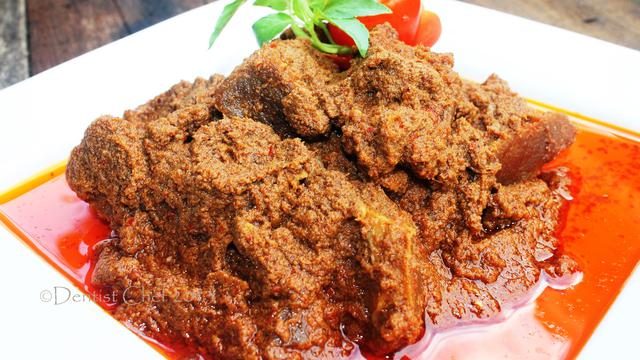
6 min read · 2 sourcesRendang is a stir-fried meat dish or dry curry made of meat stewed in coconut milk and spices, widely popular across Indonesia, Malaysia, Singapore, Brunei, and the southern parts of the Philippines, where each version is considered local cuisine. It refers to both a cooking method of frying and the dish cooked in that way. The process involves slowly cooking meat in spiced coconut milk in an uncovered pot or pan until the oil separates, allowing the dish to fry in its own sauce, coating the meat in a rich, flavorful glaze. Rooted in Malay and Minangkabau, rendang developed at the cultural crossroads of the Malacca Strait. The dish carries strong Indian influences, as many of its key ingredients are staples in Indian cooking. The introduction of chili peppers by the Portuguese through the Columbian exchange after the capture of Malacca in 1511, played a key role in the evolution of rendang. Malay and Minangkabau traders frequently carried rendang as provisions, allowing the dish to travel naturally through cultural exchange between the Sumatra and Malay Peninsula. 1
Etymology and definitions
Both the Kamus Besar Bahasa Indonesia and Kamus Dewan define rendang as meat cooked with spices and coconut milk until completely dry; rendang is also a verb for the action of frying in a pan with or without oil (only in Kamus Dewan). Food historian Khir Johari explains that rendang had a broader meaning for frying in general before the prevalence of goreng. For instance, Munshi Abdullah in his 1838 travelogue to Kelantan described the people of Terengganu enjoying rendang pisang (fried banana fritters) — what the Malays now called goreng pisang or pisang goreng. A 1960 article from Azizah Ja'afar in Berita Harian's Dewan Wanita section lists rendang as "frying with a generous amount of oil", similar to merendang pisang or jemput-jemput (fried fritters), where the things being fried would float in the hot oil. This distinguishes rendang from goreng, which involves little to no oil, as seen in dishes like nasi goreng or mi goreng. Additionally, "rendang" is also the name of a traditional Malay dish known for its rich, spicy flavors, such as rendang santan (meat cooked in coconut milk), and rendang pedas (spiced meat). 1
Linguist Tom G. Hoogervorst's etymological research traces rendang back to the 17th-century Malay wordlists. The name rendang comes from the frying process; by the late 19th century, rendang was associated more specifically with a type of dry curry by British colonial officials in Malaya, where it is noted that Malays distinguished rendang as a dry curry and gulai as a wet curry. In olden times, rendang was often translated to English as "fried meat" or "dry curry". Rendang entered Oxford English Dictionary through Malay and Indonesian rendang which also cognates with Minangkabau randang. 1
The first known use of the word
Food historian Fadly Rahman traces the earliest reference to rendang to the early 16th-century Malay manuscript Hikayat Amir Hamzah associated with the Malacca Sultanate (1400–1528). Written during the spread of Islam in the Malay world, this adaptation of the Persian Hamzanama was later compiled into Malay and intended to inspire Malacca's soldiers in their fight against the Portuguese in 1511. In Malay version, there mentioned the words "rendang" and "merendang" (roasting) which is quoted as follows: 1
This passage suggests that merendang refers to a cooking technique, while rendang describes the resulting dish have been part of the Malay vocabulary since the 16th century. 1
Earliest references in European texts
Hoogervorst's research, traces the modern term rendang back to the Malay-Dutch dictionary first compiled in Ambon and published by Caspar Wiltens and Sebastiaan Danckaert in 1623, where it was defined as "to fry in butter or oil, to fry, to fricassee". The dictionary was expanded and updated multiple times. According to Fadly Rahman, the author of the dictionary attempted to translate rendang using a European dish, something that his readers would be familiar with — fricassee, a French cooking method that involves cutting meat into pieces and braising it. 1
As a tradition in royal Malay banquets
Khir Johari notes that rendang tumis is mentioned in the Hikayat Hang Tuah, a classic Malay literary masterpiece from around the 17th-century. Another manuscript, Hikayat Awang Sulung Merah Muda, reflects 18th-century life and cooking traditions. In the narration, a prince hunts and captures a pelanduk (mouse deer), which is then prepared in various styles — tumis, rendang, and gulai. Tumis refers to a dish that is more like soup, while rendang resembles the slow-cooked dish we know today. These manuscripts offer a glimpse into the Malay cuisine of the 17th and 18th centuries. Historical records from the 19th century, including newspaper reports and travelogues, often described the key ingredients of rempah (spice paste) used in rendang, as well as its regional variations. Renowned for his refined taste and hospitality, Sultan Abu Bakar of Johor frequently hosted lavish banquets at his Istana Besar in Johor Bahru. In 1873, J.F.A. McNair described a royal Malay banquet featuring dishes such as rendang tenggiri and rendang chinchang Plentong. In 1881, when King David Kalākaua of Hawaii visited Johor, Sultan Abu Bakar served rendang tenggiri as part of the royal reception. 1
Made popular through cookbooks and newspapers
By the early 20th century, rendang recipes began appearing in published cookbooks and newspapers across British Malaya and the Dutch East Indies. On 2 February 1917, Soenting Melajoe featured an article by Datoek Soetan Maharadja, noting that Europeans residing in Palembang, Batavia, and Kupang had written to Minangkabau women, sending money through the magazine's editor to request the preparation and delivery of “rendang Alam Minangkabau”. The "Mem's" Own Cookery Book: 420 Tried and Economical Recipes for Malaya (1920) by Mrs. Kinsey, published in Singapore, included a recipe for "rundang" that used curry powder and could be served with spaghetti. In 1936, R.A. Kardinah's Cooking Guide for Ladies, published in Batavia, featured a chicken rendang recipe that emphasized slow cooking, though it adapted traditional ingredients. 1
The text above is adapted from the Wikipedia article “Rendang”, available under the Creative Commons Attribution-ShareAlike 4.0 licence. 1
rendang is spicy meat dish, according to the structured record cited below. This entry was generated automatically from that record and has not yet been reviewed by a person familiar with the tradition. 2
The source record links this tradition to 4 external registers, which can be verified through the citation. 2