The tradition & historical record
5 min read · 2 sourcesA riddle is a statement, question, or phrase having a double or veiled meaning, put forth as a puzzle to be solved. Riddles are of two types: enigmas, which are problems generally expressed in metaphorical or allegorical language that require ingenuity and careful thinking for their solution, and conundrums, which are questions relying for their effects on punning in either the question or the answer. Archer Taylor says that "we can probably say that riddling is a universal art" and cites riddles from hundreds of different cultures including Finnish, Hungarian, American Indian, Chinese, Russian, Dutch, and Filipino sources amongst many others. Many riddles and riddle-themes are internationally widespread. In the assessment of Elli Köngäs-Maranda (originally writing about Malaitian riddles, but with an insight that has been taken up more widely), whereas myths serve to encode and establish social norms, "riddles make a point of playing with conceptual boundaries and crossing them for the intellectual pleasure of showing that things are not quite as stable as they seem" — though the point of doing so may still ultimately be to "play with boundaries, but ultimately to affirm them". 1
Etymology
The modern English word riddle shares its origin with the word read, both stemming from the Common Germanic verb *rēdaną, which meant "to interpret" or "guess". From this verb came the West Germanic noun *rādislī, literally meaning "thing to be guessed" or "thing to be interpreted". From this comes Dutch raadsel, German Rätsel, and Old English *rǣdels, the latter of which became modern English riddle. 1
Definitions
Defining riddles precisely is hard and has attracted a fair amount of scholarly debate. The first major modern attempt to define the riddle within Western scholarship was by Robert Petsch in 1899, with another seminal contribution, inspired by structuralism, by Robert A. Georges and Alan Dundes in 1963. Georges and Dundes suggested that "a riddle is a traditional verbal expression which contains one or more descriptive elements, a pair of which may be in opposition; the referent of the elements is to be guessed". There are many possible subsets of the riddle, including charades, droodles, and some jokes. In some traditions and contexts, riddles may overlap with proverbs. For example, the Russian phrase "Nothing hurts it, but it groans all the time" can be deployed as a proverb (when its referent is a hypochondriac) or as a riddle (when its referent is a pig). Some consider riddles to be a subcategory for the literature. Whereas, one of earliest definitions identified the riddle as a form of metaphor, first likely ascribed by Aristotle, where he states that "metaphors imply riddles", in this classical tradition fall definitions similar to one proposed by Gaston Paris, in which he defines the riddle as "a metaphor or a group of metaphors, the employment of which has not passed into common use, and the explanation of which is not self-evident." 1
Research
Much academic research on riddles has focused on collecting, cataloguing, defining, and typologising riddles. Key work on cataloguing and typologising riddles was published by Antti Aarne in 1918–20, and by Archer Taylor. In the case of ancient riddles recorded without solutions, considerable scholarly energy has also gone into proposing and debating solutions. Whereas previously researchers had tended to take riddles out of their social performance contexts, the rise of anthropology in the 1950s and 1960s encouraged more researchers to study the social role of riddles and riddling, highlighting their role in re-orienting reality in the face of fear and anxiety. However, wide-ranging studies of riddles have tended to be limited to Western countries, with Asian and African riddles being relatively neglected. Riddles have also attracted linguists, often studying riddles from the point of view of semiotics; meanwhile, the twenty-first century has seen the rise of extensive work on medieval European riddles from the point of view of eco-criticism, exploring how riddles can inform us about people's conceptualisation and exploration of their environment. 1
International riddles
Many riddles appear in similar form across many countries, and often continents. Borrowing of riddles happens both on a local scale and across great distances. Kofi Dorvlo gives an example of a riddle that has been borrowed from the Ewe language by speakers of the neighboring Logba language: "This woman has not been to the riverside for water, but there is water in her tank". The answer is "a coconut". On a much wider scale, the Riddle of the Sphinx has also been documented in the Marshall Islands, possibly carried there by Western contacts in the last two centuries. Key examples of internationally widespread riddles follow, based on the classic (European-focused) study by Antti Aarne. 1
Writing-riddle
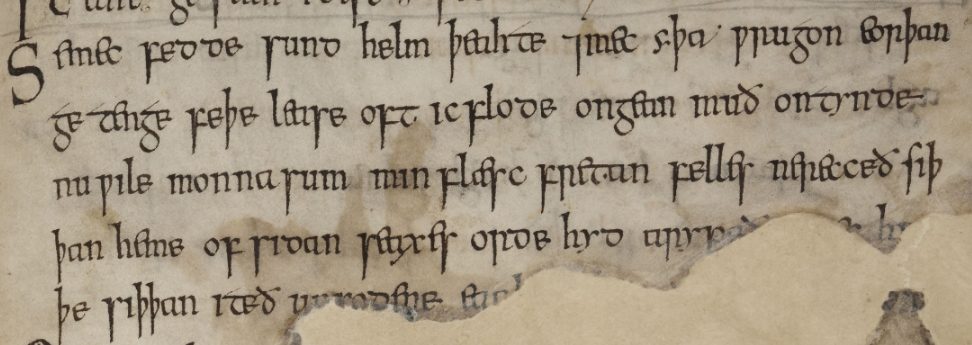
The basic form of the writing-riddle is 'White field, black seeds', where the field is a page and the seeds are letters. An example is the eighth- or ninth-century Veronese Riddle: 1
Here, the oxen are the scribe's finger(s) and thumb, and the plough is the pen. Among literary riddles, riddles on the pen and other writing equipment are particularly widespread. 1
The text above is adapted from the Wikipedia article “Riddle”, available under the Creative Commons Attribution-ShareAlike 4.0 licence. 1
riddle is statement or question or phrase having a double or veiled meaning, put forth as a puzzle to be solved, according to the structured record cited below. This entry was generated automatically from that record and has not yet been reviewed by a person familiar with the tradition. 2
The source record links this tradition to 51 external registers, which can be verified through the citation. 2