The tradition & historical record
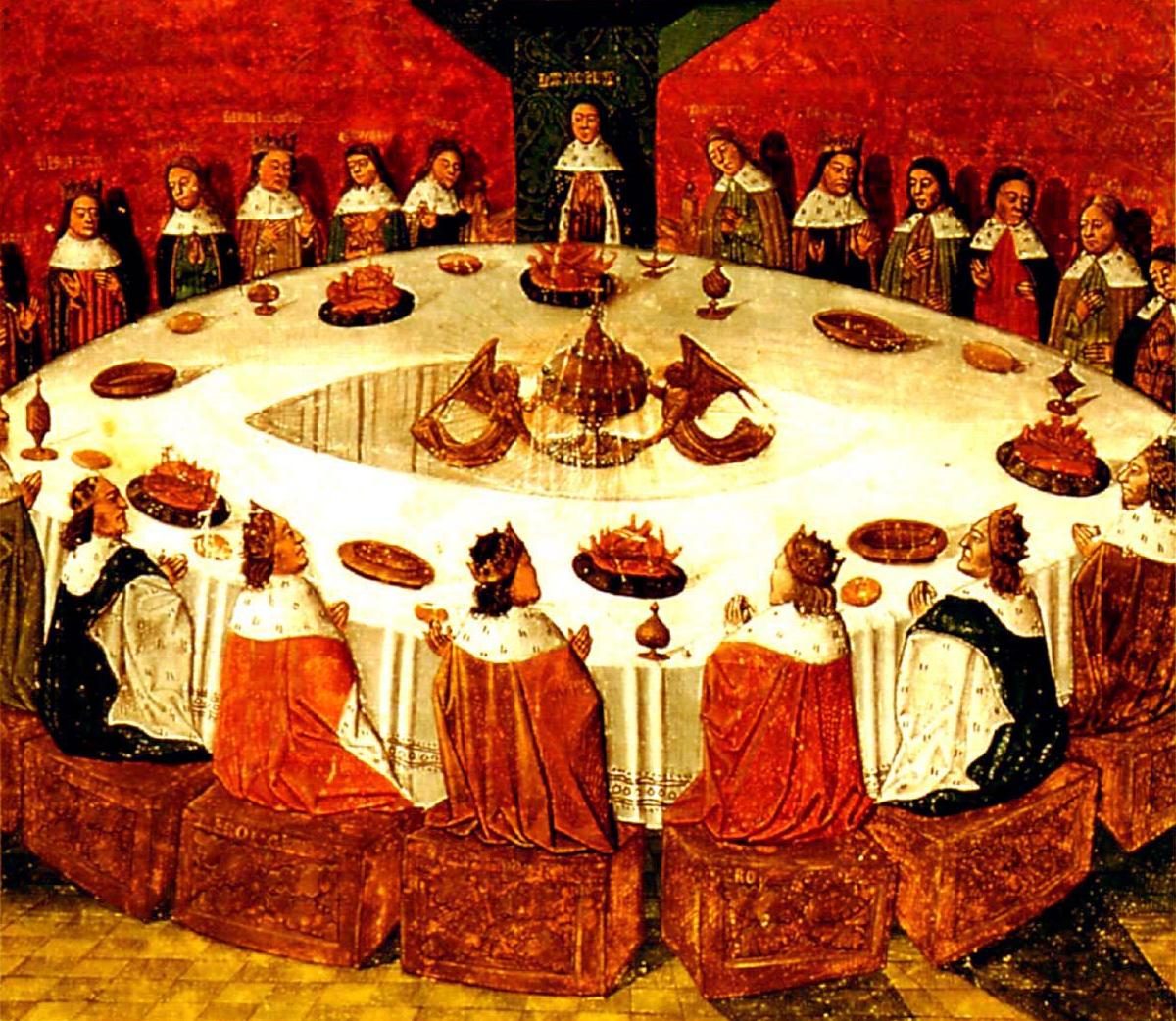
6 min read · 2 sourcesThe Round Table (French: la Table ronde; Welsh: y Ford Gron; Cornish: an Moos Krenn; Breton: an Daol Grenn; Latin: Mensa Rotunda) is King Arthur's famed table in the Arthurian legend, around which he and his knights congregate. As its name suggests, it has no head, implying that everyone who sits there has equal status, unlike conventional rectangular tables where participants order themselves according to rank. The table was first described in 1155 by Wace, who relied on previous depictions of Arthur's fabulous retinue. The symbolism of the Round Table developed over time; by the close of the 12th century, it had come to represent the chivalric order associated with Arthur's court, the Knights of the Round Table. 1
Origins
Though the Round Table is not mentioned in the earliest accounts, tales of King Arthur having a marvellous court made up of many prominent warriors are ancient. Geoffrey of Monmouth, in his Historia Regum Britanniae (composed c. 1136) says that, after establishing peace throughout Britain, Arthur "increased his personal entourage by inviting very distinguished men from far-distant kingdoms to join it." The code of chivalry so important in later medieval romance figures in it as well, as Geoffrey says Arthur established "such a code of courtliness in his household that he inspired peoples living far away to imitate him." Arthur's court was well known to Welsh storytellers; in the romance Culhwch and Olwen, the protagonist Culhwch invokes the names of 225 individuals affiliated with Arthur. The fame of Arthur's entourage became so prominent in Welsh tradition that in the later additions to the Welsh Triads, the formula tying named individuals to "Arthur's Court" in the triad titles began to supersede the older "Island of Britain" formula. Though the code of chivalry crucial to later continental romances dealing with the Round Table is mostly absent from the Welsh material, some passages of Culhwch and Olwen seem to reference it. For instance, Arthur explains the ethos of his court, saying "[w]e are nobles as long as we are sought out: the greater the bounty we may give, the greater our nobility, fame and honour." Though no Round Table appears in the early Welsh texts, Arthur is associated with various items of household furniture. The earliest of these is Saint Carannog's mystical floating altar in that saint's 12th-century Vita. 1
Legend
The Round Table first appeared in Wace's Roman de Brut, a Norman language adaptation of Geoffrey's Historia finished in 1155. Wace says Arthur created the Round Table to prevent quarrels among his barons, none of whom would accept a lower place than the others. Layamon added to the story when he adapted Wace's work into the Middle English Brut in the early 13th century, saying that the quarrel between Arthur's vassals led to violence at a Yuletide feast. In response, a Cornish carpenter built an enormous but easily transportable Round Table to prevent further dispute. Wace claims he was not the source of the Round Table; both he and Layamon credited it instead to the Bretons. Some scholars have doubted this claim, while others believe it may be true. There is some similarity between the chroniclers' description of the Round Table and a custom recorded in Celtic stories, in which warriors sit in a circle around the king or lead warrior, in some cases feuding over the order of precedence as in Layamon. There is a possibility that Wace, contrary to his own claims, derived Arthur's round table not from any Breton source, but rather from medieval biographies of Charlemagne—notably Einhard's Vita Caroli and Notker the Stammerer's De Carolo Magno—in which the king is said to have possessed a round table decorated with a map of Rome. 1
The Round Table takes on new dimensions in the romances of the late 12th and early 13th century, where it becomes a symbol of the famed order of chivalry which flourishes under Arthur. In Robert de Boron's Merlin, written around 1200, the magician Merlin creates the Round Table in imitation of the table of the Last Supper and of Joseph of Arimathea's Grail Table. 1
Round Table tournaments
During the Middle Ages, festivals called Round Tables were celebrated throughout Europe in imitation of Arthur's court. These events featured jousting, dancing, and feasting, and in some cases attending knights assumed the identities of Arthur's entourage. 1
Winchester Round Table
The Winchester Round Table is a large tabletop hanging in Winchester Castle and bearing the names of various knights of Arthur's court, was probably created for a Round Table tournament. The table is 5.5 metres (18 ft) in diameter and weighs 1.2 tonnes (2,600 lb). The current paintwork is late; it was done by order of King Henry VIII of England. The table itself is considerably older; dendrochronology calculates the date of construction to 1250–1280—during the reign of Edward I of England—using timbers that were felled over a period of years. Edward was an Arthurian enthusiast who attended at least five Round Tables and hosted one himself in 1299, which may have been the occasion for the creation of the Winchester Round Table. Martin Biddle, from an examination of Edward's financial accounts, links it instead with a tournament King Edward held near Winchester on 20 April 1290, to mark the betrothal of one of his daughters. The green and white colours represents the Welsh Livery used by the Tudor dynasty. 1
Historical Round Table of Edward III
On 22 January 1344, after a tournament at Windsor Castle, King Edward III of England (r. 1327–1377) swore an oath to restore the Order of the Round Table to the same as that of King Arthur. Receiving agreement from the earls and knights present, Edward announced that the order's first meeting would take place during Pentecost. The plan never came to fruition, but the new Order of the Garter carried connotations from this legend by the circular shape of the garter. Edward's wartime experiences during the Crécy campaign (1346–1347) seem to have been a determining factor in his abandonment of the Round Table project. It has been argued that the total warfare tactics employed by the English at Crécy in 1346 were contrary to Arthurian chivalric ideals and made Arthur a problematic paradigm for Edward, especially at the time of the institution of the Garter. There are no formal references to King Arthur and the Round Table in the surviving early 15th-century copies of the Statutes of the Garter. However, the Garter Feast of 1358 did involve a Round Table game in an overlap between the projected Round Table fellowship and the actualized Order of the Garter. 1
The text above is adapted from the Wikipedia article “Round Table”, available under the Creative Commons Attribution-ShareAlike 4.0 licence. 1
Round Table is element from the Arthurian legend, according to the structured record cited below. This entry was generated automatically from that record and has not yet been reviewed by a person familiar with the tradition. 2
The source record links this tradition to 9 external registers, which can be verified through the citation. 2