The tradition & historical record
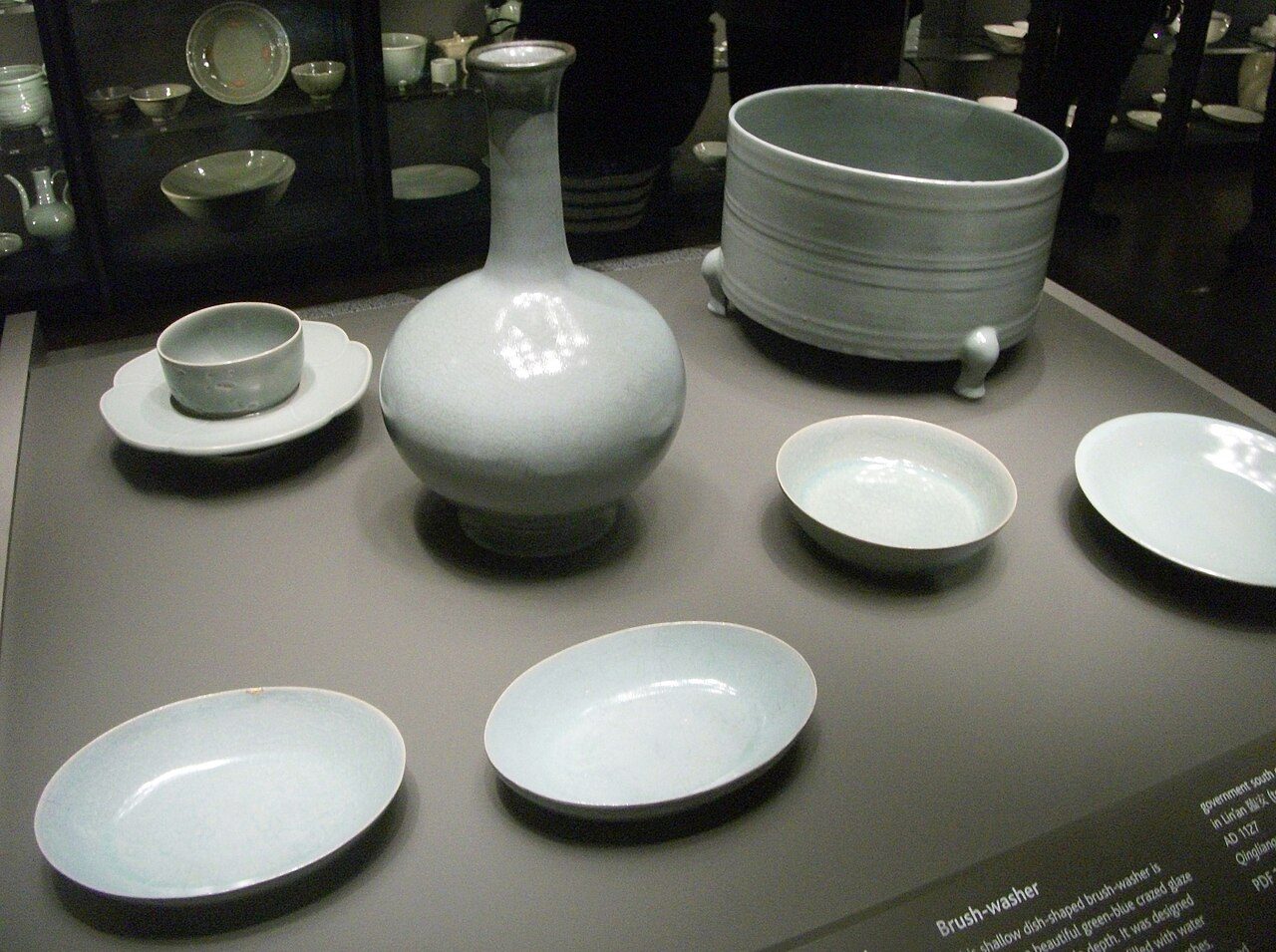
7 min read · 2 sourcesRu ware, Ju ware (Chinese: 汝瓷), or "Ru official ware" (Chinese: 汝官瓷) is a famous and extremely rare type of Chinese pottery from the Song dynasty, produced for the imperial court for a brief period around 1100. Fewer than 100 complete pieces survive, though there are later imitations which do not entirely match the originals. Most have a distinctive pale "duck-egg" blue glaze, "the colour of the sky after rain, glimpsed through a parting in the clouds" according to a medieval connoisseur, and are otherwise undecorated, though their colours vary and reach into a celadon green. The shapes include dishes, probably used as brush-washers, cups, wine bottles (carafes in modern terms), small vases, and censers and incense-burners. They can be considered as a particular form of celadon wares. Ru ware represents one of the Five Great Kilns identified by later Chinese writers. The wares were reserved for the Imperial court, with according to one contemporary source only those they rejected reaching a wider market. The source, Zhou Hui, also says the glaze contained agate, and when the kiln site was located in recent decades it was indeed very close to a site for mining agate, which is very largely composed of silica, a usual component of ceramic glazes. However, experts now discount any influence of agate in achieving the Ru glaze colour. 1
Characteristics
The pieces are mostly fairly small, for drinking, use at a scholar's desk, incense burning, or as small containers. There are a few oval "narcissus vases", which is to say planters for daffodils. Many pieces have a subtle crazed or crackled glaze, though there is some evidence that the most admired are those without this, and the effect was not deliberate. Those shapes that are not simple pottery forms show derivation from other media such as metalwork or lacquer, for example the bottomless cup-stand, which is a common shape in both. Most shapes have a "clearly defined, slightly splayed foot-rim". A very few pieces have decoration, with a "lightly impressed floral design". The glaze, applied in several layers, continues over the rims at top and bottom of the pieces, in contrast to the rival porcelain Ding ware, fired upturned and so with a rough unglazed rim, often covered with a band of metal. Instead Ru ware was kept off the kiln stack surface by being supported on three or five small spurs or prongs, presumably of metal, which left little unglazed oval spots called "sesame seeds" on the underside. The colours vary, and have been classified by Chinese authorities as "sky-blue", "pale-blue" and "egg-blue", in each case using the Chinese word qīng (青), which can cover both blue and green. This "all-over" glazing technique seems to have been invented at the Ru kilns, and increased the resemblance of the wares to jade, always the most prestigious material in Chinese art. 1
Kiln site
A group of over 15 kilns at the village of Qingliangsi, Baofeng County, Henan have been identified as the site manufacturing Ru ware. They were first identified in 1950, and in 1977 the ceramic art historian Ye Zhemin found a sherd on the site which when analysed proved identical to a Ru ware sample in Beijing. This was confirmed as the site was excavated, beginning in 1987, with the main "official ware" kiln and workshop area being uncovered in 2000 in the sixth phase of excavation. Altogether the site covers 250,000 square metres, "with kilns densely distributed throughout". As they were excavated it became clear that they had also produced large amounts of other, lesser wares, including black and three-colour wares, and also "a significant quantity of carved and incised Ru wares of inferior quality," which is not represented among surviving pieces. Apart from the last, these other styles would not normally be called "Ru ware", and fall within the range of other contemporary northern ceramics. The excavations also found sherds of "official" quality, but in more elaborate shapes than found among the surviving whole pieces. These may have been test pieces that were not put into production. There are also pieces decorated in conventional celadon techniques, also not found in the complete survivals. 1
Dating
In 2012 a Sotheby's catalogue note said "Although the exact time of the production of Ru ware is still under debate, all scholars agree that it was made for an extremely short period only. Generally a space of some twenty years is proposed, from 1086 to 1106, although some scholars have argued for a slightly longer period." Earlier Jessica Rawson thought the period was "c.1107 to 1125". Shelagh Vainker says the period was "about 40 years". The British Museum says "twenty or perhaps forty years between 1086 and 1106 or 1125". It was only produced during the reigns of the Huizong Emperor (r. 1100–1125) and perhaps his predecessor, Zhezong (r. 1085–1100). Huizong seems to have taken a close personal interest in the ware. Shortly after Huizong abdicated the Northern Song period was ended by invaders from the north, and Huizong and his successor were captured in the disastrous Jin-Song wars of the 1120s. A younger son of Huizong fled to the south and established the Southern Song as the Gaozong Emperor (1127–1163), but the Ru kiln was now in enemy territory, and production of Ru ware ceased, if it had not already done so. The kilns were abandoned, and the workers dispersed. A gift of 16 itemized pieces to Gaozong in 1151 is recorded; a rather tiny quantity by imperial standards, suggestive of their rarity. The same source records that when in 1179 the aged retired emperor visited a garden, a Ru vase was placed there for him to admire. In the south a form of official Guan ware, more green than blue, seems to have acted as a rather inadequate substitute for the court. The dates of production were long confused by a fake test disk in the Percival David Collection. 1
Collecting and imitation
The wares seem to have been very rare even during the time they were produced, and remained so, as various Chinese writers say. The Qianlong Emperor (r. 1736–1795), a keen collector who must have owned at least half of the surviving examples, describes it in a poem "as rare as stars at dawn". As they receded in time, their reputation became almost legendary, although many of the writers praising them may never have glimpsed examples. However, after Guan ware there do not seem to have been serious attempts to imitate them in China until the 18th century, when under the Yongzheng Emperor (r. 1723–1735) they were copied in imperial Jingdezhen ware, with examples from the imperial collection being sent to Jingdezhen to copy. These are known as "Ru-type" ware. The Qianlong Emperor wrote poems on several pieces – in both senses, as he had them engraved on the bases. One of these pieces was actually a recent imitation made for his father. 1
Collections
In 2012, Sotheby's identified 79 individual complete survivals, and a revised list by Regina Krahl for Sotheby's next Ru sale in 2017 increased this to 87; The National Palace Museum i… 1
The text above is adapted from the Wikipedia article “Ru ware”, available under the Creative Commons Attribution-ShareAlike 4.0 licence. 1
Ru ware is Chinese pottery made by the Song dynasty around 1100 AD, according to the structured record cited below. This entry was generated automatically from that record and has not yet been reviewed by a person familiar with the tradition. 2
The source record links this tradition to 4 external registers, which can be verified through the citation. 2