The tradition & historical record
5 min read · 2 sourcesIn Slavic folklore, the rusalka (plural: rusalki; Cyrillic: русалка, Russian pronunciation: [rʊˈsaɫkə] , plural: русалки; Polish: rusałka, plural: rusałki) is a female entity, often malicious toward mankind and frequently associated with water. It has counterparts in other parts of Europe, such as the French Melusine and the Germanic Nixie. Folklorists have proposed a variety of origins for the entity, including that they may originally stem from Slavic paganism, where they may have been seen as benevolent spirits. Rusalki appear in a variety of media in modern popular culture, particularly in Slavic language-speaking countries, where they frequently resemble the concept of the mermaid. In northern Russia, the rusalka was also known by various names such as the vodyanitsa (or vodyanikha/vodyantikha; Russian: водяница, водяниха, водянтиха; lit. "she from the water" or "the water maiden"), kupalka (Russian: купалка; "bather"), shutovka (Russian: шутовка; "joker", "jester" or "prankster") and loskotukha (or shchekotukha, shchekotunya; Russian: лоскотуха, щекотуха, щекотунья; "tickler" or "she who tickles"). In Ukraine, the rusalka was called a mavka. Those names were more common until the 20th century, and the word rusalka was perceived by many people as bookish, scholarly. 1
Etymology
The term "Rusalka" derives from "rusalija" (Church Slavonic: рѹсалиѩ, Old East Slavic: русалиꙗ, Bulgarian: русалия, Serbo-Croatian Cyrillic: русаље) which entered Slavic languages, via Byzantine Greek "rousália" (Medieval Greek: ῥουσάλια), from the Latin "Rosālia" as a name for Pentecost and the days adjacent to it. Long-standing, likely pre-Christian, annual traditions resulted in that time of year being associated with spirits (navki, mavki) which were subsequently named for the holiday. 1
Origin and appearance
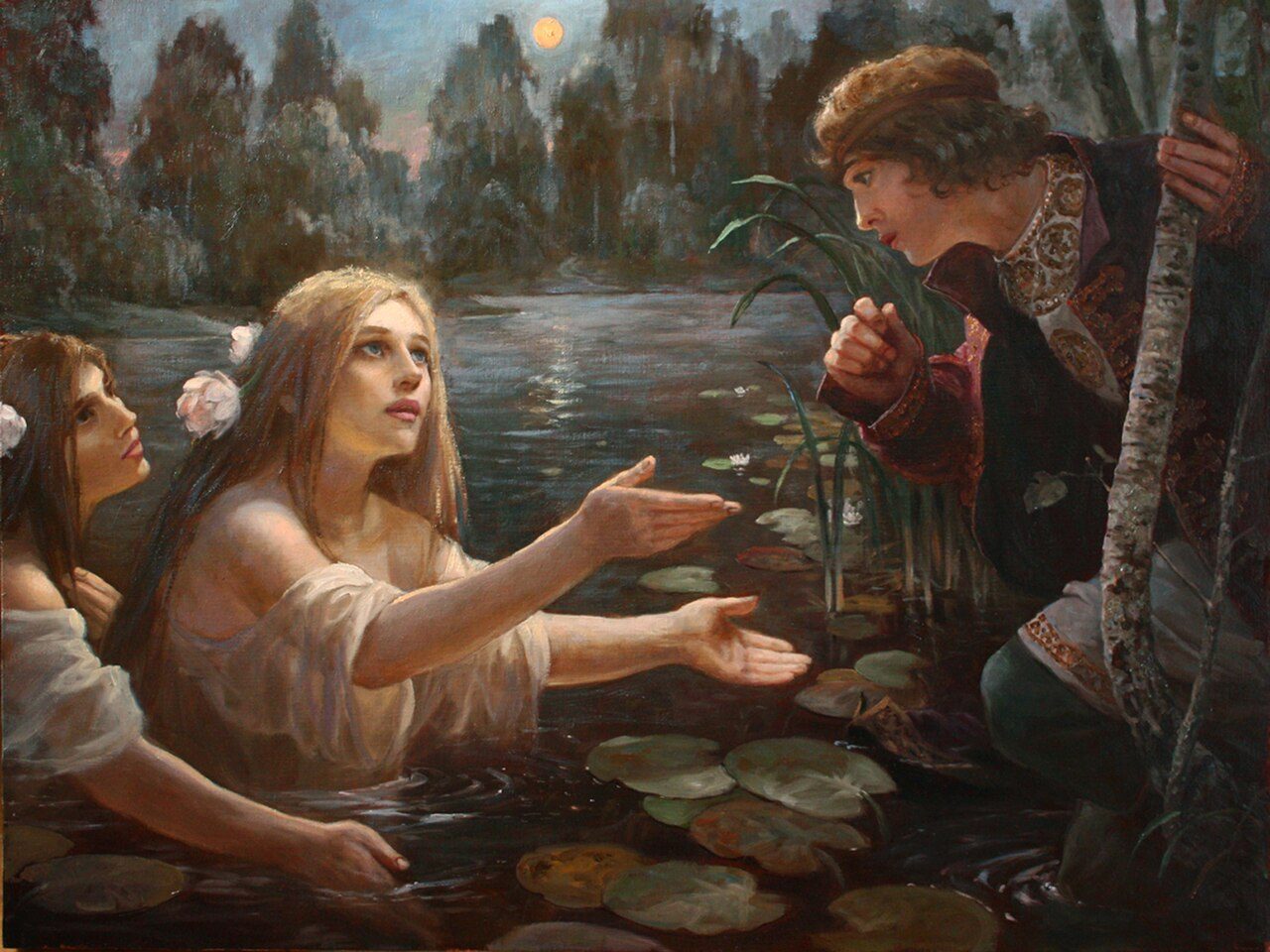
According to Vladimir Propp, the original "rusalka" was an appellation used by pagan Slavic peoples, who linked them with fertility and did not consider rusalki evil before the 19th century. They came out of the water in the spring to transfer life-giving moisture to the fields and thus helped nurture the crops. In 19th-century versions, a rusalka is an unquiet, dangerous being who is no longer alive, associated with the unclean spirit. According to Dmitry Zelenin, young women, who either committed suicide by drowning due to an unhappy marriage (they might have been jilted by their lovers or abused and harassed by their much older husbands) or who were violently drowned against their will (especially after becoming pregnant with unwanted children), must live out their designated time on Earth as rusalki. However, the initial Slavic lore suggests that not all rusalki occurrences were linked with death from water. It is accounted by most stories that the soul of a young woman who had died in or near a river or a lake would come back to haunt that waterway. This undead rusalka is not invariably malevolent, and would be allowed to die in peace if her death is avenged. Her main purpose is, however, to lure young men, seduced by either her looks or her voice, into the depths of said waterways where she would entangle their feet with her long hair and submerge them. Her body would instantly become very slippery and not allow the victim to cling on to her body in order to reach the surface. She would then wait until the victim had drowned, or, on some occasions, tickle them to death, as she laughed. 1
Variations
While lore often said that the rusalki could not stand completely out of water, some works of fiction told of rusalki that could climb trees and sing songs, sit on docks with only their feet submerged, comb their hair, or even join other rusalki in circle dances in fields. A particular feature of such stories revolves around the fact that this behaviour was limited to only certain periods of the year, usually the summer (see Rusalka Week section). 1
Region-specific
Specifics pertaining to rusalki differed among regions. In most tales they lived without men. In stories from Ukraine, they were often linked with water. In Belarus they were linked with the forest and field. They were usually pictured as beautiful naked maidens, but in some areas they were imagined as hideous and hairy. They were said to tickle men to death. According to some Russian beliefs, rusalki had the appearance of very pale little girls with green hair and long arms. In other beliefs, they were described as naked girls with light brown hair. In Poland and Czech Republic, water rusalki/rusalky were younger and fair-haired, while the forest ones looked more mature and had black hair – but in both cases, if someone looked up close, their hair turned green, and the faces became distorted. They killed their victims by tickling them to death or forcing them to participate in a frenzied dance. In Polish folklore, the term rusalka could also stand for boginka, dziwożona and various other entities. 1
Rusalka week
The rusalki were believed to be at their most dangerous during the 'Rusalka week' (Russian: Русальная неделя, romanized: Rusalnaya nedelya) in early June. At this time, they were supposed to have left their watery depths in order to swing on branches of birch and willow trees by night. Swimming during this week was strictly forbidden, lest mermaids drag a swimmer down to the river bed. A common feature of the celebration of Rusalnaya was the ritual banishment or burial of the rusalki at the end of the week, which remained as entertainment in Russia, Belarus, and Ukraine until the 1930s. 1
The text above is adapted from the Wikipedia article “Rusalka”, available under the Creative Commons Attribution-ShareAlike 4.0 licence. 1
Rusalka is female spirit in Slavic mythology, according to the structured record cited below. This entry was generated automatically from that record and has not yet been reviewed by a person familiar with the tradition. 2
The source record links this tradition to 5 external registers, which can be verified through the citation. 2