The tradition & historical record
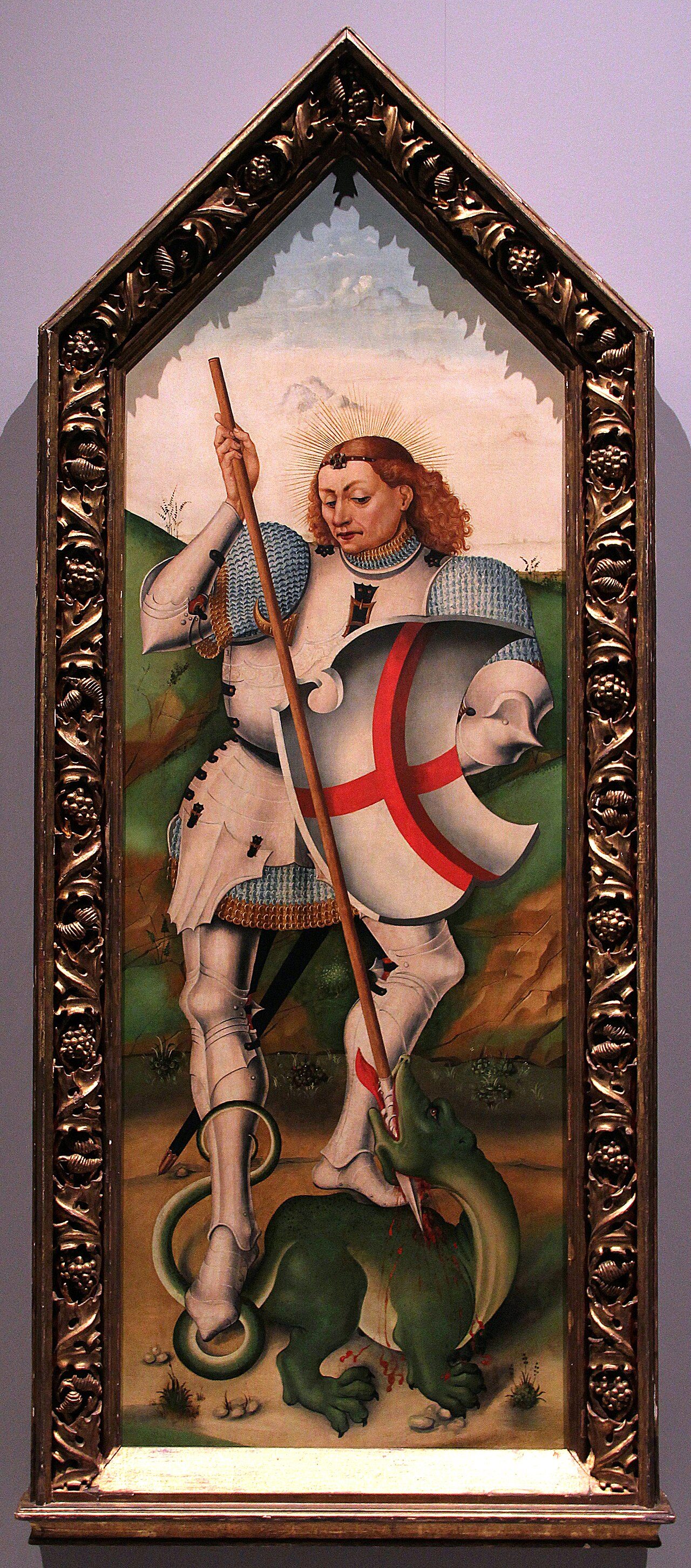
7 min read · 2 sourcesSaint George and the Dragon is a legend in which Saint George—a soldier venerated in Christianity and among the Druze—defeats a dragon. The story goes that the dragon originally extorted tribute from villagers. When they ran out of livestock and trinkets for the dragon, they started giving up a human tribute of two children per day, selected by lot. One day, the princess herself was selected as the next offering. As she was walking toward the dragon's cave, St. George saw her and asked why she was crying. The princess told the saint about the dragon's atrocities and asked him to flee immediately, in fear that he might be killed too. But the saint refused to flee, slew the dragon, and rescued the princess. The narrative was first set in Cappadocia in the earliest sources of the 11th and 12th centuries, but transferred to Libya in the 13th-century Golden Legend. The narrative has pre-Christian origins (Jason and Medea, Perseus and Andromeda, Typhon, etc.), and is recorded in various saints' lives prior to its attribution to Saint George specifically. It was particularly attributed to Saint Theodore Tiro in the 9th and 10th centuries, and was first transferred to Saint George in the 11th century. The oldest known record of Saint George slaying a dragon is found in a Georgian text of the 11th century. The legend and iconography spread rapidly through the Byzantine cultural sphere in the 12th century. 1
Pre-Christian predecessors
The iconography of military saints Theodore, George and Demetrius as horsemen is a direct continuation of the Roman-era "Thracian horseman" type iconography. The iconography of the dragon appears to grow out of the serpent entwining the "tree of life" on one hand, and with the draco standard used by late Roman cavalry on the other. Horsemen spearing serpents and boars are widely represented in Roman-era stelae commemorating cavalry soldiers. A carving from Krupac, Serbia, depicts Apollo and Asclepius as Thracian horsemen, shown besides the serpent entwined around the tree. Another stele shows the Dioscuri as Thracian horsemen on either side of the serpent-entwined tree, killing a boar with their spears. The development of the hagiographical narrative of the dragon-fight parallels the development of iconography. It draws from pre-Christian dragon myths. The Coptic version of the Saint George legend, edited by E. A. Wallis Budge in 1888, and estimated by Budge to be based on a source of the 5th or 6th century, names "governor Dadianus", the persecutor of Saint George as "the dragon of the abyss", a Greek myth with similar elements of the legend is the battle between Bellerophon and the Chimera. Budge makes explicit the parallel to pre-Christian myth: 1
I doubt much of the whole story of Saint George is anything more than one of the many versions of the old-world story of the conflict between Light and Darkness, or Ra and Apepi, and Marduk and Tiamat, woven upon a few slender threads of historical fact. 1
Christianised iconography
Depictions of "Christ militant" trampling a serpent are found in Christian art of the late 5th century. Iconography of the horseman with spear overcoming evil becomes current in the early medieval period. Iconographic representations of St Theodore as dragon-slayer are dated to as early as the 7th century, certainly by the early 10th century (the oldest certain depiction of Theodore killing a dragon is at Aghtamar, dated c. 920). Theodore is reported as having destroyed a dragon near Euchaita in a legend not younger than the late 9th century. Early depictions of a horseman killing a dragon are unlikely to represent Saint George, who in the 10th century was depicted as killing a human figure, not a dragon. 1
The earliest image of St Theodore as a horseman (named in Latin) is from Vinica, North Macedonia, and, if genuine, dates to the 6th or 7th century. Here, Theodore is not slaying a dragon, but holding a draco standard. One of the Vinica icons also has the oldest representation of Saint George with a dragon: George stands besides a cynocephalous Saint Christopher, both saints treading on snakes with human heads, and aiming at their heads with spears. Maguire (1996) has connected the shift from unnamed equestrian heroes used in household magic to the more regulated iconography of named saints to the closer regulation of sacred imagery following the iconoclasm of the 730s. 1
In the West, a Carolingian-era depiction of a Roman horseman trampling and piercing a dragon between two soldier saints with lances and shields was put on the foot of a crux gemmata, formerly in the Treasury of the Basilica of Saint Servatius in Maastricht (lost since the 18th c.). 1
Transfer to Saint George
The dragon motif was transferred to the George legend from that of his fellow soldier saint, Saint Theodore Tiro. The transfer of the dragon iconography from Theodore, or Theodore and George as "Dioskuroi" to George on his own, first becomes tangible in the early 11th century. The oldest certain images of Saint George combatting the serpent are still found in Cappadocia. 1
Golden Legend
In the well-known version from Jacobus de Voragine's Legenda aurea (The Golden Legend, 1260s), the narrative episode of Saint George and the Dragon took place somewhere he called "Silene" in what in medieval times was referred to as "Libya" (basically anywhere in North Africa, west of the Nile). Silene was being plagued by a venom-spewing dragon dwelling in a nearby pond, poisoning the countryside. To prevent it from affecting the city itself, the people offered it two sheep daily, then a man and a sheep, and finally their children and youths, chosen by lottery. One time the lot fell on the king's daughter. The king offered all his gold and silver to have his daughter spared, but the people refused. The daughter was sent out to the lake, dressed as a bride, to be fed to the dragon. Saint George, described as a "tribune" (Roman military commander), arrived at the spot. The princess tried to send him away, but he vowed to remain. The dragon emerged from the pond while they were conversing. Saint George made the Sign of the Cross and charged it on horseback, seriously wounding it with his lance. He then called to the princess to throw him her girdle (zona; a rope-like belt), and he put it around the dragon's neck. Wherever she walked, the dragon followed the girl like a "meek beast" on a leash. The same motif is also found in the legend of Graoully in Metz, France. The princess and Saint George led the dragon back to the city of Silene, where it terrified the population. Saint George offered to kill the dragon if they consented to become Christians and be baptized. Fifteen thousand men including the king of Silene converted to Christianity. George then killed the dragon, beheading it with his sword, and the body was carted out of the city on four ox-carts. 1
Relics
Arm of St. George: Originally housed at the Benedictine Convent by the St. George's Basilica, Prague at Prague Castle, now exhibited at the Metropolitan chapter room of St. 1
The text above is adapted from the Wikipedia article “Saint George and the Dragon”, available under the Creative Commons Attribution-ShareAlike 4.0 licence. 1
Saint George and the Dragon is medieval legend, according to the structured record cited below. This entry was generated automatically from that record and has not yet been reviewed by a person familiar with the tradition. 2
The source record links this tradition to 4 external registers, which can be verified through the citation. 2