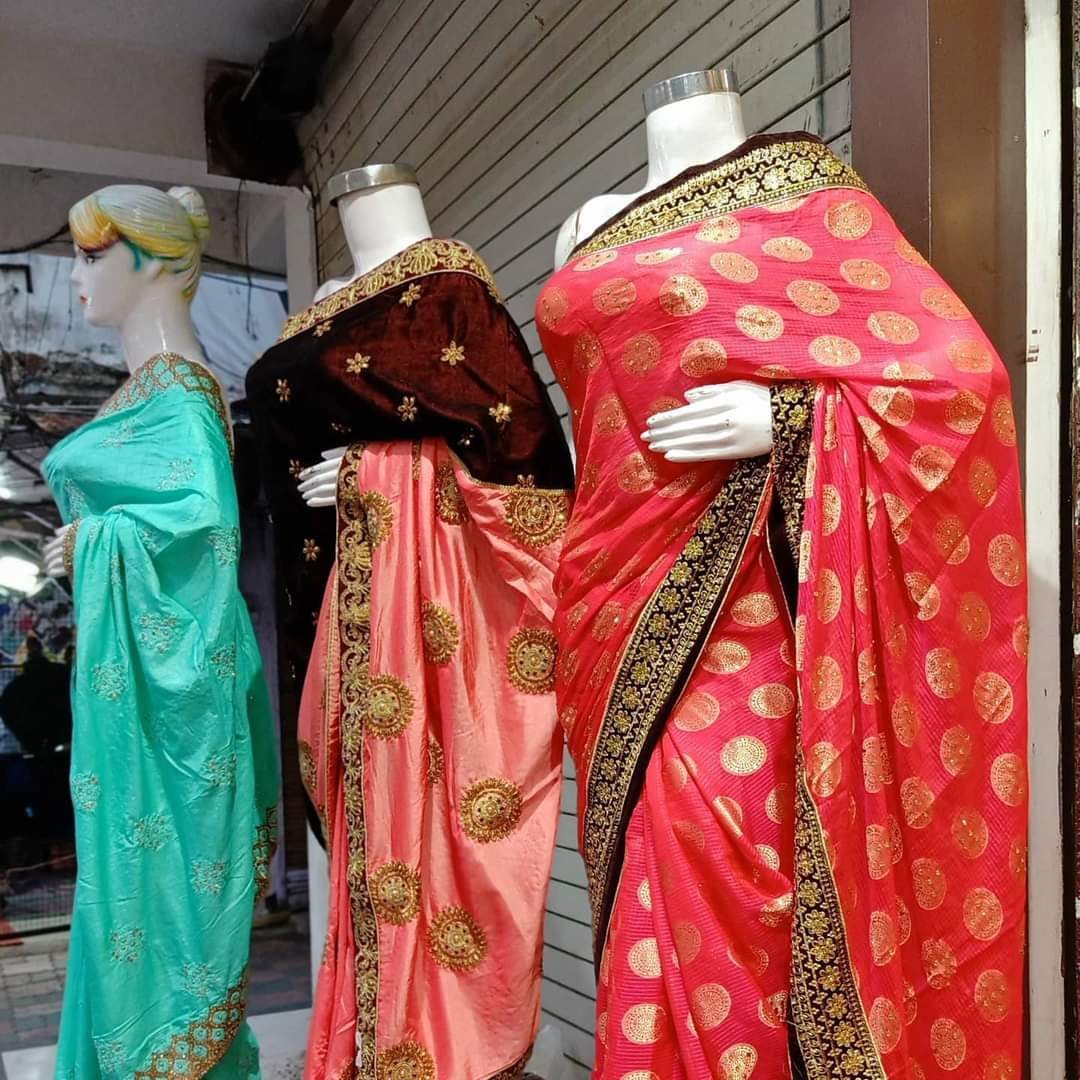
The tradition & historical record
7 min read · 2 sourcesA sari (Hindi: [saːɽiː]; sometimes also saree, sharee, or sadi) is a draped cloth and women's garment in the Indian subcontinent. It consists of an un-stitched stretch of woven fabric arranged over the body as a dress, with one end attached to the waist, while the other end rests over one shoulder as a stole, sometimes baring a part of the midriff. It may vary from 4.5 to 9 yards (4.1 to 8.2 metres) in length, and 24 to 47 inches (60 to 120 centimetres) in breadth, and is a form of traditional clothing. There are various names and styles of sari manufacture and draping, the most common being the Nivi style. The sari is worn with a fitted bodice also called a choli (ravike or kuppasa in southern India, choli in northern India, and cholo in Nepal) and a petticoat called ghagra, parkar, or ul-pavadai. It remains fashionable in the Indian subcontinent and is also considered formal attire in the countries of the region. 1
Etymology
The Hindi word sāṛī (साड़ी), described in Sanskrit śāṭī which means 'strip of cloth' and शाडी śāḍī or साडी sāḍī in Pali, ಸೀರೆ or sīre in Kannada, and which evolved to sāṛī in modern Indian languages. The word śāṭika is mentioned as describing women's dharmic attire in Sanskrit literature and Buddhist literature called the Jatakas. This could be equivalent to the modern day sari. The term for the female bodice, the choli, evolved from the ancient stanapaṭṭa. Rajatarangini, a tenth-century literary work by Kalhana, states that the choli from the Deccan was introduced under the royal order in Kashmir. The petticoat is called sāyā (साया) in Hindi, parkar (परकर) in Marathi, ul pavadai (உள் பாவாடை, "inner womens' clothing") in Tamil (pavada in other parts of South India: Malayalam: പാവാട, romanised: pāvāḍa, Telugu: పావడ, romanised: pāvaḍa, Kannada: ಪಾವುಡೆ, romanised: pāvuḍe), sāẏā (সায়া) in Bengali and eastern India, and sāya (සාය) in Sinhalese. Apart from the standard "petticoat", it may also be called an "inner skirt" or an inskirt. 1
Origins and history
The history of sari-like drapery can be traced back to ancient India, between 2800 and 1800 BCE, around the northwestern region of the Indian subcontinent. Cotton was first cultivated and woven on the Indian subcontinent around the 5th millennium BCE. Dyes used during this period are still in use, particularly indigo, lac, red madder, and turmeric. Silk was woven around 2450 BCE and 2000 BCE. The word sari is derived from śāṭikā (Sanskrit: शाटिका), which is mentioned in early Hindu literature as women's attire. The sari, or śāṭikā, evolved from a three-piece ensemble comprising the antarīya, the lower garment; the uttarīya, a veil worn over the shoulder or head; and the stanapatta, a chestband. This ensemble is mentioned in Sanskrit literature and Buddhist Pali literature during the 6th century BCE. The ancient antariya closely resembled the dhoti wrap in the "fishtail" version, which was passed through the legs, covered the legs loosely, and then flowed into long, decorative pleats at the front of the legs. It further evolved into the Bhairnivasani skirt, today known as the ghagri and lehenga. Uttariya was a shawl-like veil worn over the shoulder or head. It evolved into what is known today as the dupatta and ghoonghat. Likewise, the stanapaṭṭa evolved into the choli by the 1st century CE. The 7th century Sanskrit work Kadambari by Banabhatta and ancient Tamil poetry, such as the Cilappatikaram, describe women in exquisite drapery or saris. 1
Styles of draping
There are more than 80 recorded ways to wear a sari. The most common style is for the sari to be wrapped around the waist, with the loose end of the drape to be worn over the shoulder, exposing the navel. However, the sari can be draped in several different styles, though some styles do require a sari of a particular length or form. Ṛta Kapur Chishti, a sari historian and recognised textile scholar, has documented 108 ways of wearing a sari in her book, 'Saris: Tradition and Beyond'. The book documents the sari drapes across fourteen states: Gujarat, Maharashtra, Goa, Karnataka, Kerala, Tamil Nadu, Andhra Pradesh, Odisha, West Bengal, Jharkhand, Bihar, Chhattisgarh, Madhya Pradesh, Telangana, and Uttar Pradesh. The Sari Series, a non-profit project created in 2017, is a digital anthology documenting India's regional sari drapes, providing over 80 short films on how to drape the various styles. The French cultural anthropologist and sari researcher Chantal Boulanger categorised sari drapes into the following families: 1
Nivi sari – style originally worn in the Deccan region; besides the modern nivi, there is also the Nauvari, kaccha, or kasta nivi, where the pleats are passed through the legs and tucked in at the back. This allows free movement while covering the legs. Bihar, Uttar Pradesh, Gujarati, Rajasthani – It is worn similar to the nivi style but with the loose end of sari, aanchal or pallu, placed in the front; therefore, this style is known as sidha anchal or sidha pallu or sojha paala. After tucking in the pleats similar to the nivi style, the loose end is taken from the back, draped across the right shoulder, and pulled across to be secured in the back. 1
Nivi style
The Nivi is the most common style of sari worn today. It originated in the Deccan region. In the Deccan region, the Nivi existed in two styles, a style similar to modern Nivi and the second style worn with front pleats of Nivi tucked in the back. The increased interactions during colonial era saw most women from royal families come out of purdah in the 1900s. This necessitated a change of dress. Maharani Indira Devi of Cooch Behar popularised the chiffon sari. She was widowed early in life and followed the convention of abandoning her richly woven Baroda shalus in favour of the unadorned mourning white as per tradition. Characteristically, she transformed her "mourning" clothes into high fashion. She had saris woven in France to her personal specifications, in white chiffon, and introduced the silk chiffon sari to the royal fashion repertoire. Under colonial rule, the petticoat was adopted, along with Victorian styles of puffed-sleeved blouses, which was commonly seen among the elites in Bombay presidency and Bengal presidency. Nivi drape starts with one end of the sari tucked into the waistband of the petticoat, usually a plain skirt. The cloth is wrapped around the lower body once, then hand-gathered into even pleats below the navel. The pleats are tucked into the waistband of the petticoat. They create a graceful, decorative effect which poets have likened to the petals of a flower. After one more turn around the waist, the loose end is draped over the shoulder. The loose end is called the aanchal, pallu, pallav, seragu, or paita depending on the language. It is draped diagonally in front of the torso. It is worn across the right hip to over the left shoulder, partly baring the midriff. 1
Professional style of draping
Saris are worn as uniforms by the female hotel staff of many five-star luxury hotels in India, Sri Lanka, and Bangladesh as the symbol of Indian, Sri Lankan… 1
The text above is adapted from the Wikipedia article “Sari”, available under the Creative Commons Attribution-ShareAlike 4.0 licence. 1
sari is woman's draped garment of South Asia, according to the structured record cited below. This entry was generated automatically from that record and has not yet been reviewed by a person familiar with the tradition. 2
The source record links this tradition to 16 external registers, which can be verified through the citation. 2