The tradition & historical record
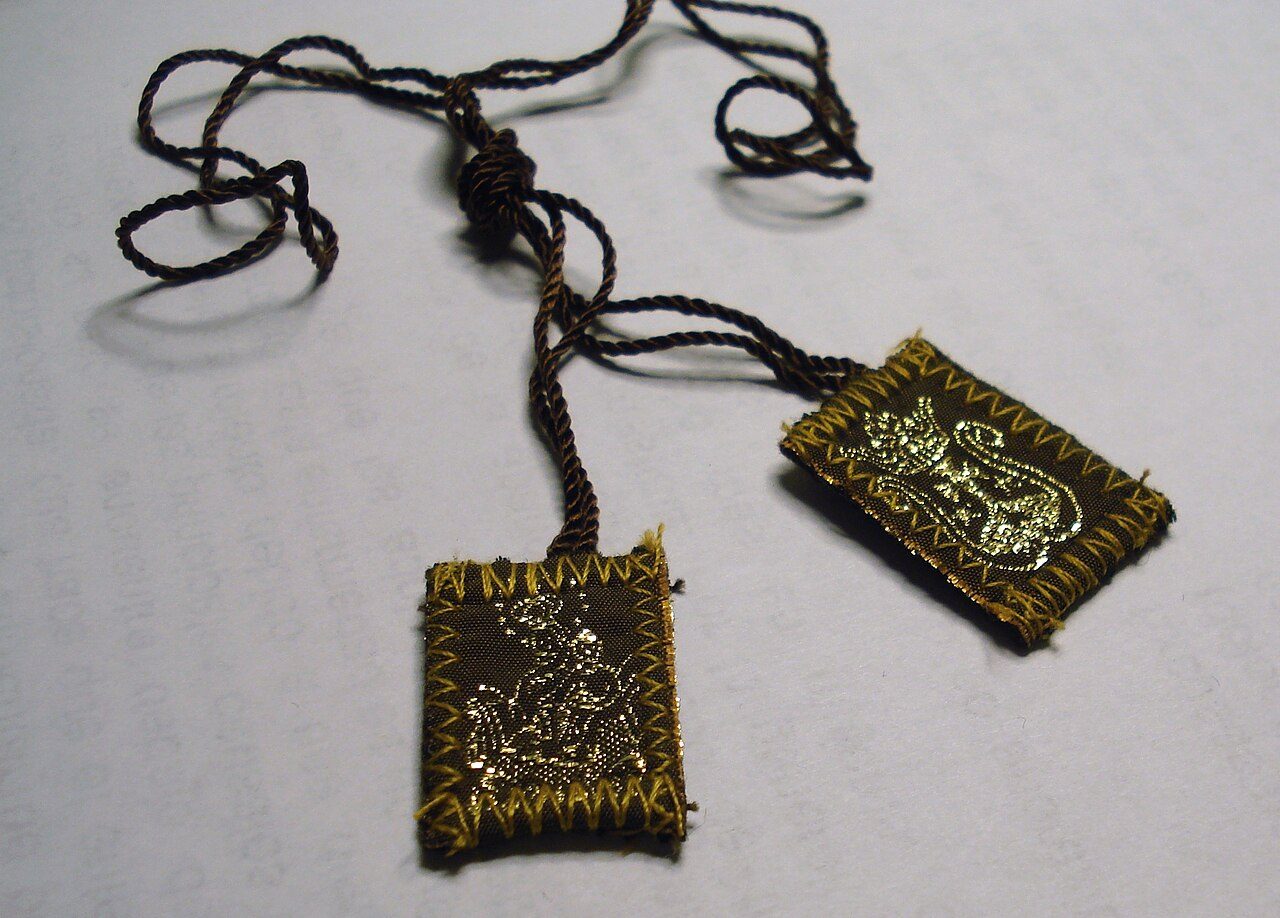
7 min read · 2 sourcesA scapular (from Latin scapula 'shoulder') is a Western Christian garment suspended from the shoulders. There are two types of scapulars, the monastic and devotional scapular; both forms may simply be referred to as "scapular". As an object of popular piety, a devotional scapular serves to remind wearers of their commitment to live a Christian life. The monastic scapular appeared first, perhaps as early as the 7th century AD in the Order of Saint Benedict. It is a length of cloth suspended both front and back from the shoulders of the wearer, either reaching almost to the hem of the tunic or ends at knee height. It may vary in shape, color, size and style. Monastic scapulars originated as aprons worn by medieval monks, and later became part of the habits for members of orders or confraternities. Monastic scapulars now form part of the religious habit of monks and nuns in many religious communities. The devotional scapular is a much smaller item and evolved from the monastic scapular. Devotional scapulars may be worn by individuals who are not members of a religious order. The devotional scapular typically consists of two small (usually rectangular) pieces of cloth, wood or laminated paper, a few inches in size, which may bear religious images or text. These are joined by two bands of cloth. 1
History
The scapular may have emerged from an apron-like piece of cloth worn by monks. Item 55 of the Rule of Saint Benedict, dating to the 7th century, refers to the use of the scapular. In the Catholic Church the key elements of a monk's habit eventually became the tunic, the cincture, the scapular and the hood. A nun's clothing included the tunic, the scapular and the head veil. Some authors interpret the scapular as a symbolic apron based on the fact that monks and nuns, when engaged on some manual labor, tend to cover it with a protective apron or carefully tuck it up or throw the front length back over their shoulder to prevent it from getting in the way. 1
Monastic scapular
Today, the monastic scapular is part of the garb, the habit, of many Christian religious orders, of both monks and nuns. It is an outer garment about the width of the chest, from shoulder to shoulder. It hangs down in the front and back almost to the feet, but is open on the sides (it was originally joined by straps at the waist). It is related to the analavos worn in the Eastern tradition. Historically, the monastic scapular was at times referred to as scutum (i.e. shield), as it was laid over the head, which it originally covered and protected with one portion (from which the hood afterwards developed). A specific aspect of the use of the monastic scapular from its earliest days was obedience and the term jugum Christi, i.e. "yoke of Christ", was used to refer to it. The term "yoke of Christ" signified obedience and removing a scapular was like removing the yoke of Christ, i.e. rebelling against authority. For instance, the Carmelite constitution of 1281 prescribed that the scapular should be worn to bed under penalty of serious fault, and the constitution of 1369 included automatic excommunication for a Carmelite saying Mass without a scapular. 1
Over the centuries the religious orders adapted the basic scapular as they considered appropriate for themselves, as a result of which there are now several distinct designs, colors, shapes and lengths in use. The Carthusians and others attached a hood to their scapular for the monks, rather than keeping the former a separate item of their habit, while some, like the friars of the Dominicans or the Carmelites, wear it beneath another layer, like a shoulder cape or capuce (that is, the "hood"). 1
Non-monastic reduced scapular
Some authors suggest that the tradition of wearing a reduced form of a non-monastic scapular started in the 11th century with Saint Peter Damian and the monastic scapular was gradually transformed from an item of clothing that was part of the habit of monks and nuns to a smaller item that expressed devotion by individuals, called oblates, who lived in the world, but wished to be affiliated with a monastery. In the Middle Ages, it became common for Christian faithful to share in the spirituality of the new mendicant orders in an auxiliary sense, sometimes called Third Orders, because they were founded after the initial orders of the friars and nuns. Although these people (called Tertiaries) were permitted to wear the religious garment of a Tertiary, because they had not taken religious vows they were not usually permitted to wear the full habit of the order. With time, it was considered a high honor and great privilege to be granted a small cloth attached by bands which would be worn over the torso in the same manner as the full monastic scapular. Confraternities came to be formed in which people would be granted the wearing of this item as a mark of their sharing in the good works of a particular order. Among the Franciscans, they were known as Cordbearers, due to their also wearing a small cord around the waist in imitation of the one worn by the friar. After the disruptions of religious life during the period of the French Revolution and the Napoleonic invasions of France and Italy, wearing of the tertiary habit became prohibited. Thus it eventually became common that a smaller form of an order's scapular would be bestowed upon the non-monastic. 1
Devotional scapular
Devotional scapulars are objects of popular piety, primarily worn by Catholics, as well as some Anglicans and Lutherans, designed to show the wearer's pledge to a confraternity, a saint, or a way of life, as well as reminding the wearer of that promise. Some devotional scapulars bear images, or verses from scripture. Devotional scapulars typically consist of two rectangular pieces of cloth, wool or other fabric that are connected by bands. One rectangle hangs over the chest of the wearer, while the other rests on the back, with the bands running over the shoulders. Some scapulars have extra bands running under the arms and connecting the rectangles to prevent them from getting dislodged underneath the wearer's top layer of clothes. The roots of devotional scapulars can be traced to the gathering of laity into confraternities for spiritual direction, whereby the faithful would be assigned some badge or token of affiliation and devotion. The image or message on the scapular usually reflects the order's focus, tradition or favored devotion. Devotional scapulars and the indulgences attached to them grew along with the growth of Catholic confraternities during the 17th and 18th centuries. 1
The fact that specific promises and indulgences were attached to the wearing of scapulars helped increase their following, as was seen with the early example of the Brown Scapular. 1
Catholic Church
The Catholic Encyclopedia lists 18 small scapulars approved by the Catholic church: 1
The White Scapular of the Most Blessed Trinity (1193) The White Scapular of Our Lady of Ransom (1218) The Brown Scapular of Our Lady of Mount Carmel (1250) The Black Scapular of the Seven Sorrows of Mary (1255) The Blue … 1
The text above is adapted from the Wikipedia article “Scapular”, available under the Creative Commons Attribution-ShareAlike 4.0 licence. 1
scapular is short cloak worn with ecclesiastical dress, according to the structured record cited below. This entry was generated automatically from that record and has not yet been reviewed by a person familiar with the tradition. 2
The source record links this tradition to 19 external registers, which can be verified through the citation. 2