The tradition & historical record
4 min read · 2 sourcesSchleicher’s fable is a text composed as a reconstructed version of the Proto-Indo-European language (PIE), published by August Schleicher in 1868. Schleicher was the first scholar to compose a text in PIE. The fable is entitled *Avis akvāsas ka (‘The Sheep [Ewe] and the Horses’). At later dates, various scholars have published revised versions of Schleicher’s fable, as the idea of how PIE should be presented and pronounced has changed over time. The resulting parallel texts serve as an illustration of the significant changes that the reconstruction of the language has experienced during the last 150 years of scholarly efforts. The first revision of Schleicher’s fable was made by Hermann Hirt (published by Arntz in 1939). A second revision was published by Winfred Lehmann and Ladislav Zgusta in 1979. Another version by Douglas Q. Adams appeared in the Encyclopedia of Indo-European Culture (1997:501). In 2007 Frederik Kortlandt published yet another version on his internet homepage. 1
English translation
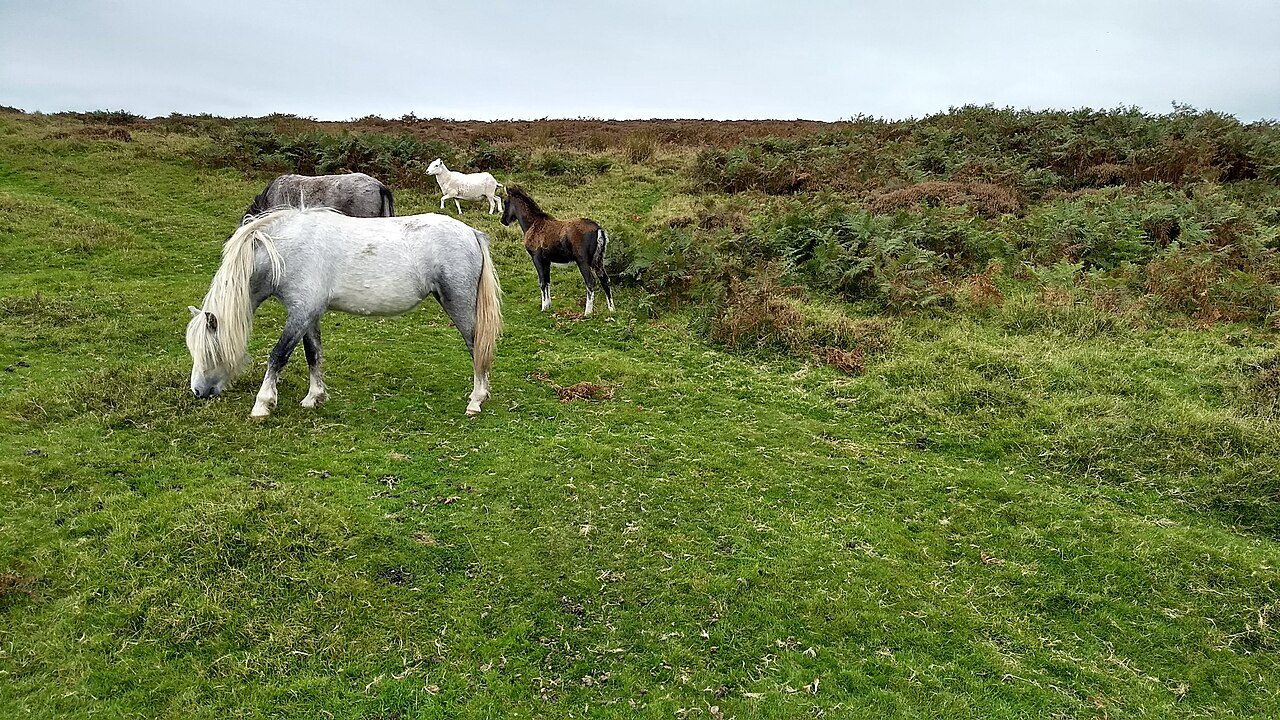
The Sheep and the Horses (1) A sheep that had no wool saw horses, one of them pulling a heavy wagon, one carrying a big load, and one carrying a man quickly. (2) The sheep said to the horses: "My heart pains me, seeing a man driving horses." (3) The horses said: "Listen, sheep, our hearts pain us when we see this: a man, the master, makes the wool of the sheep into a warm garment for himself. And the sheep has no wool." 1
(4) Having heard this, the sheep fled into the plain. 1
Kortlandt (2007, revised 2010)
After the separation of Anatolian and Tocharian: 1
Notable differences
Some of the differences between the texts are simply varying spelling conventions: *w and *u̯, for example, are only different symbols to indicate the same sound, a consonantal *u, so that *wóĝhom and *u̯óǵʰom are actually the same reconstruction. However, many other differences are to be explained by widely diverging opinions concerning the phonological and morphological systems of PIE. Schleicher’s reconstruction assumed that the o/e vocalism was secondary, and his version of PIE is based much more closely on Sanskrit than modern reconstructions. Hirt introduced the o/e vocalism, syllabic resonants, labiovelars and palatalized velars. Lehmann and Zgusta introduced a few alternative lexemes (the relative pronoun *kʷesjo; the word *nēr ‘man’), and made some use of laryngeals: their text features an h (*wl̥hnā) for what they seem to accept as a single laryngeal of PIE. Adams was the first one to represent fully the laryngeal theory in his version of the fable. Judging from the text, he seems to assume four different laryngeal phonemes. Consequently, Adams’ text no longer shows long ā. Kortlandt’s version is a radical deviation from the prior texts in a number of ways. First, he conforms to the glottalic theory, representing glottalic plosives with a following apostrophe (t’) and omitting aspirated voiced plosives. Second, he substitutes the abstract laryngeal signs with their supposed phonetic values: *h1 = *ʔ (glottal stop), *h2 = *ʕ (voiced pharyngeal fricative), *h3 = *ʕʷ (pharyngeal fricative with labialization). Kortlandt also has a different opinion about ablaut grades in many verbal and nominal forms, compared to the other scholars. 1
Cultural references
In Ridley Scott’s 2012 film Prometheus, the android character ‘David’ (played by Michael Fassbender) was shown reciting the Schleicher's Fable after a holographic teacher (played by Dr. Anil Biltoo, also the film's linguistics consultant.) 1
The text above is adapted from the Wikipedia article “Schleicher's fable”, available under the Creative Commons Attribution-ShareAlike 4.0 licence. 1
Schleicher's fable is text composed in a reconstructed version of the Proto-Indo-European language, published by August Schleicher in 1868, according to the structured record cited below. This entry was generated automatically from that record and has not yet been reviewed by a person familiar with the tradition. 2
The source record links this tradition to 1 external register, which can be verified through the citation. 2