The tradition & historical record
5 min read · 2 sourcesSea silk is an extremely rare fabric that is made from the long silky filaments, or byssus, secreted by a gland in the foot of pen shells (in particular Pinna nobilis). The byssus is used by the mussel to attach itself to the sea bed. It was previously produced in Sardinia and Taranto until the early 20th century and is still made at small scale by a few people in Sardinia. The cloth produced from byssus is extremely light and warm. It is also often described as being very thin, although it is similar in thickness to other fibers such as silk. Byssus was said to be so fine that a pair of women's gloves made from the fabric could fit into half a walnut shell and a pair of stockings in a snuffbox. However, Helen Scales has put forward the idea that this actually refers to Limerick gloves made from fine kid leather sold inside walnut shells as a marketing stunt, and that over time the walnut packaging and beliefs about byssus cloth were conflated. 1
Production
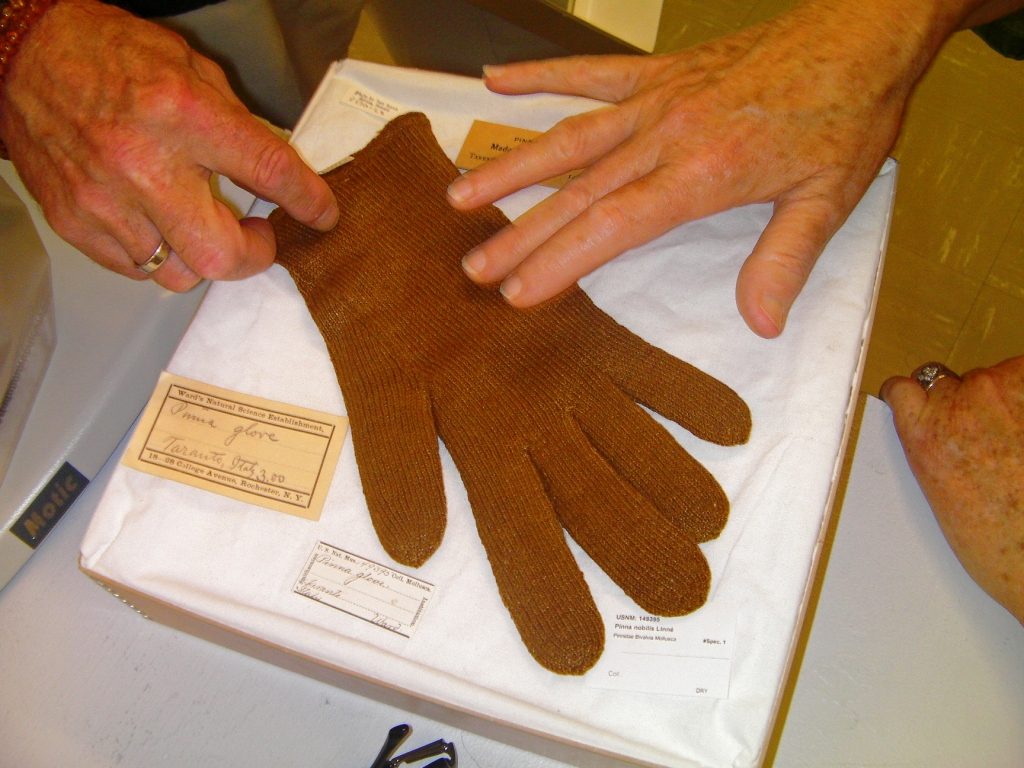
Pinna nobilis produces a beard of about 1,000 fibers to attach itself to the sea floor, which are all attached to a central stem. They can be up to 20 centimetres (7.9 in) long. The removed beard is processed in several steps. First, it is rinsed in the sea to remove debris. It is then washed in fresh water and manually cleaned. This may be followed by a third bath, again in fresh water. After drying, it is carded and then spun by hand. Beginning in the early 19th century, the beards were sometimes left intact after being cleaned and combed and then sewn together in a close, overlapping manner to produce an effect resembling fur. The fibers vary in color and have a unique egg-shaped profile when viewed under a microscope. They are 10–50 microns in diameter, which is comparable to other natural fibers such as silk (11–15 microns), merino wool (18–25 microns) or mohair (20–40 microns). It is not very strong, especially when wet, compared to other fibers. Bysus can be soaked in lemon juice for a few hours to produce a golden color. There are no known historical examples of dyed sea silk, probably because the natural color was highly valued. Modern experiments with dyeing sea silk have not shown dramatic color changes. While a few extant woven objects are known, most were knit, and many are gloves. A knitted pair of gloves probably took the byssus from around 150 shells to produce. There are historical reports of sea silk being mixed with silk, probably for economic reasons, and also with wool, though very few objects with mixed fibers are now known to exist. Sea silk fibers may also be used for embroidery. 1
History
Tracing the history of sea silk is difficult in part because the word byssus originally referred to fine fabric made of linen or perhaps cotton, and in the Middle Ages, also to that made of silk. The first written mentions of sea silk date to the 2nd century AD, and the oldest piece of sea silk that has been found dated to the 4th century AD; a fragment was discovered in a grave in Budapest in the remains of Aquincum. However, the fragment was lost during World War II. The oldest surviving sea silk object is a knit hat from the 14th century, which was found in a waste pit near Paris. 1
Egypt
The Greek text of the (196 BC) Rosetta Stone records that Ptolemy V reduced taxes on priests, including one paid in byssus cloth. This is thought to be fine linen cloth, not sea silk. In Ancient Egyptian burial customs, byssus was used to wrap mummies; this was also linen and not sea silk. 1
Greece
The sophist author Alciphron first records "sea wool" in his (c. 2nd century AD) "Galenus to Cryton" letter. Sea silk has been suggested as an interpretation of the nature of the Golden Fleece that was sought by Jason and the Argonauts but scholars reject this hypothesis. 1
Roman Empire
The early Christian Tertullian (c. 160–220 AD) mentions it when justifying his wearing a pallium instead of a toga: 1
Nor was it enough to comb and to sew the materials for a tunic. It was necessary also to fish for one's dress; for fleeces are obtained from the sea where shells of extraordinary size are furnished with tufts of mossy hair. Several sources mention lana pinna ("pinna wool"). Emperor Diocletian's (301 AD) Edict on Maximum Prices lists it as a valuable textile. The Byzantine historian Procopius's c. 550 AD Persian War, "stated that the five hereditary satraps (governors) of Armenia who received their insignia from the Roman Emperor were given chlamys (or cloaks) made from lana pinna. Apparently only the ruling classes were allowed to wear these chlamys." 1
The text above is adapted from the Wikipedia article “Sea silk”, available under the Creative Commons Attribution-ShareAlike 4.0 licence. 1
sea silk is Fabric produced using silk-like clam secretions, according to the structured record cited below. This entry was generated automatically from that record and has not yet been reviewed by a person familiar with the tradition. 2
The source record links this tradition to 3 external registers, which can be verified through the citation. 2