The tradition & historical record
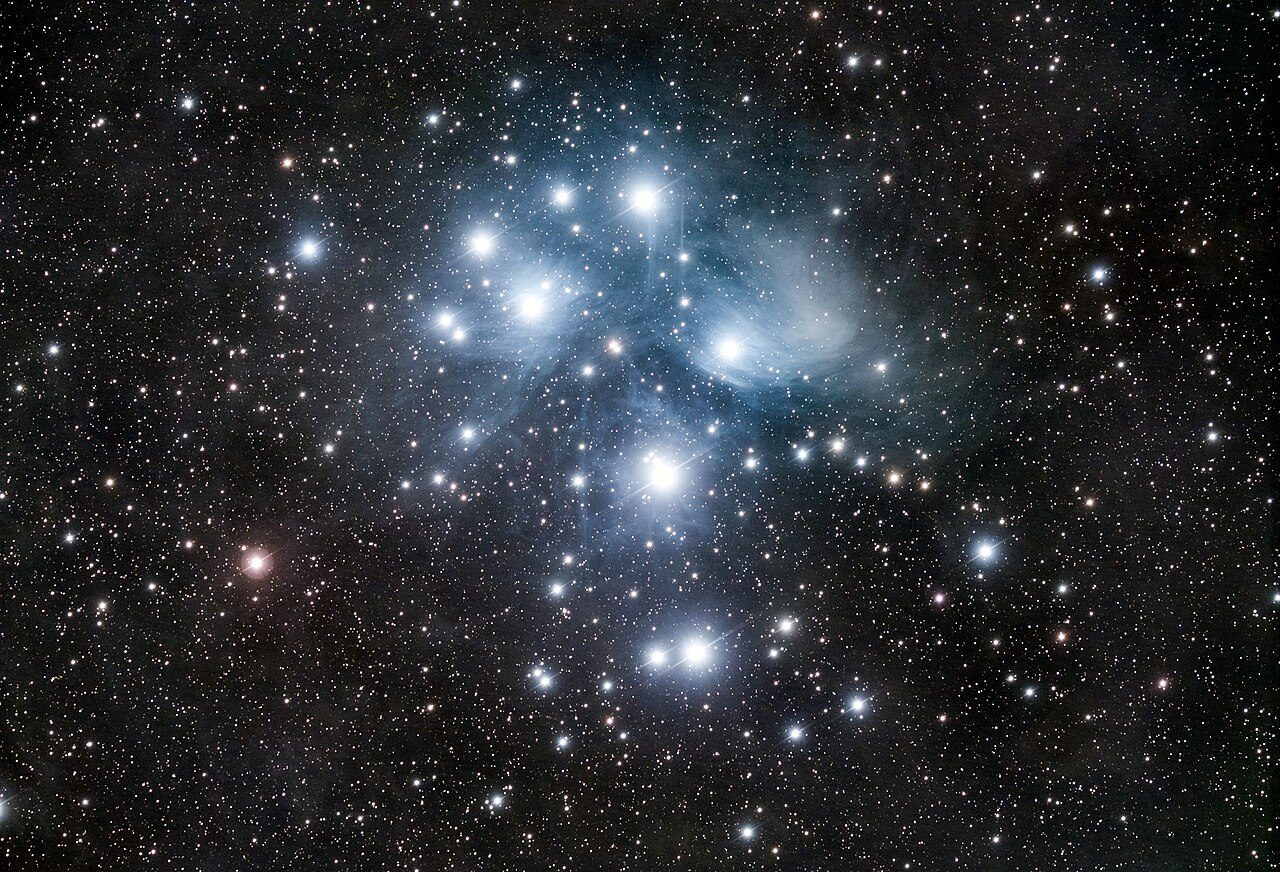
6 min read · 2 sourcesThe Seven Sisters are figures in the Dreaming of Aboriginal Australians across Australia. Their names and the details of their activities vary by country and language. In central and western desert accounts, the sisters are pursued by a lustful sorcerer. His pursuit is sexually violent, involving at times laying ambush, spying, and in some versions capturing one or more sisters. His obsession prevents an approach in accordance with cultural norms, and produces an unstable landscape that "seethes and ripples with sexual desire". The themes are similar to the story of Pleiades in Greek mythology, which also describes the pursuit of seven sisters and is also associated with the Pleiades star cluster. In the cultures of Indigenous Australians, the Dreaming is understood as an "active, continuous presence in the land", happening at all times, which is reconstituted as the keepers of stories perform ceremonies, create art, and travel the country. 1
Overview
Across Australia, Seven Sisters songlines are present in "virtually all" Aboriginal Australian language groups. Between these groups, the names of the sisters and the details of their activities vary by country and language, but a connection between and the star cluster Pleiades and constellation Orion appear to be universal. 1
Martu lands
In Martu country, the Seven Sisters are known as Minyipuru, and their pursuer Yurla. The pursuit is divided into two songlines: the Pangkal songline, wherein the sisters travel 100 kilometres in the area north of Telfer and Punmu, and the Parnngurr songline, 600 kilometres along the Canning Stock Route between Parnngurr and Pangkapini. Fleeing, they fly from Roebourne, a coastal area in north-western Western Australia. Despite starting with many sisters, their numbers diminish as they travel, reduced by the taxing process of creating landforms along their journey. The landscape they navigate is unpredictable, rendered unstable by Yurla's sexual obsession. These landforms are characterized by the Martu people as their "footprints". Yurla follows these footprints; a senior Martu lawman, relaying the songline due to the frailty of a senior lawwoman in the community, describes Yurla as "always in their sight." 600 kilometres east of Roebourne, they camp and perform ceremonies at Pangkal, a rockhole near the mining town of Telfer. Exhausted, some sisters transform into rocks, replaced by others who spring from the earth. They taunt Yurla by flying above him while exposing their genitals, producing a violent reaction in which Yurla's penis, independent from him, breaks through the rock hole "as if penetrating the earth itself." The events at Pangkal are the subject of several paintings. Travelling south, the sisters pause near Parnngurr. Yurla's penis, coiled and holding connotations of a snake, lays in wait nearby. At Kalypa, a watering hole on the Canning Stock Route, women encounter men for the first time; these men are distinct from Yurla, who is more like a "force of nature in the guise of a man". 1
Aṉangu Pitjantjatjara Yankunytjatjara lands
In Aṉangu Pitjantjatjara Yankunytjatjara (APY) land, a region in central Australia occupied by the Pitjantjatjara and Yankunytjatjara people (members of the broader Aṉangu grouping), the Seven Sisters are known as Kungkarangkalpa, and their pursuer Wati Nyiru. In accounts, the Kungkarangkalpa flee south from Irawa Bore, a site near Watarrka (Kings Canyon), to Alkara. As elsewhere, much of the Dreaming of Aṉangu people is restricted from those outside the community, as well as to those inside not considered mature or old enough. The account revealed to those outside is ambiguous, described by researcher Diana Young as "pliable and shape-shifting". A version of the Kungkarangkalpa songline performed in 2013 by elders from the deserts of Western Australia, South Australia, and the Northern Territory proceeded as follows. Travelling south from the Northern Territory, the Seven Sisters encounter a writhing multicoloured snake-like object with uneasy curiosity. Quickly, the older sister kicks it away, revealing it as the long penis of Wati Nyiru, which he had sent for them in lust. Wati Nyiru continues to pursue them, using an ability to shapeshift to tempt the women as a shady tree and bush food, although he fails to trick the older sister. At times, his lust becomes a multi-coloured rainbow across the sky, from where he spies. The women interacted with him, at times cheekily, and other times fearful. Several times he uses magic to make them tired. In his pursuit, a dejected Wati Nyiru asks himself why the women do not want to see him. He inspects his footprint, finding seven toe imprints, and infers he is flawed. He checks again and again, each time finding a different number of toe imprints, and sadly concludes he is evil. He continues pursuing the sisters. 1
Ngaanyatjarra lands
Two songlines exist for the Seven Sisters in Ngaanyatjarra country, a region west of APY country. In the Kura Ala songline, the sisters flee west from Wati Nyiru, retaining the name Kungkarangkalpa. In the Wanarn songline, fleeing north-east from Kunnamurra at the edge of Martu country, the name for the sisters changes from Minyipuru to Kungkarrangkalpa, while Yurla retains his name. Margo Neale describes these songlines as having a darker tone, and the actions of Wati Nyiru as being "more sinister". In the Kura Ala songline, the sisters are travelling west from Pirilyilunguru. At Kura Ala, a rock formation with an appearance strongly evocative of staring eyes under a defined brow, they are found by Wati Nyiru. Here, Wati Nyiru's obsessive fixation on the elder sister leaves her captured and hurt. Left weak, her sisters support her and gather food and medicinal plants, but in doing so catch the attention of Wati Nyiru. He sends his penis after them in the form of a carpet snake, but the sisters catch it and throw it east. As they begin travelling again, they chance upon the penis at Minyma Ngampi and mistake it for snake meat. After eating it, they fall ill and "[can't] walk anymore", upon which they take flight into the sky to become stars. In the Wanarn songline, the sisters in flight enter Ngaanyatjarra lands from the west. Travelling through Kunnamurra, they take rest at the rock formation Tjitjipirnitjunku. Wati Nyiru finds them, and pokes holes in the rocks in an attempt to nab them, leaving features still visible today. A cycle ensues, where the sisters flee to a new place, and are found and scared by Wati Nyiru, leaving a trail of geographic features, where had crouched, or scared them with his penis. Ultimately the sisters arrive at Wangkarirr. 1
Elsewhere
In the Canberra region, the Seven Sisters story concerns an "ice maiden". 1
The text above is adapted from the Wikipedia article “Seven Sisters songline”, available under the Creative Commons Attribution-ShareAlike 4.0 licence. 1
Seven Sisters songline is sisters in Aboriginal Australian mythology, according to the structured record cited below. This entry was generated automatically from that record and has not yet been reviewed by a person familiar with the tradition. 2