The tradition & historical record
6 min read · 2 sourcesSewing is the craft of fastening pieces of textiles together using a sewing needle and thread. Sewing is one of the oldest of the textile arts, originating in the Paleolithic era. Archaeological evidence suggests that early humans in Europe and Asia produced garments from fur and leather clothing using bone, antler or ivory sewing-needles and "thread" made of various animal body parts including sinew, catgut, and veins. Though early forms of garment creation have existed for centuries, the first known use of the word "sewing" to describe these practices appeared in the 14th century. For thousands of years, all sewing was done by hand. The sewing machine which was invented in the 19th century enabled mechanized stitching, and the mass production of garments expanded in the 20th century. Hand sewing remains common in high-quality tailoring, haute couture fashion, and custom dressmaking, and is practiced by both textile artists and hobbyists as a means of creative expression. 1
Origins
Sewing has an ancient history estimated to begin during the Paleolithic Era. Sewing was used to stitch together animal hides for clothing and for shelter. The Inuit, for example, used sinew from caribou for thread and needles made of bone; the indigenous peoples of the American Plains and Canadian Prairies used sophisticated sewing methods to assemble tipi shelters. Sewing was combined with the weaving of plant leaves in Africa to create baskets, such as those made by Zulu weavers, who used thin strips of palm leaf as "thread" to stitch wider strips of palm leaf that had been woven into a coil. The weaving of cloth from natural fibers originated in the Middle East around 4000 BC, and perhaps earlier during the Neolithic Age, and the sewing of cloth accompanied this development. During the Middle Ages, Europeans who could afford it employed seamstresses and tailors. The vital importance of sewing was indicated by the honorific position of "Lord Sewer" at many European coronations from the Middle Ages. An example was Robert Radcliffe, 1st Earl of Sussex who was appointed Lord Sewer at the coronation of Henry VIII of England in 1509. Women mainly occupied these roles as sewing has been often classified as a household chore and traditional gender norms sought to confine women to the home. Most sewing before the 19th century was focused on repairing and maintaining clothing. Garments were often taken apart and reconstructed to extend their lifespan. Worn fabric was sometimes taken apart and made into quilts or other household textiles. This push for garment reconstruction and reuse challenges the notion of mended clothing as a poor or degraded style of dress and allows women's craft to have a longer legacy. 1
Industrial Revolution
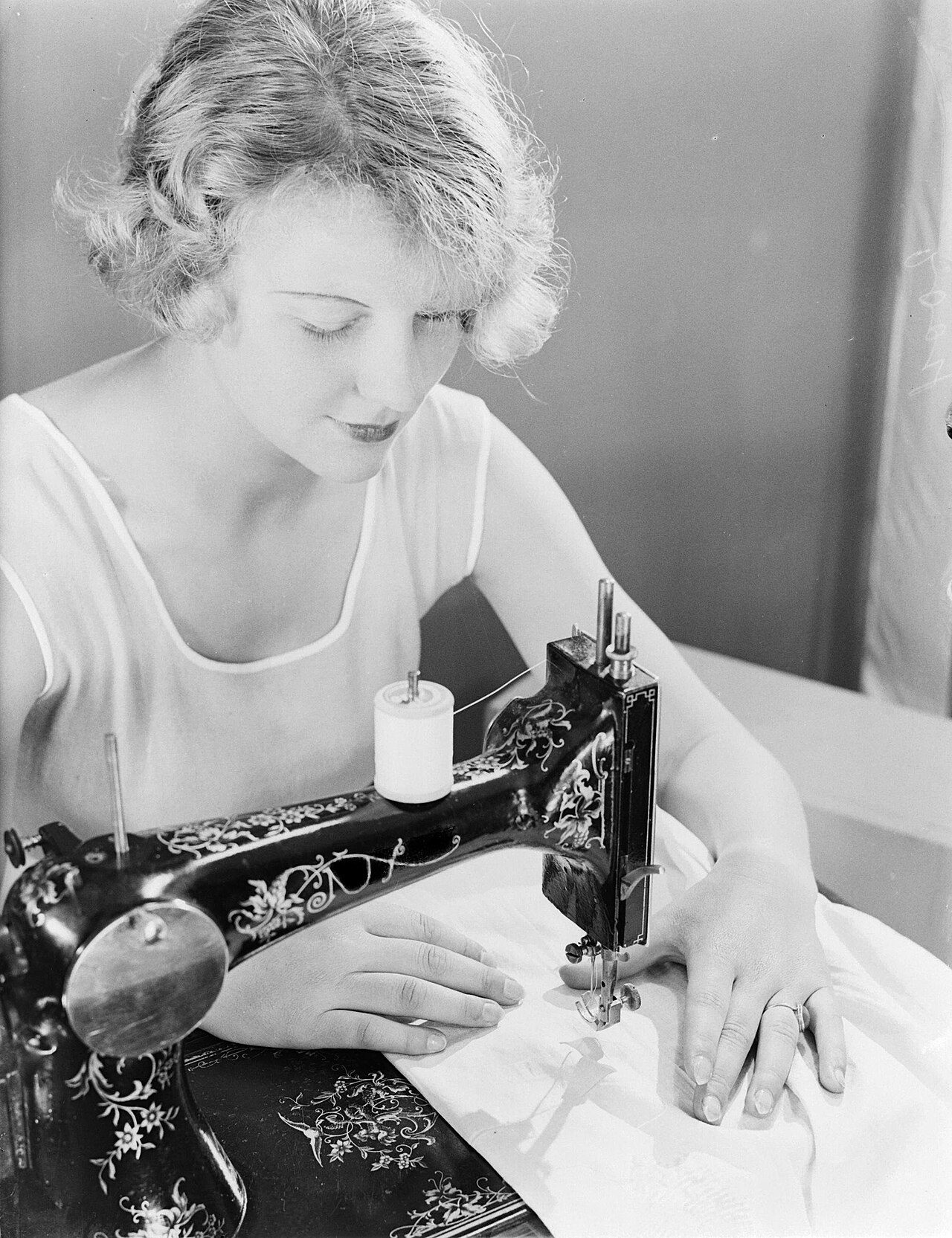
The Industrial Revolution shifted the production of textiles from the household to the mills. In the early decades of the Industrial Revolution, the machinery produced whole cloth. The world's first sewing machine was patented in 1790 by Thomas Saint. By the early 1840s, other early sewing machines began to appear. Barthélemy Thimonnier introduced a simple sewing machine in 1841 to produce military uniforms for France's army; shortly afterward, a mob of tailors broke into Thimonnier's shop and threw the machines out of the windows, believing the machines would put them out of work. By the 1850s, Isaac Singer developed the first sewing machines that could operate quickly and accurately and surpass the productivity of a seamstress or tailor sewing by hand. While much clothing was still produced at home by female members of the family, more and more ready-made clothes for the middle classes were being produced with sewing machines. Textile sweatshops full of poorly paid sewing machine operators grew into entire business districts in large cities like London and New York City. To further support the industry, piece work was done for little money by women living in slums. Needlework was one of the few occupations considered acceptable for women, but it did not pay a living wage. Women working from home often worked 14-hour days to earn enough to support themselves, sometimes by renting sewing machines that they could not afford to buy. Tailors became associated with higher-end clothing during this period. In London, this status grew out of the dandy trend of the early 19th century, when new tailor shops were established around Savile Row. 1
20th century onward
Sewing underwent further developments during the 20th century. As sewing machines became more affordable to the working class, demand for sewing patterns grew. Women had become accustomed to seeing the latest fashions in periodicals during the late 19th and early 20th centuries, increasing demand for sewing patterns yet more. American tailor and manufacturer Ebenezer Butterick met the demand with paper patterns that could be traced and used by home sewers. The patterns, sold in small packets, became wildly popular. Several pattern companies soon established themselves. Women's magazines also carried sewing patterns, and continued to do so for much of the 20th century. Women began to sew less in the home when they started using sewing as a way to make money, such as by selling their products and patterns to others and teaching sewing in schools to young girls. During the late 20th and early 21st centuries, scholars have noted that motivations for home sewing shifted significantly. Whereas sewing had long been associated with economic necessity, its decline coincided with major changes in fashion consumption, household labor, and gender expectations. Research suggests that attitudes toward sewing increasingly reflected broader social trends: sewing was sometimes perceived as old-fashioned or incompatible with modern lifestyles, while the intergenerational transmission of skills diminished. At the same time, sewing continued to hold symbolic meaning for many people, relating to identity, creativity, and personal agency in domestic life. 1
Patterns and fitting
Garment construction is usually guided by a sewing pattern. A pattern can be quite simple; some patterns are nothing more than a mathematical formula that the sewer calculates based on the intended wearer's measurements. Once calculated, the sewer has the measurements needed to cut the cloth and sew the garment together. At the other end of the spectrum are haute couture fashion designs. When a couture garment is made of unusual material, or has extreme proportions, the design may challenge the sewer's engineering knowledge. Complex designs are drafted and refitted dozens of times, may take around 40 hours to develop a final pattern, and require 60 hours of cutting and sewing. It is important for a pattern to be created well because the way a completed piece fits is the reason it will either be worn or not. Most clothing today is mass-produced, and conforms to standard sizing, based on body measurements that are intended to fit the greatest proportion of the population. 1
Tools
Sewers working on a simple project need only a few sewing tools, such as fle… 1
The text above is adapted from the Wikipedia article “Sewing”, available under the Creative Commons Attribution-ShareAlike 4.0 licence. 1
sewing is craft of fastening or attaching objects using stitches made with a needle and thread, according to the structured record cited below. This entry was generated automatically from that record and has not yet been reviewed by a person familiar with the tradition. 2
The source record links this tradition to 41 external registers, which can be verified through the citation. 2