The tradition & historical record
5 min read · 2 sourcesThe Shahnameh, also romanized Shahnama (lit. 'Book of Kings'), is a long epic poem written by the Persian poet Ferdowsi between c. 977 and 1010 CE and is the national epic of Greater Iran. Consisting of some 50,000 distichs or couplets (two-line verses), the Shahnameh is one of the world's longest epic poems, and the longest epic poem created by a single author. It tells of the mainly mythical but to some extent historical past of Iran from the creation of the world until the Muslim conquest in the seventh century. Iran, Afghanistan, Azerbaijan, Tajikistan and the greater region influenced by Persian culture such as Armenia, Dagestan, Georgia, Turkey, Turkmenistan and Uzbekistan celebrate this national epic. It took Ferdowsi 33 years to complete the Shahnameh in its entirety. The work is of central importance in Persian culture and Persian language. It is regarded as a literary masterpiece, and is the definitive work of the ethno-national cultural identity of Iran. 1
Composition
Ferdowsi began writing the Shahnameh in 977 AD and completed it on 8 March 1010. The Shahnameh is a monument of poetry and historiography, being mainly the poetical recast of what Ferdowsi, his contemporaries, and his predecessors regarded as the account of Iran's ancient history. Many such accounts already existed in prose, an example being the Shahnameh of Abu-Mansur. A small portion of Ferdowsi's work, in passages scattered throughout the Shahnameh, is entirely of his own conception. The Shahnameh is an epic poem of over 50,000 couplets written in Early New Persian. It is based mainly on a prose work of the same name compiled in Ferdowsi's earlier life in his native Tus. This prose Shahnameh was in turn and for the most part the translation of a Pahlavi (Middle Persian) work, known as the Khwadāy-Nāmag "Book of Kings", a late Sasanian compilation of the history of the kings and heroes of Persia from mythical times down to the reign of Khosrow II (590–628). The Khwadāy-Nāmag contained historical information on the later Sasanian period, but it does not appear to have drawn on any historical sources for the earlier Sasanian period (3rd to 4th centuries). Ferdowsi added material continuing the story to the overthrow of the Sasanians by the Muslim armies in the middle of the seventh century. The first to undertake the versification of the Pahlavi chronicle was Daqiqi, a contemporary of Ferdowsi, poet at the court of the Samanid Empire, who came to a violent end after completing only 1,000 verses. These verses, which deal with the rise of the prophet Zoroaster, were afterward incorporated by Ferdowsi, with acknowledgment, in his own poem. The style of the Shahnameh shows characteristics of both written and oral literature. 1
Content
Traditional historiography in Iran holds that Ferdowsi was grieved by the fall of the Sasanian Empire and its subsequent rule by Arabs and Turks. The Shahnameh, the argument goes, is largely his effort to preserve the memory of Persia's golden days and transmit it to a new generation, so that, by learning from it, they could acquire the knowledge needed to build a better world. Although most scholars have contended that Ferdowsi's main concern was the preservation of the pre-Islamic legacy of myth and history, a number of authors have formally challenged this view. 1
Mythical age
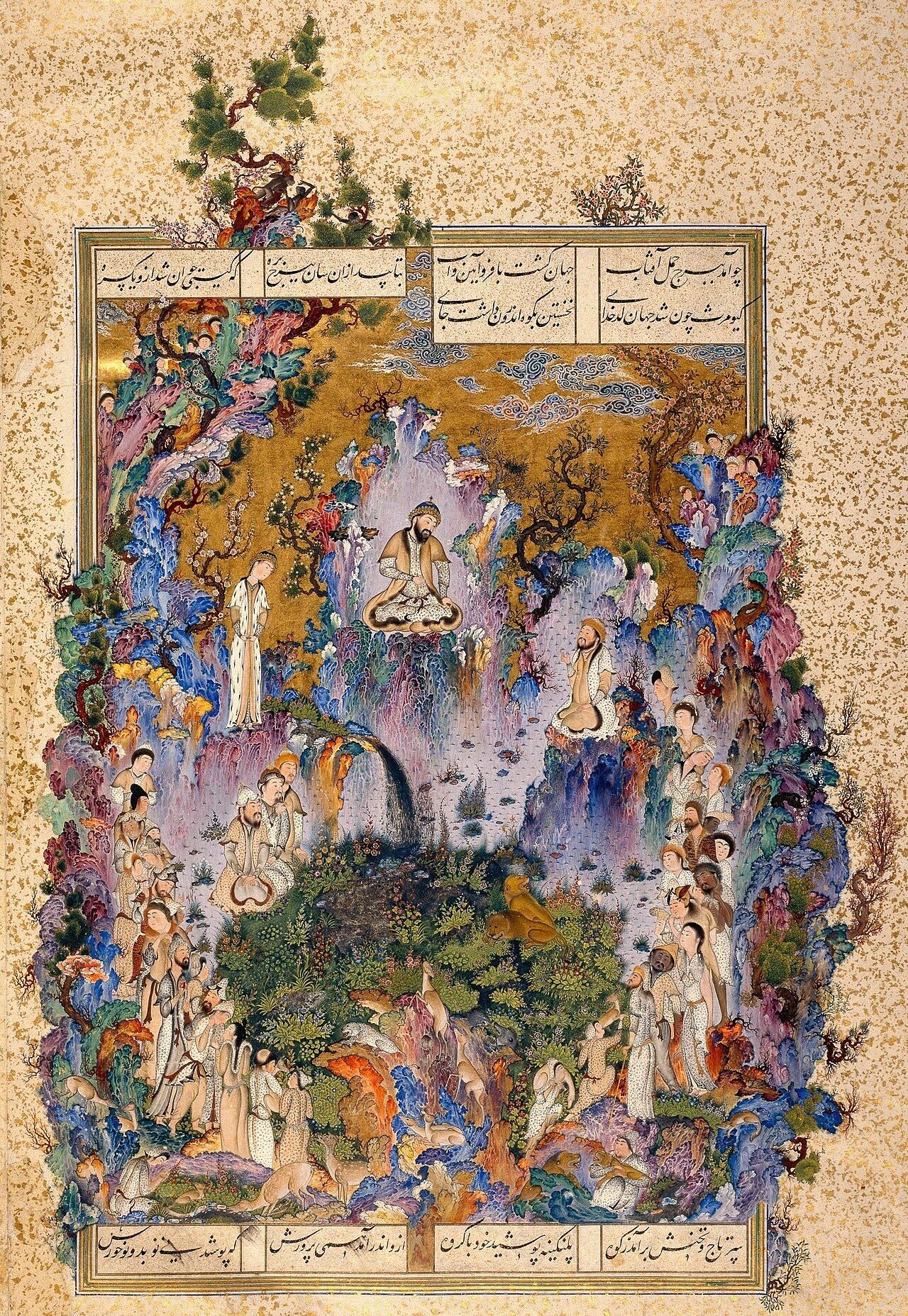
This portion of the Shahnameh is relatively short, amounting to some 2100 verses or four percent of the entire book. After an opening in praise of God and Wisdom, the Shahnameh gives an account of the creation of the world and of man as believed by the Sasanians. This introduction is followed by the story of the first man, Keyumars, who also became the first king after a period of mountain-dwelling. His grandson Hushang, son of Siamak, accidentally discovered fire and established the Sadeh Feast in its honor. Stories of Tahmuras, Jamshid, Zahhak, Kawa or Kaveh, Fereydun and his three sons Salm, Tur, and Iraj, and his grandson Manuchehr are related in this section. 1
Heroic age
Almost two-thirds of the Shahnameh are devoted to the age of heroes, extending from Manuchehr's reign until the conquest of Alexander the Great. This age is also identified as the kingdom of the Kayanians, which established a long history of heroic age in which myth and legend are combined. The main feature of this period is the major role played by the Saka or Sistani heroes who appear as the backbone of the Empire. Garshasp is briefly mentioned with his son Nariman, whose own son Sam acted as the leading paladin of Manuchehr while reigning in Sistan in his own right. His successors were his son Zal and Zal's son Rostam, the bravest of the brave, and then Faramarz. Among the stories described in this section are the romance of Zal and Rudaba, the Seven Stages (or Labors) of Rostam, Rostam and Sohrab, Siyavash and Sudaba, Rostam and Akvan Div, the romance of Bijan and Manijeh, the wars with Afrasiab, Daqiqi's account of the story of Goshtasp and Arjasp, and Rostam and Esfandyar. 1
Historical age
A brief mention of the Arsacid (Parthian) dynasty follows the history of Alexander and precedes that of Ardashir I, founder of the Sasanian Empire. After this, Sasanian history is related with a good deal of accuracy. The fall of the Sassanids and the Arab conquest of Persia are narrated romantically. 1
The text above is adapted from the Wikipedia article “Shahnameh”, available under the Creative Commons Attribution-ShareAlike 4.0 licence. 1
Shahnameh is epic poem written by the Persian poet Ferdowsi, according to the structured record cited below. This entry was generated automatically from that record and has not yet been reviewed by a person familiar with the tradition. 2
The source record links this tradition to 23 external registers, which can be verified through the citation. 2