The tradition & historical record
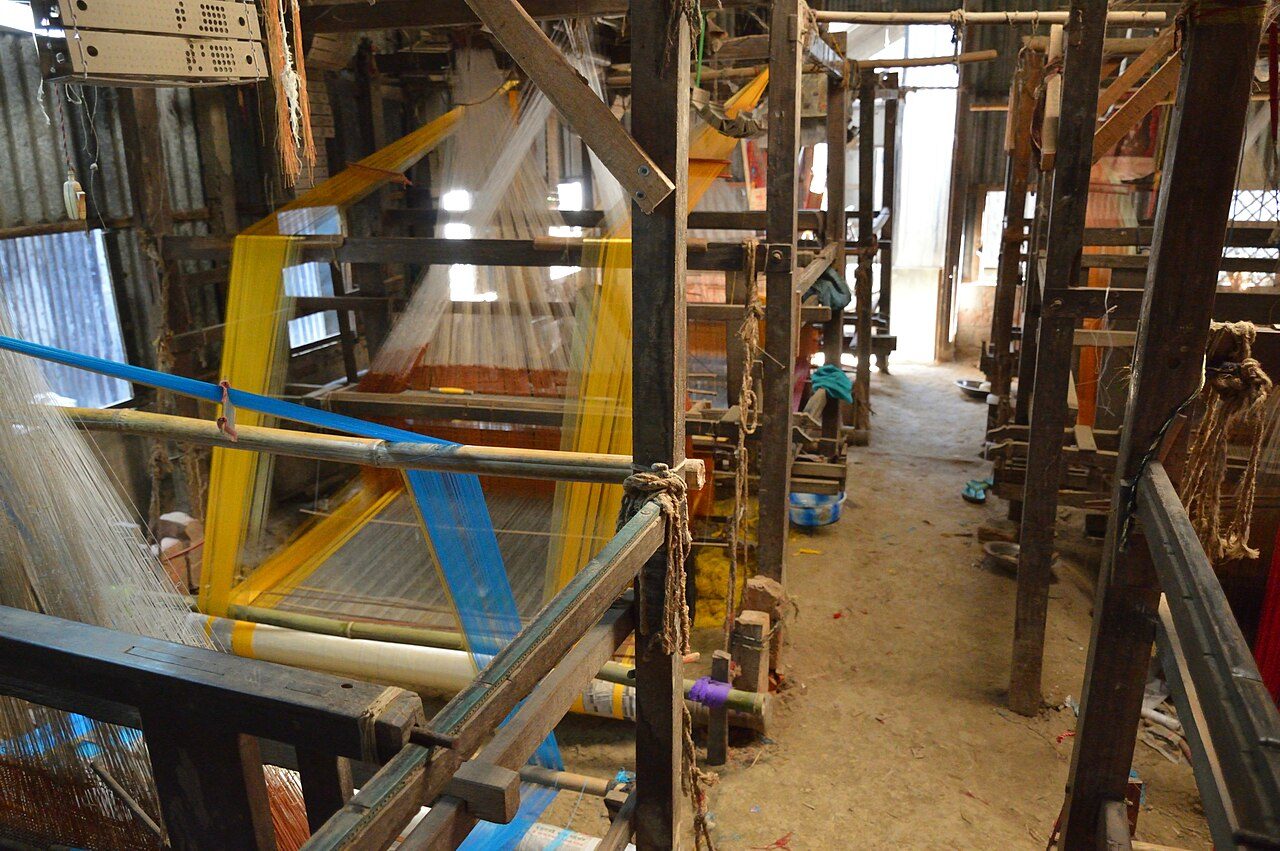
6 min read · 2 sourcesShantipur Handloom Industry, also known Shantipur Handloom Cluster, is a handloom weaving industry in Nadia district of West Bengal. It is one of the foremost handloom centers of India. This handloom industry is world famous for the production of cotton Sari (saree). The two main centers of this industrial zone are Shantipur and Phulia. Shantipur has an old reputation for cotton sarees, known as Shantipuri sarees, and Phulia is well known for Tangail-Jamdani sarees. Shantipur Handloom Industry has a long history. Handloom industry was developed in Shantipur as early as the 15th century. This handloom industry flourished during the Mughal and Nawab periods. But during the British Raj in India, Shantipur, like Bengal and other handloom industry centers of India, suffered a recession. However, after independence, Shantipur's industrial area expanded to neighboring Phulia. At the end of the 20th century and the beginning of the 21st century, Shantipur Handloom Industry, which depended on handlooms, was threatened by mechanized looms. In the first decade of the 21st century, the Government of India launched the "National Handloom Development Programme" to develop the handloom industry in India. This program has led to the development of handloom industry Centers – Shantipur and Phulia – of Shantipur Handloom Industry. During the 2010s, the number of handlooms increased more at Phulia than in Shantipur. 1
Early History: Ancient age–1757
Shantipur is mentioned in the Charyapada written between the 8th and 10th centuries. A number of weavers, tailors and master craftsmens came from Dhaka's Dhamrai in the 12th century at the request of Gaur king Lakshmana Sen and settled in Shantipur. The beginning of the Shantipur weaving industry took place in the early 15th century. According to the oldest information available, the weaving program of Shantipur began in the year 1409 AD during the reign of Gaur Ganesh Danu Mardhanadeva. Advaita Acharya came from Sylhet and settled in Shantipur, as a result many weavers of the Vaishnava community came to Shantipur from Dhaka, Tangail, Bikrampur and other areas of East Bengal. During the first half of the 16th century, many weavers migrated from Dhaka to Shantipur in Nadia district because to the disturbances caused in East Bengal by Mogs and Arakan bandits. Due to the influx of weavers from East Bengal, Shantipur and the surrounding area gradually developed into a major textile center and its prosperity increased manifold. many weavers brought high-quality cotton seeds with them during migration from East Bengal to Shantipur, which they cultivated in their farmlands in East Bengal. The cotton produced from the high-quality cotton seeds of East Bengal was of much better quality than the local cotton of Shantipur. The fabric produced from this new variety of cotton was known as mulmul or Shantipuri mulmul. During the 15th–16th centuries, fabric was woven in Shantipur using 250–300 count fine yarn. This fineness reached the height of using 1000 count fine yarn during the Mughal period. During the reign of King Rudra Roy of Nadia, sari weaving was circulated. 1
Colonial History: 1757–1947
Shantipuri muslin was of a very fine quality, although its quality was not the same as that of Dhakai muslin. During the reign of Raja Krishna Chandra, a group of Mallik youths from Ranaghat collected fine quality muslin from Shantipur and exported it to European countries. In the early 19th century, Representatives of the East India Company collected £170,000 of muslin from the Shantipur Handloom Industry. The fine quality cotton cloth produced in Shantipur was in great demand in the market, and the British recognized this cloth as muslin. At this time in Shantipur, very fine muslins 40 yards long and 2¼ yards wide were produced, which only a few weavers were able to weave well, and ordinary mulmuls were made by all the weavers, which were 40 yards long and 2 yards wide and 40 yards long and 2½ yards wide. Nadia was one of the worst affected areas in Bengal during the Great Bengal famine of 1770, which damaged the weaving industry of Bengal, including Shantipur. A large number of people died in the famine which led to the collapse of agricultural activities. 25% of the weavers of Shantipur died due to this famine. As the Industrial Revolution began in England, the employment of weavers was threatened. England and its Parliament had been keen to protect the growth of the Industrial Revolution since the 1700s. This effort began to materialize in the 1790s. But there is ample evidence from the 1780s, 1790s and even 1810–15 AD to prove that Shantipur textiles were extremely popular. Excluding the cloth produced at Kuthi, the company purchased cloth worth Rs 1.5 million annually in the 1790s. Restrictions were imposed in 1806 due to the blockade of Napoleon, which affected overall exports from Bengal and adversely affected Shantipur's fine textile exports. 1
Independent India: 1947–current
India was divided on the basis of religion in 1947; This partition of India divided Bengal into West Bengal and East Pakistan. After India's independence through the partition of British India, the Hindu weavers of East Pakistan had sought refuge in India, a section of whom settled in Shantipur and surrounding areas. The process of migration intensified during the Indo-Pak War in 1965, and reached its peak during the Bangladesh Liberation War in 1971. Like the weavers who came from East Bengal in the 16th century, the refugee weavers after 1947 contributed greatly to the prosperity and expansion of Shantipur handloom industry and industrial area. In the early part of the 1980s, The Bengal Small Scale Aids Industry Act was the government's support for the growth in handloom industry. According to the law, a maximum of ₹10,000 was provided for the purchase of the handloom, of which 50% had grants and 50% loan. Later, due to the extra profit of the Mahajans, the income of the weavers declined. In the middle of the eighties and later in the mid-1990s, the movement was organized by weavers in Shantipur to increase wages, but this movement failed to suppress the Mahajans. Since the first decade of the 21st century, the Government of India has been trying to develop the Shantipur handloom industry through the "National Handloom Development Programme". 1
Geographical area
Shantipur is situated under Ranaghat sub-division of Nadia district of West Bengal, a place of ancient culture, religion and tradition and has its own glory. The geographical coordinates of the Handloom Industry are 23°15′N and 88°26′E, which is about 90 km (56 mi) from Kolkata. The industrial area developed in the Ganges Delta on the eastern bank of the Bhagirathi river, one of the two main tributaries of the Ganges. 1
Raw materials
The main raw materials required for this industry are cotton yarns, zari and silk yarns. West Bengal has a small amount of cotton cultivation and cotton yarn production, which is unable to meet the demand of handloom industrial areas of the state including Shantipur. 1
The text above is adapted from the Wikipedia article “Shantipur Handloom Industry”, available under the Creative Commons Attribution-ShareAlike 4.0 licence. 1
Shantipur Handloom Industry is a handloom industrial area, according to the structured record cited below. This entry was generated automatically from that record and has not yet been reviewed by a person familiar with the tradition. 2