The tradition & historical record
5 min read · 2 sourcesShigaraki ware (信楽焼) is a type of stoneware pottery made in Shigaraki area, Japan. The kiln is one of the Six Ancient Kilns in Japan. Although figures representing the tanuki are a popular product included as Shigaraki ware, the kiln and local pottery tradition has a long history. 1
History
The development of kilns during the medieval period are thought to have taken place through the transformation of Sue ware technology. In the later half of the Heian period, Sue ware production came to an abrupt decline, with production now centralizing in the Owari, Mino, Bizen, and Omi provinces. Political collapse in the Heian period caused Sue ware potters to begin producing inexpensive wares such as tsubo (jars), kame (wide mouthed bowls), and suribachi (mortars or grinding). The Sue ware workshops began producing in characteristic regional blocks. All these led to the development of kilns in the region known as the ‘Six Old Kilns’. The regional blocks consisted of Seto, Echizen, Tokoname, Bizen, Tamba, and Shigaraki. The name Shigaraki describes a collective group of ceramic products made in a similar geographic area. Shigaraki ware is said to have begun when tiles were constructed for the Emperor Shōmu’s Shigaraki-no-miya Palace in 742. However, evidence has shown old kiln remains in the ruins of Shigaraki village dating back to the Kamakura period and early in the Muromachi period. It is suggested that Bizen potters traveled to Shigaraki and began producing works there because early Shigaraki wares appear to have been influenced by Bizen wares. It is often hard to distinguish wares from both the Kamakura and Muromachi periods because of the embedded granules of feldspar that give both wares their striking appearance. The town of Shigaraki was formed up of eighteen independent communities along the Daido River in the valley in the most southern tip of Shiga prefecture. Three of the earliest kiln sites may date back to 1278. The communities were Kamagatani, Minami Matsuo in Nagano, and Goinoki in Koyama. 1
Tea ceremony
Tea drinking was common in Japan since early times. The general public drank tea out of wooden bowls at fairs and markets, and the upper classes made a guessing game with the drink. It was not until a tea master by the name of Murata Juko wrote a letter discussing the disciples of the tea ceremony that Shigaraki wares were produced for the specific ceremony. Influenced by Zen Buddhist traditions, Juko reestablished that the tea ceremony should reflect the concept of wabi, the belief of emphasizing simplicity, humility, and intense appreciation of the immediate experience. The natural appearance of this pottery helped reflect these principles and fit into the aesthetic of the tea ceremony atmosphere. The tea ceremony transformed the manner in which the Japanese viewed objects, including ceramic ware. Beginning in 1520, after Juko’s statement of tea ceremony principles, other tea masters began ordering the production of certain styles of ceramic wares for the ceremonies. Takeno Sho-o was attracted to the Shigaraki ware and ordered ware with red glazes that ran into green and brown glazes to be produced. Towards the end of the sixteenth century, the tea master Rikyu also patronized a certain appearance of wares, called Rikyu Shigaraki. These wares were made with a grey faience that imitated Korean wares. The Todo family came to power in 1635 and employed a tea master by the name of Kobori Enshu to supervise what would be later called Enshu Shigaraki ware. 1
Description
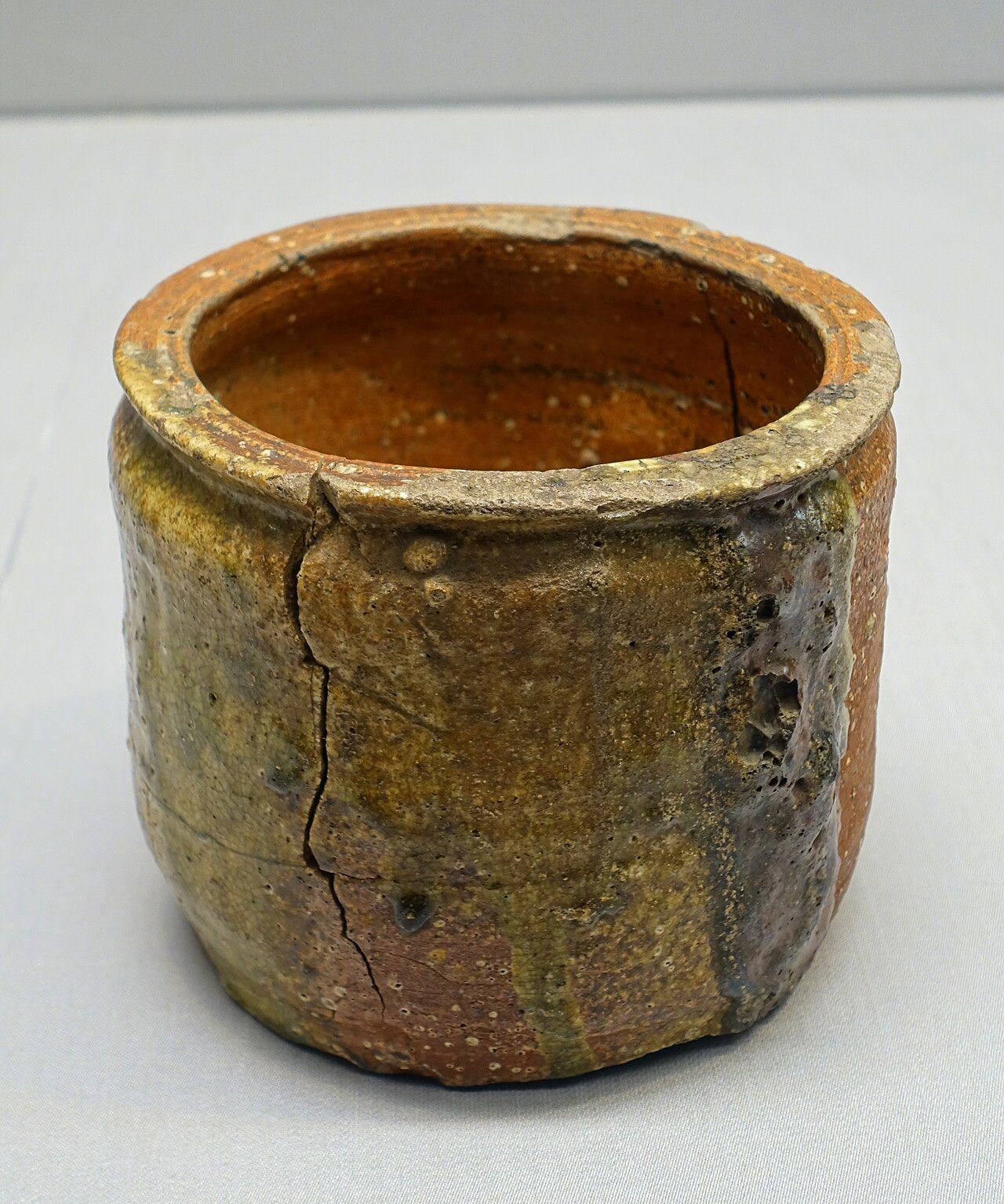
The local sandy clay from the bed of Lake Biwa has a warm orange color, and makes very durable pottery. This clay characterizes Shigaraki ware. The ceramics have irregular contours and an archaic flavor. Firing technique shifted from reduction to oxidation firing, which allows free admission of air during the firing rather than limited air admission into the kiln. This allows iron oxides to be used as part of the coloring process. The allowance of free air is due to the type of ancient kiln, called an anagama kiln, which is used to fire Shigaraki ware. The term anagama is a Japanese term meaning "cave kiln", as these kilns were usually constructed into the side of hills. They are single chambered structures with a sloping tunnel shape. The wood fuel must be constantly supplied in order to achieve temperatures high enough to fire the clay. Using this type of kiln also achieves the mineral glaze surface so popular with Shigaraki wares. Depending on the placement of the piece, the resulting coat of ash and minerals will vary. An oatmeal appearance is usually the result, with a greyish to a reddish-brown colorizing the body. Small impurities protrude, caused by embedded quartz partially fired. Covered with a thin layer of overrun yellowish-brown to a peach blossom red color glaze that crackles when fired is also characteristic of the fired stoneware. A light, transparent, or almost glass-like glaze with a bluish-green tint also appears on some Shigaraki wares. The glazes were dribbled, sprayed or spattered over the ceramic surface. Unless allowed to gather in small pools, the glaze appears near invisible in most lighting, only becoming visible when the piece is held and turned in the hand. 1
The text above is adapted from the Wikipedia article “Shigaraki ware”, available under the Creative Commons Attribution-ShareAlike 4.0 licence. 1
Shigaraki ware is pottery and stoneware made in Shigaraki area, Japan, according to the structured record cited below. This entry was generated automatically from that record and has not yet been reviewed by a person familiar with the tradition. 2
The source record links this tradition to 11 external registers, which can be verified through the citation. 2