The tradition & historical record
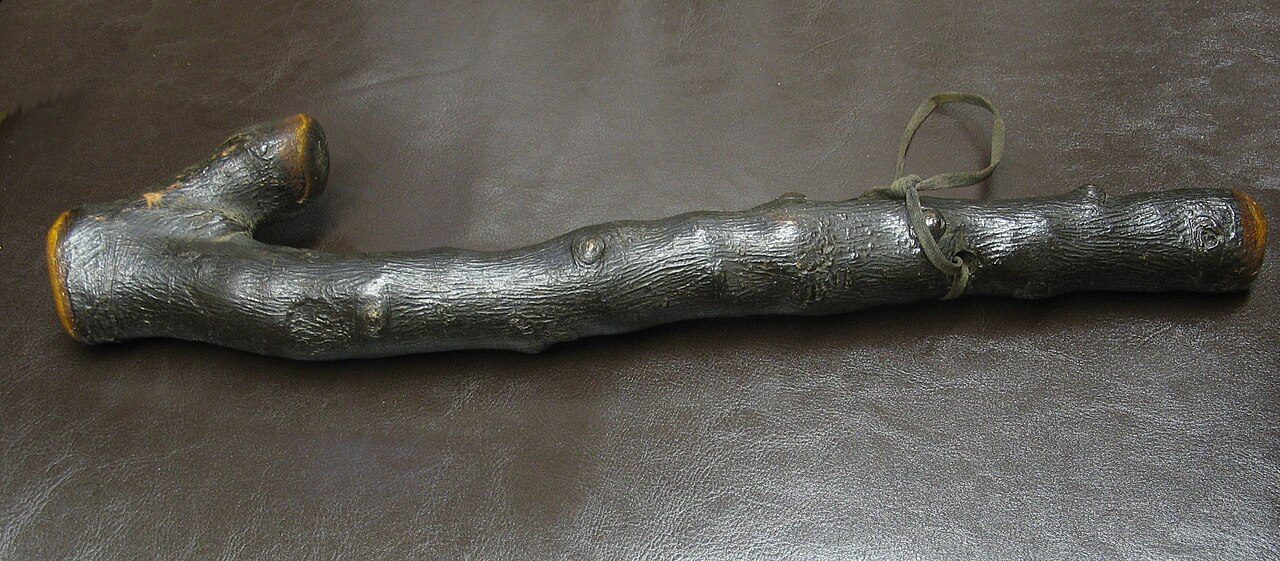
4 min read · 2 sourcesA shillelagh ( shil-AY-lee, -lə; Irish: sail éille or saill éalaigh [ˌsˠal̠ʲ ˈeːlʲə], 'thonged willow') is a wooden walking stick and club or cudgel, typically made from a stout knotty blackthorn stick with a large knob at the top. It is associated with Ireland and Irish folklore. Other spelling variants include shillelah, shillalah, and shillaly. 1
Etymology
The name shillelagh is the Hiberno-English corruption of the Irish (Gaelic) form sail éille, where sail means 'willow' or 'cudgel' and éille is genitive for iall meaning 'thong', 'strap', 'leash', and 'string', among others. As an alternate etymology, Anna Maria Hall and Patrick Weston Joyce have written that the name may have been derived from the wood being sourced from forest land in the village or barony of Shillelagh, County Wicklow. The geographic name Shillelagh derives from Síol Éalaigh, or 'descendants of Éalach' in English. 1
Construction
Shillelaghs are traditionally made from blackthorn (sloe) wood (Prunus spinosa) or oak. With the scarcity of oak in Ireland the term came increasingly to denote a blackthorn stick, and therefore blackthorn stick is sometimes glossed as an equivalent to shillelagh. Wood from the root was prized since this would be used for the knob, and was less prone to crack or break during use. 1
Curing and polishing
Most commonly, the chosen wood would be placed up a chimney to cure for a duration of several months to several years; the accumulated layer of soot gave the shillelagh its typical black shiny appearance. The less frequent methods were to bury the shank in a dung pile, or in slaked lime. The stick may require protection from its dung bath by being wrapped in well-greased oiled brown paper (steeped in hog's lard or oil). Both of the previous methods would be finished with oils or sealants, etc. A further coat of special soot finish may be applied, or a mixture of black lead and grease rubbed on with woolen cloth to a polishing finish. Some examples may just be given a coat of black paint. Rarer still was brining, where the shank was placed into a basin of saltwater. The saltwater, being a hypertonic solution, would pull moisture from the shank with little warping. One isolated case of this brining method being used, by Charlotte Brontë's uncle named Hugh, has been documented. Hugh Brontë is said to have rubbed train oil (whale oil) on the stick using chamois leather, and applied magpie blood to give it a darker appearance. 1
Dimensions
Shillelaghs are commonly the length of a walking-stick (distance from the floor to the wrist with elbow slightly bent), typically about 3 feet (0.91 m), or rather longer at about 4 or 5 feet (1.2 or 1.5 m). In the broad sense, the Shillelagh bata or sticks could include short mallets only 1 to 2 feet (0.30 to 0.61 m) long, to long poles 6 to 9 feet (1.8 to 2.7 m) long. 1
Fittings
Shillelaghs may be hollowed at the heavy "hitting" end and filled with molten lead to increase the weight beyond the typical two pounds; this sort of shillelagh is known as a 'loaded stick'. This loaded type needed to have its knob fitted with iron ferrules to maintain structural integrity, and the stick also has an iron ferrule fitted onto its narrow end. Shillelaghs may also have a heavy knob for a handle which can be used for striking. Shillelaghs may also have a strap attached, similar to commercially made walking sticks, to place around the holder's wrist. 1
The text above is adapted from the Wikipedia article “Shillelagh”, available under the Creative Commons Attribution-ShareAlike 4.0 licence. 1
shillelagh is Irish type of club (weapon), according to the structured record cited below. This entry was generated automatically from that record and has not yet been reviewed by a person familiar with the tradition. 2
The source record links this tradition to 5 external registers, which can be verified through the citation. 2