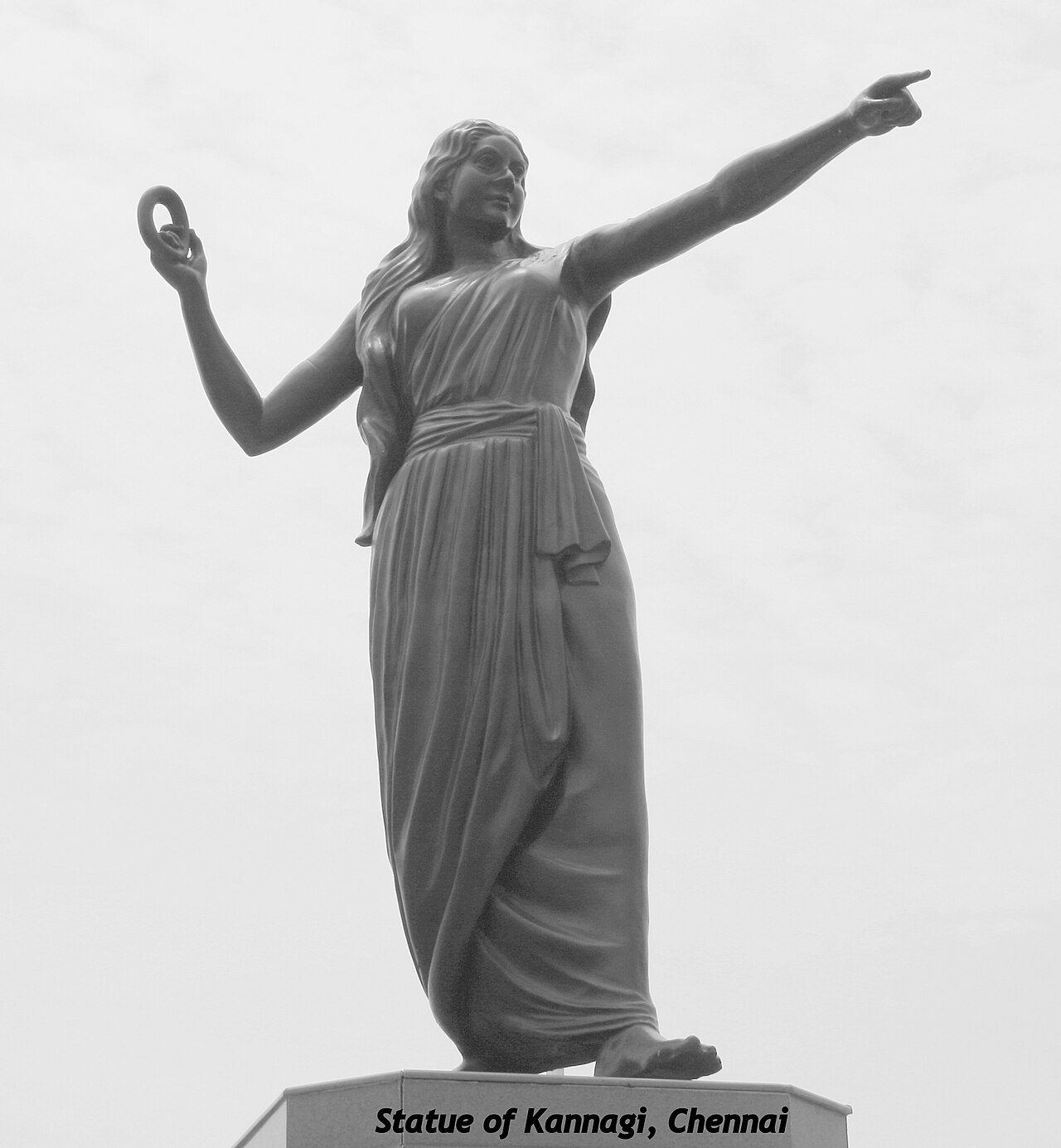
The tradition & historical record
6 min read · 2 sourcesCilappatikāram (Tamil: சிலப்பதிகாரம்) (Tamil pronunciation: [ʧiləppət̪ikɑːrəm], lit. 'the Tale of an Anklet'), also referred to as Silappathikaram or Silappatikaram, is the earliest Tamil epic. It is a poem of 5,730 lines in almost entirely akaval (aciriyam) meter. The epic is a tragic love story of an ordinary couple, Kaṇṇaki and her husband Kōvalaṉ. The Cilappatikāram has more ancient roots in the Tamil bardic tradition, as Kannaki and other characters of the story are mentioned or alluded to in the Sangam literature such as in the Natṟiṇai and later texts such as the Kovalam Katai. It is attributed to a prince-turned-jain-monk Iḷaṅkō Aṭikaḷ, and was probably composed in the 5th century CE (although estimates range from 2nd to 6th century CE). The Cilappatikāram is an ancient literary masterpiece. It is to the Tamil culture what the Iliad is to the Greek culture, states R. Parthasarathy. It blends the themes, mythologies and theological values found in the Jain, Buddhist and Hindu religious traditions. It is a Tamil story of love and rejection, happiness and pain, good and evil like all classic epics of the world. Yet unlike other epics that deal with kings and armies caught up with universal questions and existential wars, the Cilappatikāram is an epic about an ordinary couple caught up with universal questions and internal, emotional war. The Cilappatikaram legend has been a part of the Tamil oral tradition. 1
Plot
The Cilappatikāram is set in a flourishing seaport city of the early Chola kingdom. Kaṇṇaki and Kōvalaṉ are a newly married couple, in love, and living in bliss. Over time, Kōvalaṉ meets Mātavi (Mādhavi) – a courtesan. He falls for her, leaves Kaṇṇaki and moves in with Mātavi. He spends lavishly on her. Kaṇṇaki is heartbroken, but as the chaste woman, she waits despite her husband's unfaithfulness. During the festival for Indra, the rain god, there is a singing competition. Kōvalaṉ sings a poem about a woman who hurt her lover. Mātavi then sings a song about a man who betrayed his lover. Each interprets the song as a message to the other. Kōvalaṉ feels Mātavi is unfaithful to him and leaves her. Kaṇṇaki, still waiting for him, takes him back. 1
Kannagi and Kōvalaṉ leave the city and travel to Madurai, the capital of the Pandya kingdom. Kōvalaṉ is penniless and destitute. He confesses his deceit to Kannagi. She forgives him and describes him the hurt his adultery caused her. Then, she encourages her husband to rebuild their life together, and gives him one of her jeweled anklets to sell to raise starting capital. Kōvalaṉ sells it to a merchant, but the merchant falsely frames him as having stolen the anklet from the queen. The king arrests Kōvalaṉ and then executes him, without the due checks and processes of justice. When Kōvalaṉ does not return home, Kannagi goes searching for him. She learns what has happened. She protests the injustice and then proves Kōvalaṉ's innocence by throwing in the court the other jeweled anklet of the pair. The king accepts his folly. Kannagi curses the king and the people of Madurai, tearing off her breast and throwing it at the gathered public. The king dies. 1
Nomenclature
According to V R Ramachandra Dikshitar, the title Silappatikāram – also spelled Silappadikaram – is a combination of two words, "silambu" (anklet) and "adikaram" (the story about). It therefore connotes a "story that centers around an anklet". The content and context around that center is elaborate, with Atiyarkkunallar describing it as an epic story told with poetry, music, and drama. 1
Author
The Tamil tradition attributes Cilappatikaram to the Iḷaṅkō Aṭikaḷ ("the venerable ascetic prince"), also spelled Ilango Adigal. He is reputed to have been a Jain Monk and the brother of Chera king Chenkuttuvan, whose family and rule are described in the Fifth Ten of the Patiṟṟuppattu, a poem of the Sangam literature. In it or elsewhere, however, there is no evidence that the famous king had a brother. V. Kanakasabhai opined that Ilango was a monk of a nirgrantha sect of Jain. The Sangam poems never mention Ilango Adigal, the epic or the name of any other author for the epic. The Ilango Adigal name appears in a much later dated patikam (prologue) attached to the poem, and the authenticity of this attribution is doubtful. According to Gananath Obeyesekere, the story of the purported Cilappadikaram author Ilango Adigal as the brother of a famous Chera king "must be later interpolations", something that was a characteristic feature of early literature. The mythical third section about gods meeting Kannaki after Kovalan's death, in the last Canto, mentions a legend about a prince turned into a monk. This has been conflated as the story of the attributed author as a witness. However, little factual details about the real author(s) or evidence exist. Given the fact that older Tamil texts mention and allude to the Kannaki's tragic love story, states Parthasarathy, the author was possibly just a redactor of the oral tradition and the epic poem was not a product of his creative genius. The author was possibly a Jaina scholar, as in several parts of the epic, the key characters of the epic meet a Jaina monk or nun. 1
Date
In the modern era, some Tamil scholars have linked the Ilango Adigal legend about his being the brother of king Cenkuttuvan, as a means to date this text. A Chera king Cenkuttuvan is tentatively placed in the 100–250 CE, and the traditionalists, therefore, place the text to the same period. In 1939, for example, the Tamil literature scholar Ramachandra Dikshitar presented a number of events mentioned within the text and thereby derived that the text was composed about 171 CE. According to Dhandayudham, the epic should be dated to between the 3rd and 5th century. Ramachandra Dikshitar analysis that the epic was composed before the Pallava dynasty emerged as a major power in the 6th-century is accepted by most scholars, because there is no mention of the highly influential Pallavas in the epic. His chronological estimate of 171 CE for Cilappadikaram cannot be far from the real date of composition, states Alain Daniélou – a French Indologist who translated the Cilappadikaram in 1965. Daniélou states that the epic – along with the other four Tamil epics – were all composed sometime between the last part of the Sangam and the subsequent centuries, that is "3rd to 7th-century". Other scholars, such as Kamil Zvelebil – a Tamil literature and history scholar, state that the legends in the epic itself are a weak foundation for dating the text. A stronger foundation is the linguistics, events and other sociological details in the text when compared to those in other Tamil literature, new words and grammatical forms, and the number of non-Tamil loan words in the text. 1
Structure of Cilappatikaram
The Cilappatikaram is divided into three kantams (book, Skt: khanda), which are further subdivided into katais (cantos, Skt: katha). 1
The text above is adapted from the Wikipedia article “Cilappatikaram”, available under the Creative Commons Attribution-ShareAlike 4.0 licence. 1
Silappatikaram is Earliest Tamil epic, story of Kannaki, Kovalan and the anklet, according to the structured record cited below. This entry was generated automatically from that record and has not yet been reviewed by a person familiar with the tradition. 2
The source record links this tradition to 2 external registers, which can be verified through the citation. 2