The tradition & historical record
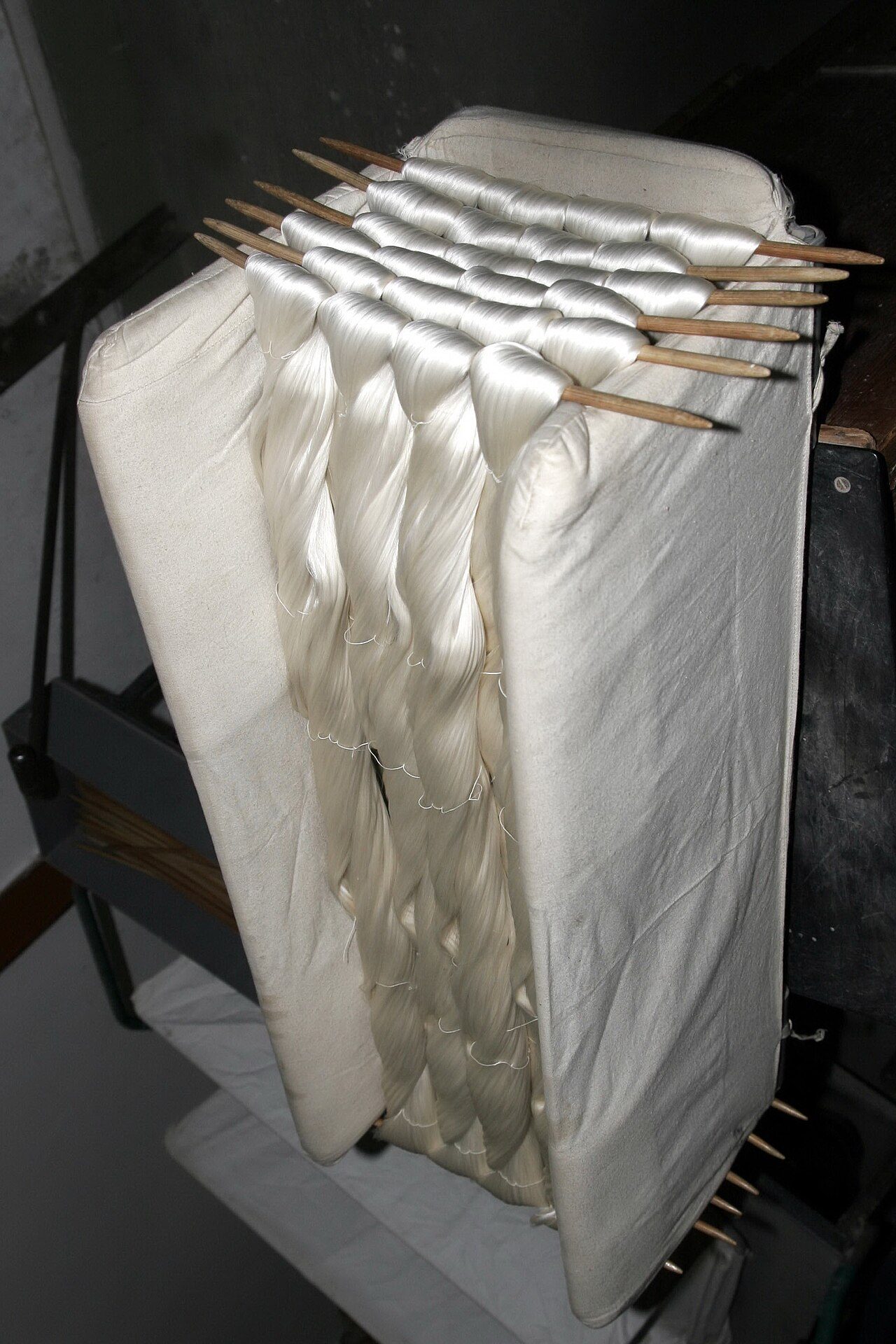
6 min read · 2 sourcesSilk is a natural protein fiber, some forms of which can be woven or knitted into textiles. The protein fiber of silk is composed mainly of fibroin (75-80%) and a smaller coating of sericin (20-25%). It is most commonly produced from the cocoons of certain insect larvae. The best-known silk is obtained from the cocoons of the larvae of the mulberry silkworm Bombyx mori, which are reared in captivity (sericulture). Harvested silk is produced by numerous insects; generally, only the silk of various moth caterpillars has been used for textile manufacturing. Research into other types of silk, which differ at the molecular level, has been conducted. Silk is produced primarily by the larvae of insects undergoing complete metamorphosis, but some insects, such as webspinners and raspy crickets, produce silk throughout their lives. Silk production also occurs in hymenoptera (bees, wasps, and ants), silverfish, caddisflies, mayflies, thrips, leafhoppers, beetles, lacewings, fleas, flies, and midges. Other types of arthropods also produce silk, most notably various arachnids, such as spiders. 1
Etymology
The word silk comes from Old English: sioloc, from Latin: sericum and Ancient Greek: σηρικός, romanized: sērikós, "silken", ultimately from the Chinese word "sī" and other Asian sources—compare Standard Chinese sī "silk", Mongolian sirkek. 1
History
The production of silk originated in central China in the Neolithic period, although it would eventually reach other places of the world (Yangshao culture, 4th millennium BC). Silk production remained confined to China until the Silk Road opened at some point during the latter part of the 1st millennium BC, though China maintained its virtual monopoly over silk production for another thousand years. 1
Wild silk
Several kinds of wild silk, produced by caterpillars other than the mulberry silkworm, have been known and spun in China, South Asia, and Europe since ancient times. However, the scale of production was always far smaller than for cultivated silks. There are several reasons for this: first, they differ from the domesticated varieties in colour and texture and are therefore less uniform; second, cocoons gathered in the wild have usually had the pupa emerge from them before being discovered so the silk thread that makes up the cocoon has been torn into shorter lengths; and third, many wild cocoons are covered in a mineral layer that prevents attempts to reel from them long strands of silk. Thus, the only way to obtain silk suitable for spinning into textiles in areas where commercial silks are not cultivated was by tedious and labor-intensive carding.Some natural silk structures have been used without being unwound or spun. Spider webs were used as a wound dressing in ancient Greece and Rome, and as a base for painting from the 16th century. Butterfly caterpillar nests were pasted together to make a fabric in the Aztec Empire. Commercial silks originate from reared silkworm pupae, which are bred to produce a white-colored silk thread with no mineral on the surface. The pupae are killed by either dipping them in boiling water before the adult moths emerge or by piercing them with a needle. These factors all contribute to the ability of the whole cocoon to be unravelled as one continuous thread, permitting a much stronger cloth to be woven from the silk. 1
Wild silks also tend to be more difficult to dye than silk from the cultivated silkworm. 1
China
Silk use in fabric was first developed in ancient China. The earliest evidence for silk is the presence of the silk protein fibroin in soil samples from two tombs at the neolithic site Jiahu in Henan, which date back about 8,500 years. The earliest surviving example of silk fabric dates from about 3630 BC, and was used as the wrapping for the body of a child at a Yangshao culture site in Qingtaicun near Xingyang, Henan. Legend gives credit for developing silk to a Chinese empress, Leizu (Hsi-Ling-Shih, Lei-Tzu). Silks were originally reserved for the emperors of China for their own use and gifts to others, but spread gradually through Chinese culture and trade both geographically and socially, and then to many regions of Asia. Because of its texture and lustre, silk rapidly became a popular luxury fabric in the many areas accessible to Chinese merchants. Silk was in great demand, and became a staple of pre-industrial international trade. Silk was also used as a surface for writing, especially during the Warring States period (475–221 BCE). The fabric was light, it survived the damp climate of the Yangtze region, absorbed ink well, and provided a white background for the text. In July 2007, archaeologists discovered intricately woven and dyed silk textiles in a tomb in Jiangxi province, dated to the Eastern Zhou dynasty roughly 2,500 years ago. Although historians have suspected a long history of a formative textile industry in ancient China, this find of silk textiles employing "complicated techniques" of weaving and dyeing provides direct evidence for silks dating before the Mawangdui-discovery and other silks dating to the Han dynasty (202 BC – 220 AD). Silk is described in a chapter of the Fan Shengzhi shu from the Western Han empire (202 BC – 9 AD). 1
Japan
Archaeological evidence indicates that sericulture has been practiced since the Yayoi period. The silk industry was dominant from the 1930s to 1950s, but is less common now. Silk from East Asia had declined in importance after silkworms were smuggled from China to the Byzantine Empire. However, in 1845, an epidemic of flacherie among European silkworms devastated the silk industry there. This led to a demand for silk from China and Japan, where as late as the nineteenth and early twentieth centuries, Japanese exports competed directly with Chinese in the international market in such low value-added, labor-intensive products as raw silk. Between 1850 and 1930, raw silk ranked as the leading export for both countries, accounting for 20%–40% of Japan's total exports and 20%–30% of China's. Between the 1890s and the 1930s, Japanese silk exports quadrupled, making Japan the largest silk exporter in the world. This increase in exports was mostly due to the economic reforms during the Meiji period and the decline of the Qing dynasty in China, which led to rapid industrialization of Japan whilst the Chinese industries stagnated. During World War II, embargoes against Japan had led to adoption of synthetic materials such as nylon, which led to the decline of the Japanese silk industry and its position as the lead silk exporter of the world. Today, China exports the largest volume of raw silk in the world. 1
The text above is adapted from the Wikipedia article “Silk”, available under the Creative Commons Attribution-ShareAlike 4.0 licence. 1
silk is fine, lustrous, natural fiber produced by the larvae of various silk moths, especially the species Bombyx mori, according to the structured record cited below. This entry was generated automatically from that record and has not yet been reviewed by a person familiar with the tradition. 2
The source record links this tradition to 65 external registers, which can be verified through the citation. 2