The tradition & historical record
6 min read · 2 sourcesSintering or frittage is the process of compacting and forming a solid mass of material by pressure or heat without melting it to the point of liquefaction. Sintering happens as part of a manufacturing process used with metals, ceramics, plastics, and other materials. The atoms/molecules in the sintered material diffuse across the boundaries of the particles, fusing the particles together and creating a solid piece. Since the sintering temperature does not have to reach the melting point of the material, sintering is often chosen as the shaping process for materials with extremely high melting points, such as tungsten and molybdenum. The study of sintering in metallurgical powder-related processes is known as powder metallurgy. An example of sintering can be observed when ice cubes in a glass of water adhere to each other, which is driven by the temperature difference between the water and the ice. Examples of pressure-driven sintering are the compacting of snowfall to a glacier, and the formation of a hard snowball by pressing loose snow together. The material produced by sintering is called sinter. The word sinter comes from the Middle High German sinter, a cognate of English cinder. 1
General sintering
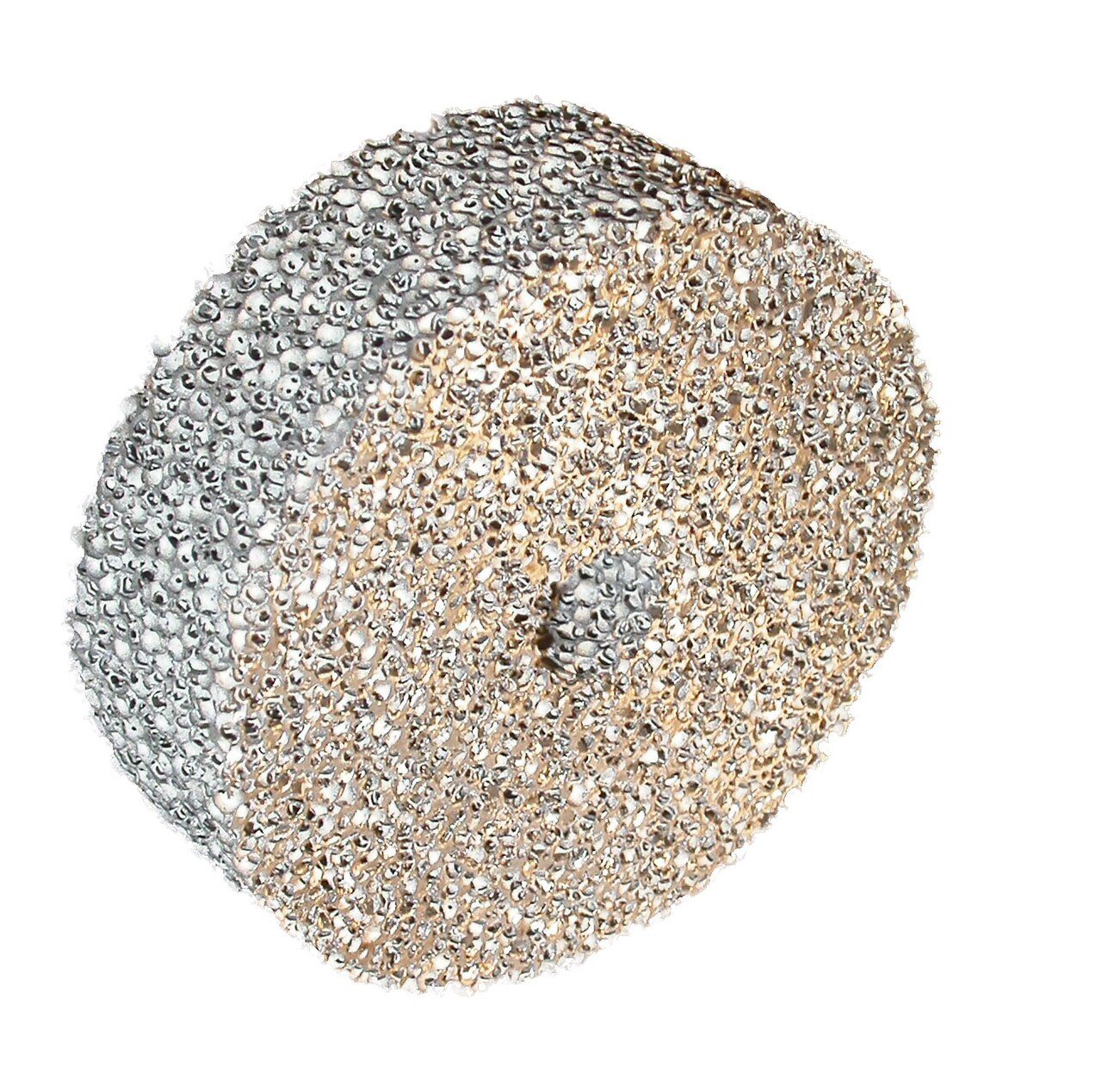
In manufacturing, sintering is generally considered successful when the process reduces porosity and enhances properties such as strength, electrical conductivity, translucency and thermal conductivity. In some special cases, sintering is carefully applied to enhance the strength of a material while preserving porosity (like in filters or catalysts, where gas adsorption is a priority). During the sintering process, atomic diffusion drives powder surface elimination in different stages, starting at the formation of necks between powders to final elimination of small pores at the end of the process. The driving force for densification is the change in free energy from the decrease in surface area and lowering of the surface free energy by the replacement of solid-vapor interfaces. It forms new but lower-energy solid-solid interfaces with a net decrease in total free energy. On a microscopic scale, material transfer is affected by the change in pressure and differences in free energy across the curved surface. If the size of the particle is small (and its curvature is high), these effects become very large in magnitude. The change in energy is much higher when the radius of curvature is less than a few micrometers, which is one of the main reasons why much ceramic technology is based on the use of fine-particle materials. The ratio of bond area to particle size is a determining factor for properties such as strength and electrical conductivity. To yield the desired bond area, temperature and initial grain size are precisely controlled over the sintering process. 1
Ceramic sintering
Sintering is part of the firing process used in the manufacture of pottery and other ceramic objects. Sintering and vitrification (which requires higher temperatures) are the two main mechanisms behind the strength and stability of ceramics. Sintered ceramic objects are made from substances such as glass, alumina, zirconia, silica, magnesia, lime, beryllium oxide, and ferric oxide. Some ceramic raw materials have a lower affinity for water and a lower plasticity index than clay, requiring organic additives in the stages before sintering. Sintering begins when sufficient temperatures have been reached to mobilize the active elements in the ceramic material, which can start below their melting point (typically at 50–80% of their melting point), e.g. as premelting. When sufficient sintering has taken place, the ceramic body will no longer break down in water; additional sintering can reduce the porosity of the ceramic, increase the bond area between ceramic particles, and increase the material strength. Industrial procedures to create ceramic objects via sintering of powders generally include: 1
mixing water, binder, deflocculant, and unfired ceramic powder to form a slurry spray-drying the slurry putting the spray dried powder into a mold and pressing it to form a green body (an unsintered ceramic item) heating the green body at low temperature to burn off the binder sintering at a high temperature to fuse the ceramic particles together. All the characteristic temperatures associated with phase transformation, glass transitions, and melting points, occurring during a sinterisation cycle of a particular ceramic's formulation (i.e., tails and frits) can be easily obtained by observing the expansion-temperature curves during optical dilatometer thermal analysis. 1
Sintering of metallic powders
Most metals can be sintered, although some with greater difficulty (i.e., aluminium alloy and titanium alloys). This applies especially to pure metals produced in vacuum which suffer no surface contamination. Sintering under atmospheric pressure requires the use of a protective gas, quite often endothermic gas. Sintering, with subsequent reworking, can produce a great range of material properties. Changes in density, alloying, and heat treatments can alter the physical characteristics of various products. For instance, the Young's modulus En of sintered iron powders remains somewhat insensitive to sintering time, alloying, or particle size in the original powder for lower sintering temperatures, but depends upon the density of the final product: 1
E n / E = ( D / d ) 3.4 {\displaystyle E_{n}/E=(D/d)^{3.4}} 1
where D is the density, E is Young's modulus and d is the maximum density of iron. Sintering is static when a metal powder under certain external conditions may exhibit coalescence, and yet reverts to its normal behavior when such conditions are removed. In most cases, the density of a collection of grains increases as material flows into voids, causing a decrease in overall volume. Mass movements that occur during sintering consist of the reduction of total porosity by repacking, followed by material transport due to evaporation and condensation from diffusion. 1
Advantages
Particular advantages of the powder technology include: 1
Very high levels of purity and uniformity in starting materials Preservation of purity, due to the simpler subsequent fabrication process (fewer steps) that it makes possible Stabilization of the details of repetitive operations, by control of grain size during the input stages Absence of binding contact between segregated powder particles – or "inclusions" (called stringering) – as often occurs in melting processes No deformation needed to produce directional elongation of grains Capability to produce materials of controlled, uniform porosity. Capability to produce nearly net-shaped objects. Capability to produce materials which cannot be produced by any other technology. Capability to fabricate high-strength material like turbine blades. After sintering the m… 1
Plastics sintering
P… 1
The text above is adapted from the Wikipedia article “Sintering”, available under the Creative Commons Attribution-ShareAlike 4.0 licence. 1
sintering is process of compacting granular material into a coherent solid by heat or pressure, without melting, according to the structured record cited below. This entry was generated automatically from that record and has not yet been reviewed by a person familiar with the tradition. 2
The source record links this tradition to 29 external registers, which can be verified through the citation. 2