The tradition & historical record
6 min read · 2 sourcesSir Orfeo is an anonymous Middle English Breton lai or lay dating from the late 13th or early 14th century. It retells the story of Orpheus as a king who rescues his wife from the fairy king. The folk song Orfeo (Roud 136, Child 19) is based on this poem. 1
History and manuscripts
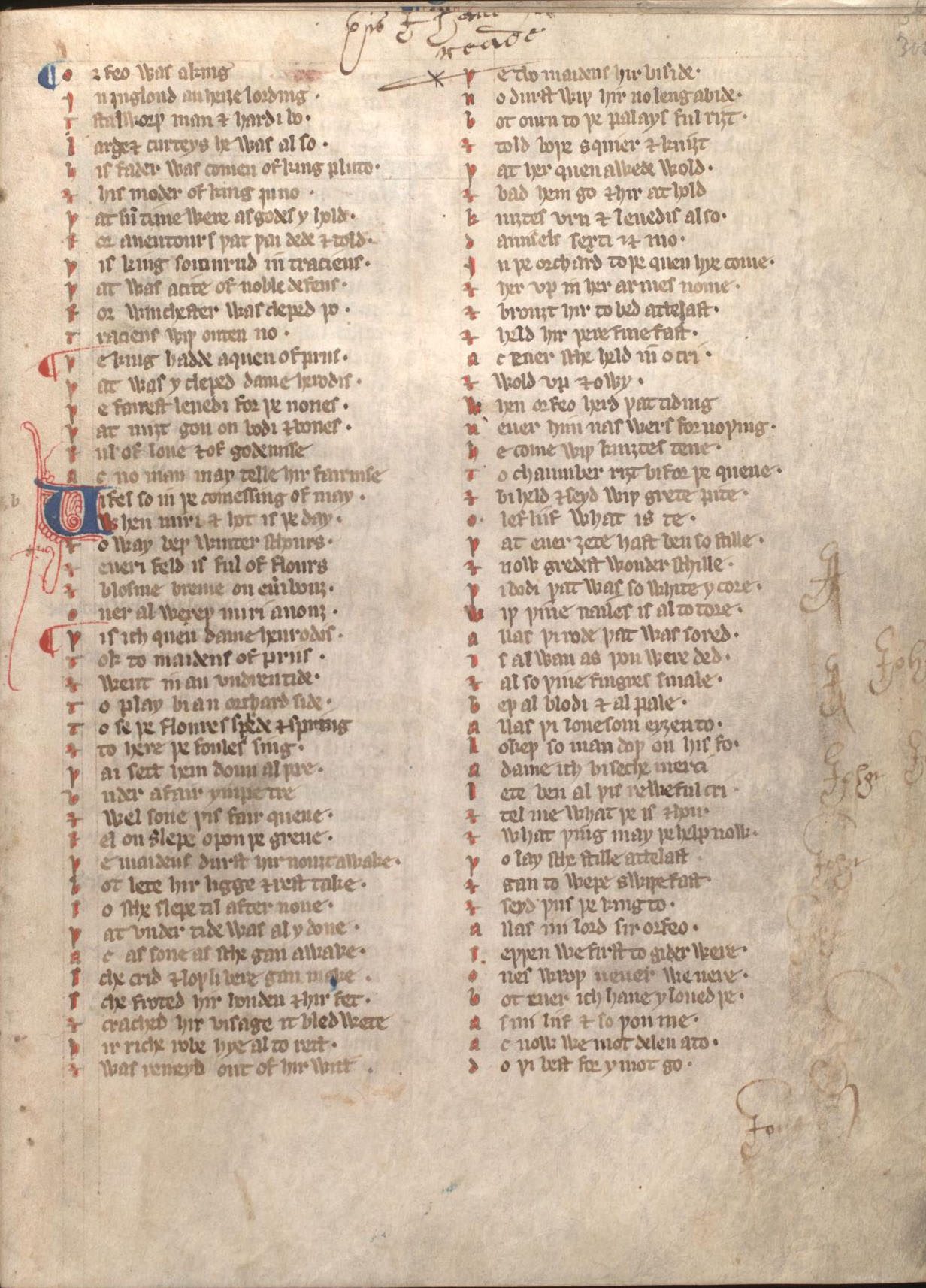
Sir Orfeo was probably written in the late 13th or early 14th century in the Westminster-Middlesex area. It is preserved in three manuscripts: the oldest, Advocates 19.2.1, known as the Auchinleck MS. is dated about 1330; Harley 3810 is from about the beginning of the fifteenth century; and Ashmole 61 was compiled over the course of several years, the portion of the MS. containing Sir Orfeo dating around 1488. The beginning of the poem describes itself as a Breton lai and says it is derived from a no longer extant text, the Lai d'Orphey, also attested in other romances such as Floris and Blancheflor. The story contains a mixture of the Greek myth of Orpheus with Celtic mythology and folklore concerning fairies, introduced into English via the Old French Breton lais of poets like Marie de France (fl. 1160–1215). The Wooing of Etain bears particular resemblance to the romance and was a probable influence. The fragmentary Child Ballad 19, "King Orfeo", is closely related to this poem, the surviving text containing only portions of the known story. In a Scottish fragment of the tale, the loyal steward who preserves Orfeo's throne is also indicated as Orfeo's nephew. 1
Synopsis
Sir Orfeo, a king in England, loses his wife Heurodis (i.e. Eurydice) to the fairy king, who steals her away from under an ympe-tre (a tree propagated by grafting), probably an apple or cherry tree. Heurodis had visited the orchard the day before, accompanied by two maidens, to sleep beneath the shade of its branches; however, when she had awoken from her midday nap, she was so distressed that they had to call for the help of knights to restrain her. In her sleep, she had been visited by the king of the Otherworld, she claimed, who was intent upon taking her to his underworld kingdom. Now, a day later, she is in the orchard again, as the king of the Otherworld has instructed her to be, and despite a posse of armed knights surrounding and protecting her, she vanishes away. Orfeo, distraught by this, leaves his court and wanders alone in a forest. He has left his steward in charge of the kingdom and seems to have no intention of returning to his capital city of Winchester (in southern England, the old capital of the Anglo-Saxon kingdom of Wessex). Winchester was called Thrace in those days, the reader is assured. Sir Orfeo leaves instructions that when they learn of his death, they should convene another parliament and choose a new king. Sir Orfeo wanders in the forest for several years, sleeping on the bare earth and living on berries and fruits in summer, roots and the bark of trees in winter. After ten years, he sees Heurodis riding past in the company of a fairy host, who cries with pity for him over his physical condition. She is riding with sixty ladies, with no men among them, hunting by a river. 1
Oral tradition
Fragments of the ballad survived in the oral tradition in the Shetland Islands. John Stickle of Unst and Kitty Anderson of Lerwick were recorded in the 1940s and 1950s singing versions with a refrain in the Norn language. The following excerpt is the first two verses of the version collected by Francis James Child from Andrew Coutts, an old man in Unst, which also combines Shetlandic and Norn. 1
Manuscript differences
The three preserved manuscripts—the Auchinleck MS., London, British Library, Harley 3810/I, and Oxford, Bodleian Library, Ashmole 61–have striking differences present throughout the texts. The three manuscripts are very similar in the content of the story; however, there exists a small discrepancy between the Auchinleck and Ashmole manuscripts: Sir Orfeo's wife is called Meroudys in the Ashmole manuscript and is called Heurodus in the Auchinleck manuscript. While their content is similar, each manuscript omits certain lines and adds lines in order to portray the story more accurately, which may be a result of the time period. The Auchinleck manuscript was originally written on 332 vellum leaves. Most of this manuscript has been mutilated, and a large number of leaves have been cut away. Eight of these missing leaves have been recovered, and the present contents of the volume originally consisted of 52 gatherings. This manuscript is the closest to the presumed original version and is often known as the "base" text of 604 lines. The Harley 3180 manuscript was composed of 34 paper folios and contained only six works: Sir Orfeo and moral and religious pieces being two of them. The verse on the last folio is written in sixteenth-century hand with an inscription being: Hic liber olim fuit liber Wil’mi Shawcler’ et Cur de Badesly Clinton: Eccl’a. The Harleian Collection version of Sir Orfeo has only been printed once. It contains only 509 lines, about 100 shorter than the Auchinleck version. Using that as the base text this Harleian version omits lines 49–50, 166–7, 206–7, 241–2, 247–50, 293–6, 391–404, 411–12, 439–42, 445–6, 458, 481–2, 485–6, 501–8, 521–2, 527–8, 539–40, 545–52, 555–6, 559–62, 565–82, 585–6, 589–94, 597–602. 1
Folklore elements
The poem shows Celtic influence in the Kingdom of the Fairies being a parallel dimension to the everyday world rather than the Land of the Dead as in the Greek myth of Orpheus and Eurydice. The ability to move between one world and the other distinguishes the tale as told in its various British versions such as Sir Orfeo and the Shetland ballad King Orfeo where the captors are envisaged as inhabitants of a parallel fairy domain rather than as the infernal region of the Dead ruled over by Hades as in the Greek myth. Katharine Briggs sees the tale as related in British folk narratives as being equally influenced by Celtic stories such as The Wooing of Etain as it is from Classical sources, in particular the version of the story in Ovid’s Metamorphoses which would have been the most widely available source in Britain in the Middle Ages and for some time after 1
The text above is adapted from the Wikipedia article “Sir Orfeo”, available under the Creative Commons Attribution-ShareAlike 4.0 licence. 1
Sir Orfeo is Middle English narrative lay, according to the structured record cited below. This entry was generated automatically from that record and has not yet been reviewed by a person familiar with the tradition. 2
The source record links this tradition to 12 external registers, which can be verified through the citation. 2