The tradition & historical record
3 min read · 2 sourcesSiwa (or Suwa) (Tigrinya: ሰዋ, romanized: säwa), Amharic: ጠላ, is a beer originating from Eritrea and Ethiopia. Traditionally home-brewed, siwa remains locally popular during social events, after (manual) work, and as an incentive for farmers and labourers. Thousands of traditional beer houses (Enda Siwa) straddle the Tigrayan urban and rural landscapes. 1
Siwa, the traditional beer of Tigray
In almost every rural household of Tigray, the woman knows how to prepare the local beer, siwa in Tigrinya language. Basic ingredients are water; a home-baked and toasted flatbread commonly made from barley in the highlands, and from sorghum, finger millet or maize in the lowlands; some yeast (Saccharomyces cerevisiae); and dried leaves of gesho (Rhamnus prinoides) that serve as a catalyst. The brew is allowed to ferment for a few days, after which it is served, sometimes with the pieces of bread floating on it (the customer will gently blow them to one side of the beaker). The alcoholic content is 2% to 5%. Siwa has a smoky flavour (originating from the toasted bread) and a typical sourness, bitterness, and sweetness (pH between 4 and 5). Most of the coarser part of the brew, the atella, remains back and is used as cattle feed. 1
Variants
A stronger version of siwa is called meknen, locally also filter, lifter or tselim siwa, which may reach an alcoholic content of 6% and beyond The softer version, often a secondary brew, is called gu'esh In the highland parts of Tigray and Amhara (often above elevations of 3000 metres), a light version, with the consistency of injera dough is taken particularly as breakfast; it is called korofieh In Amharic the siwa is called talla, and in Oromiffaa and Raya Tigrinya farso Myes, or in Amharic tej, is a similar alcoholic brew based on honey and is the Ethiopian version of mead. Myes is produced and consumed in mead houses (inda myes or tej bet). The brew is typically served in long-necked glass bottles. 1
Receptacles
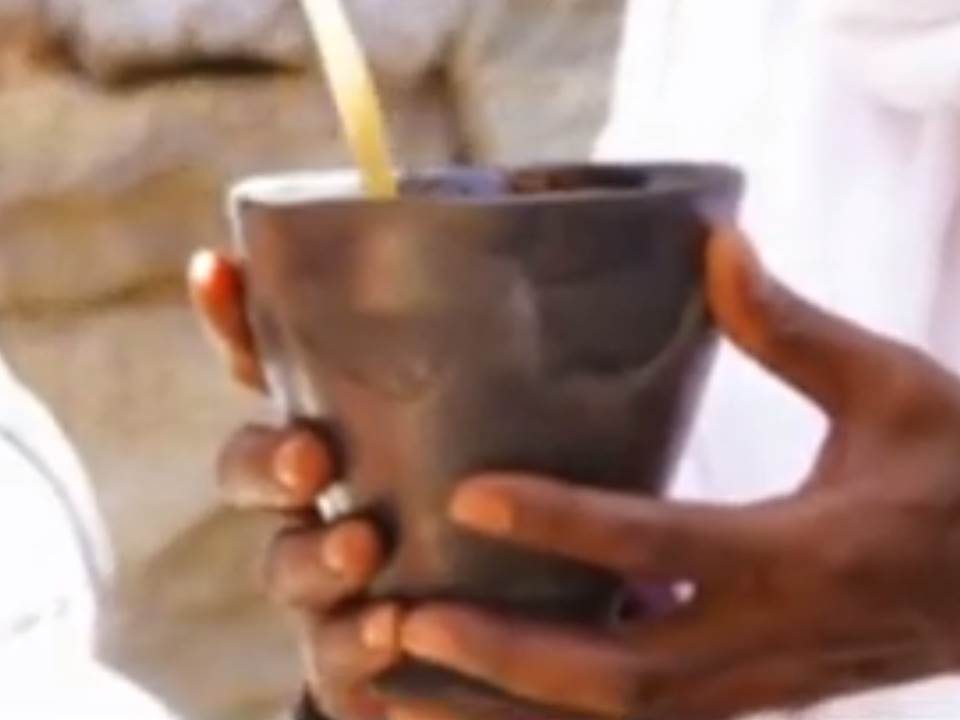
The three traditional bowls in which siwa is served are: clay beakers (shekhla or wancha), hollowed gourds, and, less frequently, cattle horns. Recently, plastic or metal beakers and tins have become much used. Meknen is commonly served in one-litre glass bottles. The siwa itself is conserved in large clay vases, called etriro, which tend to get replaced with plastic drums. In the hotter lowlands, the etriro continues to be used because it has the particularity to keep the brew fresh. 1
In daily life
When farmers go to plough their land, and even more when threshing their crops, there will always be siwa for the whole crew of farmers. Typically, the construction owner will also serve siwa to the labourers at house construction sites. 1
Social events
Siwa is traditionally served at every social event (baptisms, marriages, graduations, etc.). Typically, the cups are filled up to the edge, and the party's organizer will ensure that they are refilled before the guest can empty their cup. 1
The text above is adapted from the Wikipedia article “Siwa (beer)”, available under the Creative Commons Attribution-ShareAlike 4.0 licence. 1
Siwa is beer originated from Tigray, Ethiopia and Eritrea, according to the structured record cited below. This entry was generated automatically from that record and has not yet been reviewed by a person familiar with the tradition. 2
The source record links this tradition to 1 external register, which can be verified through the citation. 2