The tradition & historical record
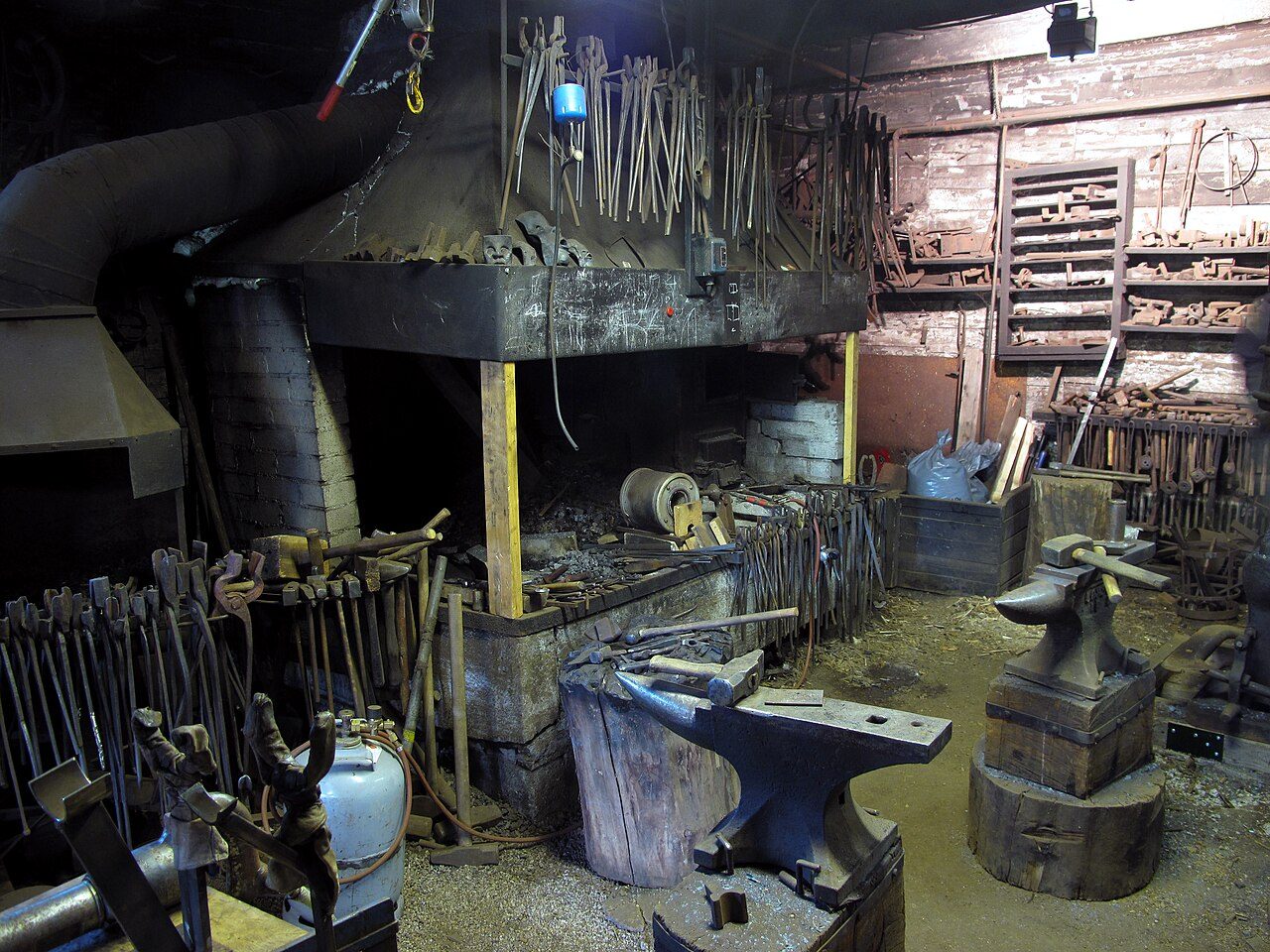
6 min read · 2 sourcesA forge is a type of hearth used for heating metals, or the workplace (smithy) where such a hearth is located. The forge is used by the smith to heat a piece of metal to a temperature at which it becomes easier to shape by forging, or to the point at which work hardening no longer occurs. The metal (known as the "workpiece") is transported to and from the forge using tongs, which are also used to hold the workpiece on the smithy's anvil while the smith works it with a hammer. Sometimes, such as when hardening steel or cooling the work so that it may be handled with bare hands, the workpiece is transported to the slack tub, which rapidly cools the workpiece in a large body of water. However, depending on the metal type, it may require an oil quench or a salt brine instead; many metals require more than plain water hardening. The slack tub also provides water to control the fire in the forge. 1
Coal/coke/charcoal forge
A forge typically uses bituminous coal, industrial coke or charcoal as the fuel to heat metal. The designs of these forges have varied over time, but whether the fuel is coal, coke or charcoal the basic design has remained the same. A forge of this type is essentially a hearth or fireplace designed to allow a fire to be controlled such that metal introduced to the fire may be brought to a malleable state or to bring about other metallurgical effects (hardening, annealing, and tempering as examples). The forge fire in this type of forge is controlled in three ways: amount of air, the volume of fuel, and shape of the fuel/fire. 1
Over thousands of years of forging, these devices have evolved in one form or another as the essential features of this type of forge: 1
Tuyere—a pipe through which air can be forced into the fire Bellows or blower—a means for forcing air into the tuyere Hearth—a place where the burning fuel can be contained over or against the tuyere opening. Traditionally hearths have been constructed of mud-brick (adobe), fired brick, stone, or later, constructed of iron. During operation, fuel is placed in or on the hearth and ignited. A source of moving air, such as a fan or bellows, introduces additional air into the fire through the tuyere. With additional air, the fire consumes fuel faster and burns hotter (and cleaner - smoke can be thought of as escaped potential fuel). A blacksmith balances the fuel and air in the fire to suit particular kinds of work. Often this involves adjusting and maintaining the shape of the fire. In a typical coal forge, a firepot will be centered in a flat hearth. The tuyere will enter the firepot at the bottom. In operation, the hot core of the fire will be a ball of burning coke in and above the firepot. 1
Gas forge
A gas forge typically uses propane or natural gas as the fuel. One common, efficient design uses a cylindrical forge chamber and a burner tube mounted at a right angle to the body. The chamber is typically lined with refractory materials such as a hard castable refractory ceramic or a soft ceramic thermal blanket (ex: mineral wool). The burner mixes fuel and air which are ignited at the tip, which protrudes a short way into the chamber lining. The air pressure, and therefore heat, can be increased with a mechanical blower or by taking advantage of the Venturi effect. Gas forges vary in size and construction, from large forges using a big burner with a blower or several atmospheric burners to forges built out of a coffee can utilizing a cheap, simple propane torch. A small forge can even be carved out of a single soft firebrick. The primary advantage of a gas forge is the ease of use, particularly for a novice. A gas forge is simple to operate compared to coal forges, and the fire produced is clean and consistent. They are less versatile, as the fire cannot be reshaped to accommodate large or unusually shaped pieces. It is also difficult to heat a small section of a piece. A common misconception is that gas forges cannot produce enough heat to enable forge-welding, but a well-designed gas forge is hot enough for any task. 1
Finery forge
A finery forge is a water-powered mill where pig iron is refined into wrought iron. 1
Anvil
The anvil serves as a workbench to the blacksmith, where the metal to be forged is worked. Anvils may seem clunky and heavy, but they are a highly refined tool carefully shaped to suit a blacksmith's needs. Anvils are made of cast or wrought iron with a tool steel face welded on or of a single piece of cast or forged tool steel. Some anvils are made of only cast iron and have no tool steel face. These are not real anvils, and will not serve a blacksmith as such because they are too soft. A common term for a cast iron anvil is "ASO" or "Anvil Shaped Object". The purpose of a tool steel face on an anvil is to provide what some call "rebound" as well as being hard and not denting easily from misplaced hammer blows. The term rebound means it projects some of the force of the blacksmith's hammer blows back into the metal thus moving more metal at once than if there were no rebound. A good anvil can project anywhere from 50 to 99% of the energy back into the workpiece. The flat top, called the "face" is highly polished and usually has two holes (but can have more or less depending on the design). The square hole is called the hardy hole, where the square shank of the hardy tool fits. There are many different kinds of hardy tools. The smaller hole is called the pritchel hole, used as a bolster when punching holes in hot metal, or to hold tools similar to how the hardy tool does, but for tools that require being able to turn a 360-degree angle such as a hold-down tool for when the blacksmith's tongs cannot hold a workpiece as securely as it needs to be. On the front of the anvil, there is sometimes a "horn" that is used for bending, drawing out steel, and many other tasks. 1
Hammer
There are many types of hammer used in a blacksmith's workshop but this will name just a few common ones. Hammers can range in shape and weight from half an ounce to nearly 30 pounds depending on the type of work being done with it. 1
Hand hammer - used by the smith. Ball-peen hammer Cross-peen hammer Straight-peen hammer Rounding hammer Sledge hammer - used by the striker. 1
The text above is adapted from the Wikipedia article “Forge”, available under the Creative Commons Attribution-ShareAlike 4.0 licence. 1
smithy is workshop of a blacksmith, who is an ironsmith who makes iron into tools or other objects, according to the structured record cited below. This entry was generated automatically from that record and has not yet been reviewed by a person familiar with the tradition. 2
The source record links this tradition to 33 external registers, which can be verified through the citation. 2