The tradition & historical record
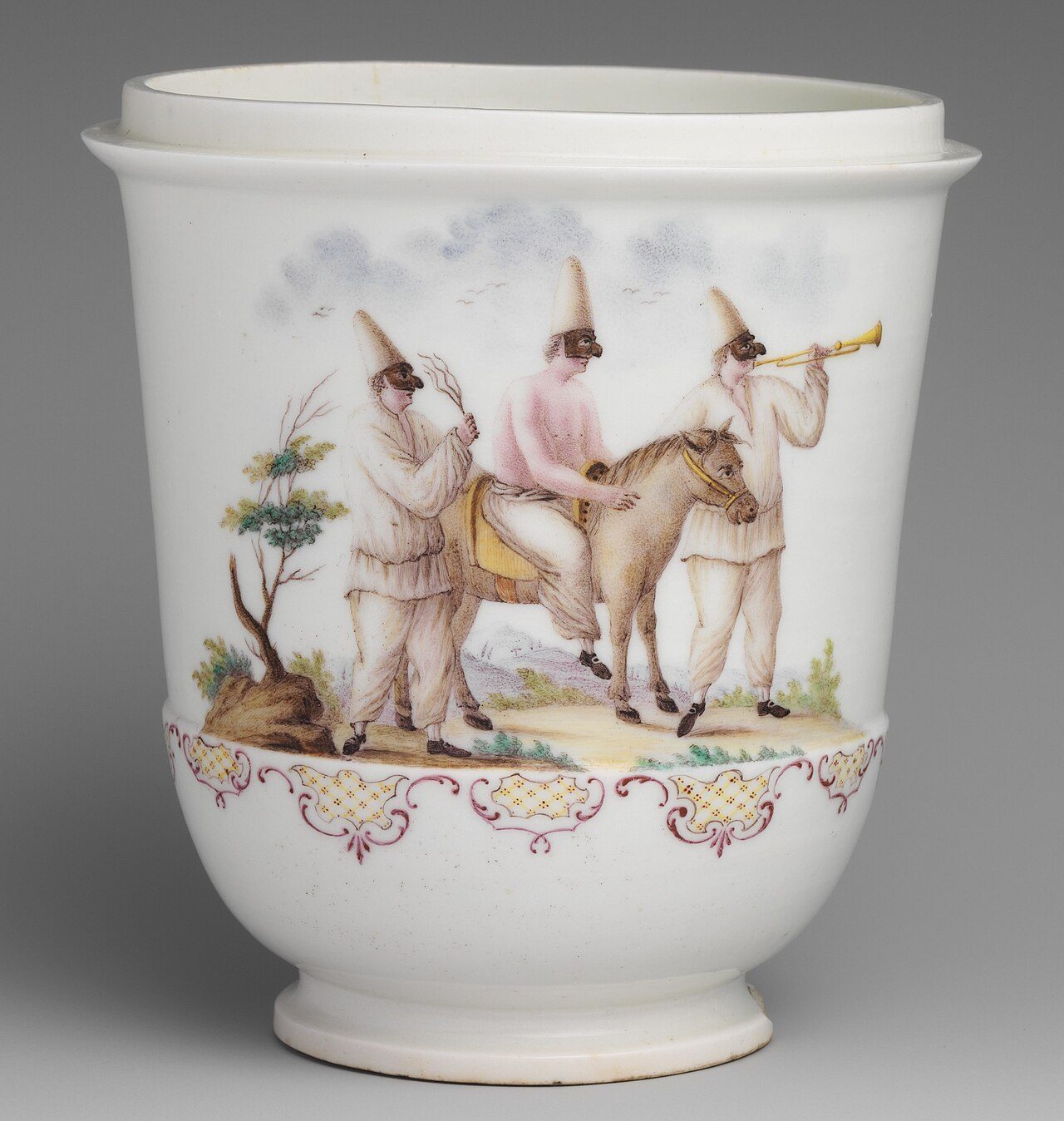
6 min read · 2 sourcesSoft-paste porcelain (sometimes simply "soft paste", or "artificial porcelain") is a type of ceramic material in pottery, usually accepted as a type of porcelain. It is weaker than "true" hard-paste porcelain, and does not require either its high firing temperatures or special mineral ingredients. There are many types, using a range of materials. The material originated in the attempts by many European potters to replicate hard-paste Chinese export porcelain, especially in the 18th century, and the best versions match hard-paste in whiteness and translucency, but not in strength. But the look and feel of the material can be highly attractive, and it can take painted decoration very well. The ingredients varied considerably, but always included clay, often ball clay, and often ground glass, bone ash, soapstone (steatite), flint, and quartz. They rarely included the key ingredients necessary for hard-paste, china clay including kaolin, or the English china stone, although some manufacturers included one or other of these, but failed to get their kilns up to a hard-paste firing temperature. 1
Background
There were early attempts by European potters to replicate Chinese porcelain when its composition was little understood and its constituents were not widely available in the West. The earliest formulations were mixtures of clay and ground-up glass (frit). Soapstone (steatite) and lime are also known to have been included in some compositions. The first successful attempt was Medici porcelain, produced between 1575 and 1587. It was composed of white clay containing powdered feldspar, calcium phosphate and wollastonite (CaSiO3), with quartz. Other early European soft-paste porcelain, also a frit porcelain, was produced at the Rouen manufactory in 1673, which was known for this reason as "Porcelaine française". Again, these were developed in an effort to imitate high-valued Chinese hard-paste porcelain. As these early formulations slumped in the kiln at high temperatures, they were difficult and uneconomic to use. Later formulations used kaolin (china clay), quartz, feldspars, nepheline syenite and other feldspathic rocks. Soft-paste porcelain with these ingredients was technically superior to the traditional soft-paste and these formulations remain in production. 1
Characteristics
Soft-paste formulations containing little clay are not very plastic and shaping it on the potter's wheel is difficult. Pastes with more clay (now more commonly referred to as "bodies"), such as electrical porcelain, are extremely plastic and can be shaped by methods such as jolleying and turning. The feldspathic formulations are, however, more resilient and suffer less pyroplastic deformation. Soft-paste is fired at lower temperatures than hard-paste porcelain, typically around 1100 °C for the frit based compositions and 1200 to 1250 °C for those using feldspars or nepheline syenites as the primary flux. The lower firing temperature gives artists and manufacturers some benefits, including a wider palette of colours for decoration and reduced fuel consumption. The body of soft-paste is more granular than hard-paste porcelain, less glass being formed in the firing process. A consistent problem was a tendency to shatter with the temperature shock of having hot or boiling water poured into a vessel that had not first been warmed up. To this day, English tea customs dictate warming the teapot with a little water before the tea is added and the main flow of water. Putting the milk into a teacup before the tea is also a common habit; both these go back to 18th-century soft-paste. 1
European soft-paste
Chinese porcelain, which arrived in Europe before the 14th century, was much admired and expensive to purchase. Attempts were made to imitate it from the 15th century onwards but its composition was little understood. Its translucency suggested that glass might be an ingredient, so many experiments combined clay with powdered glass (frit), including the porcelain made in Florence in the late 16th century under the patronage of the Medicis. In Venice there were experiments supposedly using opaque glass alone. German factories either made hard-paste from their foundation, like Meissen, Vienna, Ludwigsburg, Frankenthal and later factories, or obtained the secret and switched. France did in fact make hard-paste at Strasbourg in 1752–1754, until Louis XV gave his own factory, Vincennes, a monopoly, at which point the factory moved to become the Frankenthal operation. Early factories in France, England, Italy, Denmark, Sweden, Holland, Switzerland and other countries made soft-paste, the switch to hard-paste generally coming after 1750, with France and England rather in the rear, as explained below. The American China Manufactory (or Bonnin and Morris) in Philadelphia, America's first successful porcelain factory, also made soft-paste from about 1770–1772. 1
France
Experiments at the Rouen manufactory produced the earliest soft-paste in France, when a 1673 patent was granted to Louis Poterat, but it seems that not much was made. An application for the renewal of the patent in 1694 stated, "the secret was very little used, the petitioners devoting themselves rather to faience-making". Rouen porcelain, which is blue painted, is rare and difficult to identify. The first important French porcelain was made at the Saint-Cloud factory, which was an established maker of faience. In 1702, letters-patent were granted to the family of Pierre Chicaneau, who were said to have improved upon the process discovered by him, and since 1693 to have made porcelain as "perfect as the Chinese". The typical blue-painted Saint-Cloud porcelain, says Honey, "is one of the most distinct and attractive of porcelains, and not the least part of its charm lies in the quality of the material itself. It is rarely of a pure white, but the warm yellowish or ivory tone of the best wares of the period is sympathetic and by no means a shortcoming; and while actually very soft and glassy, it has a firm texture unlike any other. The glaze often shows a fine satin-like pitting of the surface that helps to distinguish it from the brilliant shiny glaze of Mennecy, which is otherwise similar. The heavy build of the pieces is also characteristic and is saved from clumsiness by a finer sense of mass, revealed in the subtly graduated thickness of wall and a delicate shaping of edges." Louis Henry de Bourbon, prince de Condé established a soft-paste factory on the grounds of his château de Chantilly in 1730; Chantilly porcelain continued to be made after his death in 1740. A soft-paste factory was opened at Mennecy by François Barbin in 1750. 1
England
The first soft-paste in England was demonstrated by Thomas Briand to the Royal Society in 1742 and is believed to have been based on the Saint-Cloud formula. In 1749, Thomas Frye, a portrait painter, took out a patent on a porcelain containing bone ash. 1
The text above is adapted from the Wikipedia article “Soft-paste porcelain”, available under the Creative Commons Attribution-ShareAlike 4.0 licence. 1
soft-paste porcelain is Porcelain material consisting of clay and other materials, according to the structured record cited below. This entry was generated automatically from that record and has not yet been reviewed by a person familiar with the tradition. 2
The source record links this tradition to 7 external registers, which can be verified through the citation. 2