The tradition & historical record
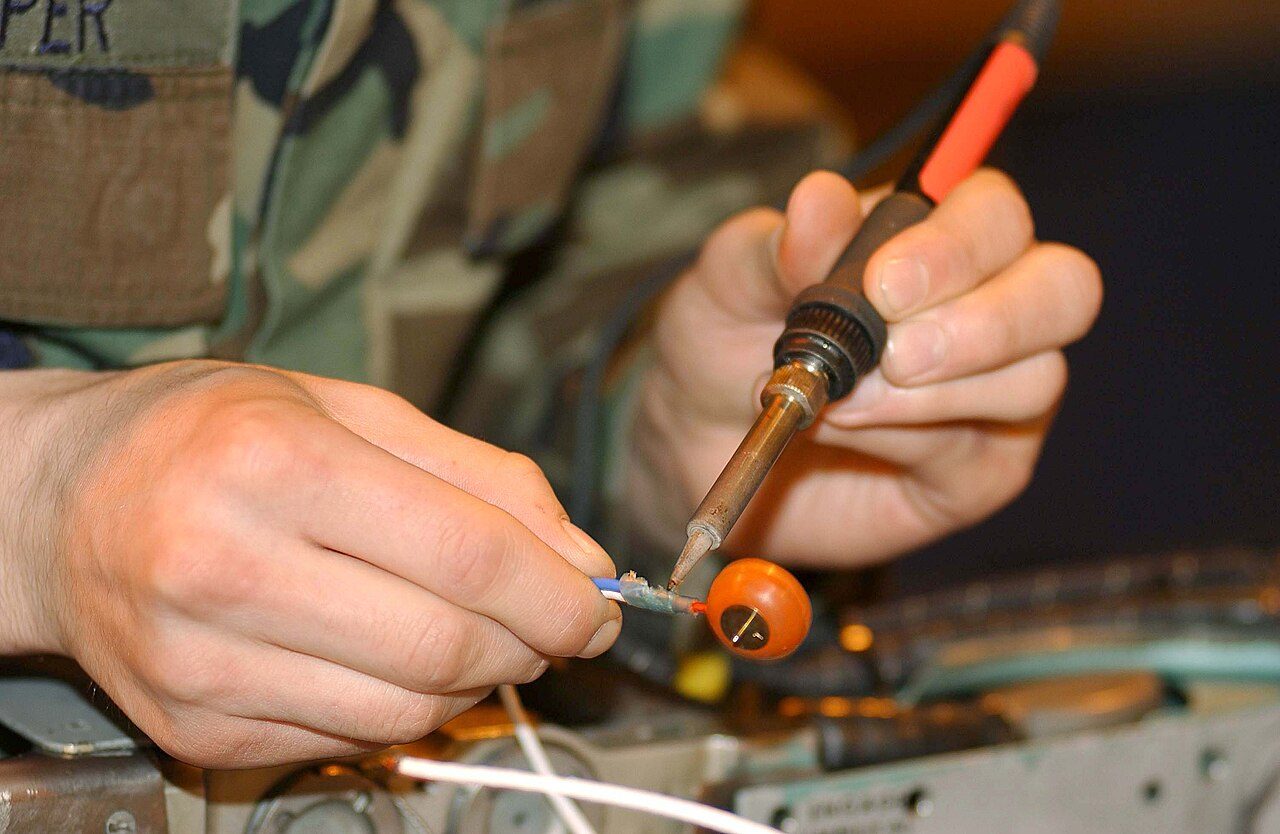
6 min read · 2 sourcesSoldering (US: ; UK: ) joins two metal surfaces using a filler metal called solder. The surfaces are heated, melting the solder, which is then allowed to cool and solidify, creating a strong and durable joint. Soldering is commonly used in the electronics industry for the manufacture and repair of printed circuit boards (PCBs) and other electronic components. It is also used in plumbing and metalwork, as well as in the manufacture of jewelry and other decorative items. Various alloys are used as solder, depending on the application. Common ones include tin-lead, tin-silver, and tin-copper. Lead-free solder has become more common because of the health and environmental dangers of lead. The temperature and method of heating play a crucial role in soldering. Different solders require different temperatures to melt, and heating must be carefully controlled to avoid damaging the materials being joined or creating weak joints. There are several methods of heating used in soldering, including soldering irons, torches, and hot air guns. Each method has its advantages and disadvantages, and the choice depends on the application and the materials being joined. Soldering is a skill used in many industries and hobbies, and requires a combination of technical knowledge and practical experience. 1
Origins
Soldering was apparently employed as early as 5,000 years ago in Mesopotamia. Soldering and brazing probably originated early in the history of metal-working, probably before 4000 BC. Sumerian swords from c. 3000 BC were assembled using hard soldering. Soldering was historically used to make jewelry, cookware and cooking tools, assembling stained glass, as well as other uses. 1
Applications
Soldering is used in plumbing, electronics, and metalwork from flashing to jewelry and musical instruments. Soldering provides reasonably permanent but reversible connections between copper pipes in plumbing systems as well as joints in sheet metal objects such as food cans, roof flashing, rain gutters and automobile radiators. Jewelry components, machine tools and some refrigeration and plumbing components are often assembled and repaired by the higher temperature silver soldering process. Small mechanical parts are often soldered or brazed as well. Soldering is also used to join lead came and copper foil in stained glass work. Electronic soldering connects electrical wiring to devices, and electronic components to printed circuit boards. Electronic connections may be hand-soldered with a soldering iron. Automated methods such as wave soldering or use of ovens can make many joints on a complex circuit board in one operation, vastly reducing production cost of electronic devices. Musical instruments, especially brass and woodwind instruments, use a combination of soldering and brazing in their assembly. Brass bodies are often soldered together, while keywork and braces are most often brazed. The USSR and Russian military used zinc coffins sealed with solder to transport the dead. 1
Solderability
The solderability of a substrate is a measure of the ease with which a soldered joint can be made to that material. Some metals are easier to solder than others. Copper, zinc, brass, silver and gold are easy. Iron, mild steel and nickel are next in difficulty. Because of their thin, strong oxide films, stainless steel and some aluminium alloys are even more difficult to solder. Titanium, magnesium, cast irons, some high-carbon steels, ceramics, and graphite can be soldered only with a process similar to joining carbides: they are first plated with a suitable metallic element that induces interfacial bonding. 1
Solders
Soldering filler materials are available in many different alloys for differing applications. In electronics assembly, the eutectic alloy with 63% tin and 37% lead (or 60/40, which is almost identical in melting point) has been the alloy of choice. Other alloys are used for plumbing, mechanical assembly, and other applications. Some examples of soft-solder are tin-lead for general purposes, tin-zinc for joining aluminium, lead-silver for strength at higher than room temperature, cadmium-silver for strength at high temperatures, zinc-aluminium for aluminium and corrosion resistance, and tin-silver and tin-bismuth for electronics. A eutectic formulation has advantages when applied to soldering: the liquidus and solidus temperatures are the same, so there is no plastic phase, and it has the lowest possible melting point. Having the lowest possible melting point minimizes heat stress on electronic components during soldering. And, having no plastic phase allows for quicker wetting as the solder heats up, and quicker setup as the solder cools. A non-eutectic formulation must remain still as the temperature drops through the liquidus and solidus temperatures. Any movement during the plastic phase may result in cracks, resulting in an unreliable joint. Common solder formulations based on tin and lead are listed below. The fraction represent percentage of tin first, then lead, totaling 100%: 1
63/37: melts at 183 °C (361 °F) (eutectic: the only mixture that melts at a point, instead of over a range) 60/40: melts between 183–190 °C (361–374 °F) 50/50: melts between 183–215 °C (361–419 °F) For environmental reasons and the introduction of regulations such as the European RoHS (Restriction of Hazardous Substances Directive), lead-free solders are becoming more widely used. 1
Soldering vs. brazing
There are three forms of soldering, each requiring progressively higher temperatures and producing an increasingly stronger joint strength: 1
soft soldering, which originally used a tin-lead alloy as the filler metal silver soldering, which uses an alloy containing silver brazing which uses a brass alloy for the filler The alloy of the filler metal for each type of soldering can be adjusted to modify the melting temperature of the filler. Soldering differs significantly from gluing in that the filler metals directly bond with the surfaces of the workpieces at the junction to form a bond that is both electrically conductive and gas- and liquid-tight. Soft soldering is characterized by having a melting point of the filler metal below approximately 400 °C (752 °F), whereas silver soldering and brazing use higher temperatures, typically requiring a flame or carbon arc torch to achieve the melting of the filler. Soft solder filler metals are typically alloys (often containing lead) that have liquidus temperatures below 350 °C (662 °F). In this soldering process, heat is applied to the parts to be joined, causing the solder to melt and to bond to the workpieces in a surface alloying process called wetting. In stranded wire, the solder is drawn up into the wire between the strands by capillary action in a process called 'wicking'. Capillary action also takes place when the workpieces are very close together or touching. 1
The text above is adapted from the Wikipedia article “Soldering”, available under the Creative Commons Attribution-ShareAlike 4.0 licence. 1
soldering or brazing is process of joining metal pieces with heated filler metal, according to the structured record cited below. This entry was generated automatically from that record and has not yet been reviewed by a person familiar with the tradition. 2
The source record links this tradition to 28 external registers, which can be verified through the citation. 2