The tradition & historical record
6 min read · 2 sourcesSongket or sungkit is a tenun fabric that belongs to the brocade family of textiles of Brunei, Indonesia, and Malaysia. It is hand-woven in silk or cotton, and intricately patterned with gold or silver threads. The metallic threads stand out against the background cloth to create a shimmering effect. In the weaving process the metallic threads are inserted in between the silk or cotton weft (latitudinal) threads in a technique called supplementary weft weaving technique. Songket is often associated with the Srivijaya Empire as the origin of the songket tradition, several types of popular Songket can not be separated from locations that were once under Srivijaya rule, one of the dominant locations which is also believed to be the capital of the Srivijaya Empire in the past, namely Palembang, which located in South Sumatra, Indonesia. Besides Palembang, several areas in Sumatra are also the best-in-class Songket producing locations, which include areas in Minangkabau or West Sumatra such as Pandai Sikek, Silungkang, Koto Gadang, and Padang. 1
Etymology
The term songket derived from the Malay word of sungkit, which means "to hook". It is referred to the method of songket making; to hook and pick a group of threads, and then slip the gold and silver threads in it. Another theory suggested that it was constructed from the combination of two terms, tusuk (prick) and cukit (pick), that combined as sukit, modified further as sukit and finally songket. The Malay word menyongket means ‘to embroider with gold or silver threads’. Songket is a luxury product traditionally worn during ceremonial occasions as sarong, shoulder cloths or head ties and tanjak, a headdress songket. Songket were worn at the courts of Kingdoms in Sumatra especially the Srivijaya, as the source and the origin of Malay culture in Southeast Asia. In the early kingdom age, Songkets are also traditionally worn as an apparel by the Malay royal families in Sumatra such as the Deli Sultanate in Medan, Serdang Sultanate, Palembang Sultanate in Palembang and the recently restored royal house in Jambi and sultanates in Malay Peninsula such as Pattani, Kelantan and Terengganu. The fabric is even mandated as part of the ceremonial court dress of Bruneian royalty since the time of Omar Ali Saifuddien III. Traditionally women are the weavers of songket, however in this modern time men also are known to weave it as well. Songket is known in many names in vernacular Indonesian languages. Other than in Sumatra and Malay peninsula, it is also commonly known as songket/tenun cag cag in Bali. While it is known as songke in Manggarai, Flores, and Bima in Sumbawa. The Karo Batak of North Sumatra, call it jongkit. 1
History
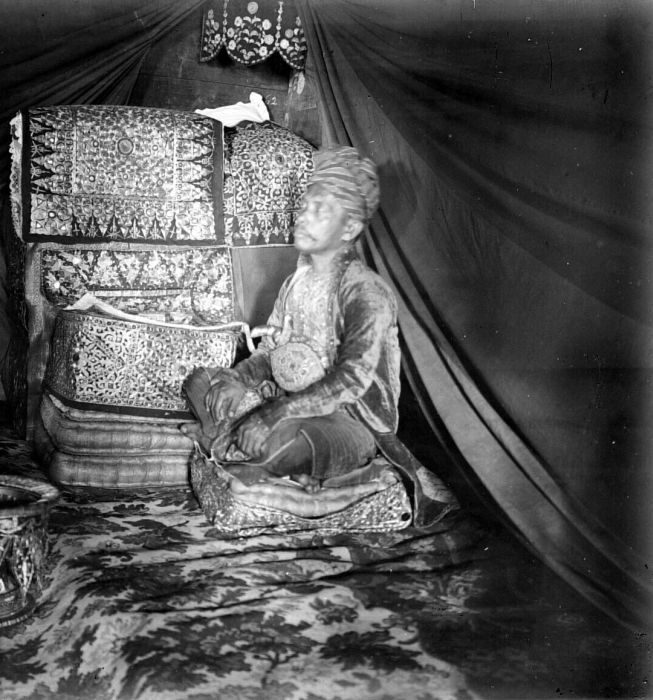
Songket weaving traditions at first, historically associated with Srivijaya empire, a wealthy 7th to 13th-century maritime trading empire based on Sumatra. Palembang and Minangkabau Pandai Sikek area are the best and the most famous songket producers in Indonesia. According to a Palembang folk tradition that has been narrated for generations, the origin of songket came from the Chinese traders who brought silk threads, while the Indian or Middle Eastern traders brought gold threads. Subsequently, the woven combination has become the exquisitely shimmering golden songket. It associated with areas of Malay settlement in Sumatra, and the production techniques could have been introduced by Indian or Arab merchants. Songket is a luxurious textile that required some amount of real gold leaves and gold threads to be hand-woven into exquisite fabrics, surely it has become a symbol of luxury and social status. Historically the gold mines are located in Sumatra hinterland; Jambi and Minangkabau Highlands. Although gold threads were found buried in the Srivijaya ruins in Sumatra, along with unpolished rubies and pieces of gold plate, there is no corroborating evidence that the local weavers used gold threads as early as 7th century to early 8th century. Based on archaeological data, it can be seen that songket has been known by the people of South Sumatra between the 8th to the 9th century CE, as seen in ancient statues cloths motifs from the site of the Bumiayu temple complex in Penukal Abab Lematang Ilir Regency, South Sumatra Province, Indonesia. At that time the use of songket was reserved only for the nobility, as seen from the statues which were probably the deified personification of a king. 1
Tradition
Songket is traditionally considered an exquisite, luxurious and prestigious traditional fabric, only worn for special occasions, religious festivals, and traditional social functions. It has become a required garment for brides and grooms for their weddings, as in the traditional wedding costumes of Palembangese, Minangkabau and Balinese people. In Indonesian tradition, songket has become a marker of social status. Traditionally a certain songket motif is reserved for particular social status. For example in Palembang songket tradition, the lepus motifs were originally reserved only for bangsawan (royalty, nobles or aristocrats). Songket is indeed employed as a social marker of the wearer, even as far as to inform the marital status of the wearer. In old Palembang, widows wore outstanding selendang (shoulder cloth) songket to disclose their social and marital status. There are two kinds of specific songket motifs for widows; those for widows eligible for remarriage is called songket janda berias (dress up widow songket), and those for widow brides is called songket janda pengantin (widow bride songket). Today, songket are usually made from affordable materials, such as using artificial gold threads made of nylon instead of pure gold threads. Nevertheless, there are few rare songket actually made from real gold threads. These are precious textiles that are held as pusaka or heirloom passed down for generations within a family. 1
Today, songket is mostly worn in traditional settings as traditional costumes for weddings or any traditional ceremonies. Several efforts have been conducted to promote songket as a popular fabric for fashion locally and abroad. During the Dutch colonial era, West Sumatran songket were exhibited in the Netherlands. 1
Songket Minangkabau
Songket Minangkabau is a traditional songket woven cloth from West Sumatra that is an important part of cultural identity in the Minangkabau tradition. Songket is closely related to the Minangkabau community because it has been widely used as a material for traditional clothing and other traditional core crafts. There are various types of Minangkabau songket motifs and philosophies, each motif passed down from generation to generation for use in the Pepatih custom. The history of the Songket Minangkabau itself comes from the Srivijaya which was then developed through the Sumatran kingdom until it finally entered the Minang realm. 1
Equipments and materials
There are two categories of songket weaving equipment; the main weaving equipment made from wooden or bamboo frame; and the supporting equipment which includes a thread stretching tool, a moti… 1
The text above is adapted from the Wikipedia article “Songket”, available under the Creative Commons Attribution-ShareAlike 4.0 licence. 1
songket is traditional Malay woven fabric figured with colored or metallic supplemental wefts, originally from Malay region, according to the structured record cited below. This entry was generated automatically from that record and has not yet been reviewed by a person familiar with the tradition. 2
The source record links this tradition to 1 external register, which can be verified through the citation. 2