The tradition & historical record
4 min read · 2 sourcesThe Sonobe module is one of the many units used to build modular origami. The popularity of Sonobe modular origami models derives from the simplicity of folding the modules, the sturdy and easy assembly, and the flexibility of the system. 1
History
The origin of the Sonobe module is unknown. Two possible creators are Toshie Takahama (Japanese: 高浜利恵) and Mitsunobu Sonobe (Japanese: 薗部光伸), who published several books together and were both members of Sōsaku Origami Gurūpu '67 (Japanese: 創作折り紙グループ'67). The earliest appearance of a Sonobe module was in a cube attributed to Mitsunobu Sonobe in the Sōsaku Origami Gurūpu '67's magazine Origami in Issue 2 (1968). It does not reveal whether he invented the module or used an earlier design; the phrase "finished model by Mitsunobu Sonobe" is ambiguous. The diagram from Issue 2 reappears in 1970 in the group's book New Introduction to Origami (Japanese: 新しい折り紙入門, Hepburn: Atarashii origami nyūmon). Another 1970s appearance of the unit was in the model "Toshie's Jewel", from Toshie Takahama's book Creative Life With Creative Origami Vol 1 (Japanese: 暮しをかざるおりがみ). In the mid-1970s, Steve Krimball created the 30-unit ball, as mentioned in The Origamian vol. 13, no. 3 June 1976. Since then, many variations of modified Sonobe units have been developed; some examples of these can be found in Meenakshi Mukerji's book Marvelous Modular Origami (2007). Another variation of Sonobe models is the addition of secondary units to basic Sonobe unit forms to create new geometric shapes; some of which can be seen in Tomoko Fuse's book Unit Origami: Multidimensional Transformations (1990). 1
Description
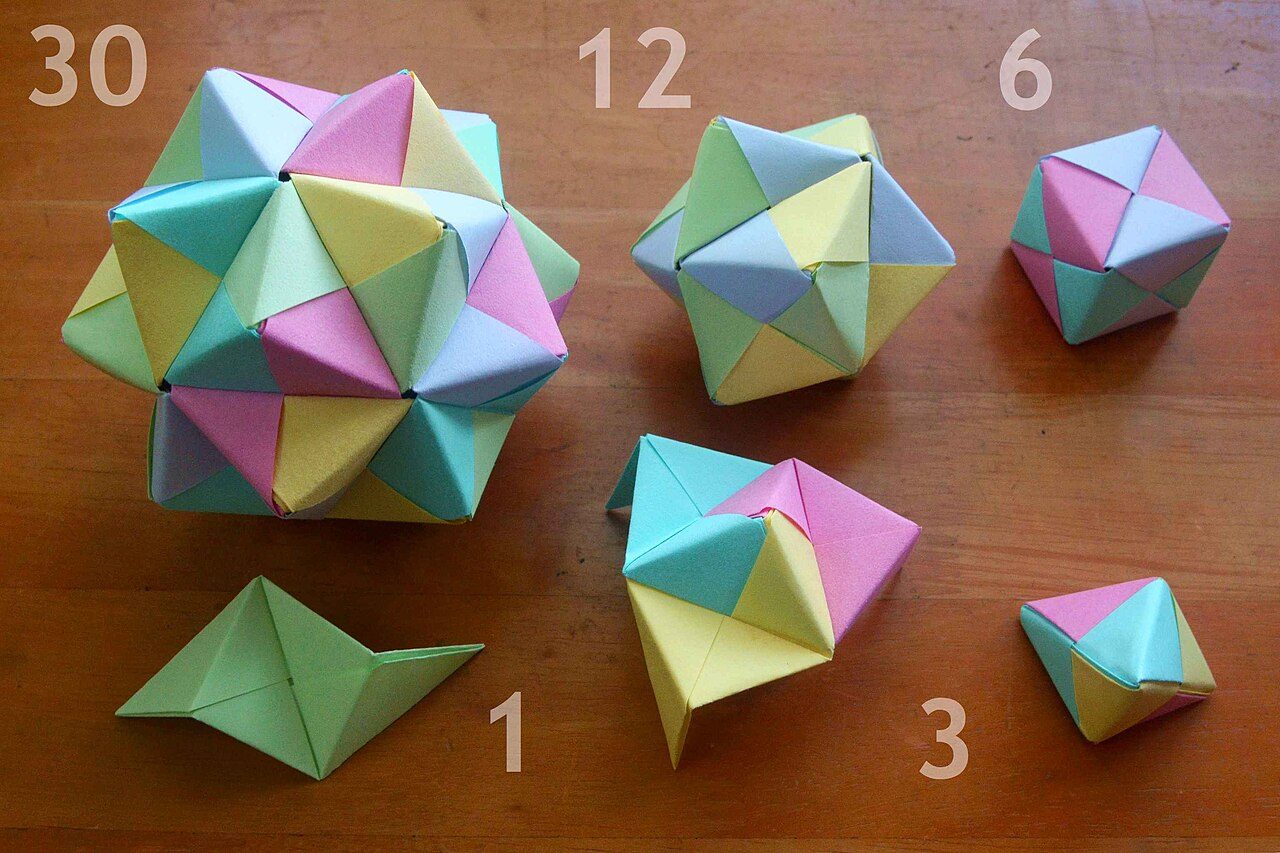
Each individual unit is folded from a square sheet of paper, of which only one face is visible in the finished module; many ornamented variants of the plain Sonobe unit that expose both sides of the paper have been designed. The Sonobe unit has the shape of a parallelogram with 45º and 135º angles, divided by creases into two diagonal tabs at the ends and two corresponding pockets within the inscribed center square. The system can build a wide range of three-dimensional geometric forms by docking these tabs into the pockets of adjacent units. Three interconnected Sonobe units will form an open-bottomed triangular pyramid with an equilateral triangle for the open bottom, and isosceles right triangles as the other three faces. It will have a right-angle apex (equivalent to the corner of a cube) and three tab/pocket flaps protruding from the base. This particularly suits polyhedra that have equilateral triangular faces: Sonobe modules can replace each notional edge of the original deltahedron by the central diagonal fold of one unit and each equilateral triangle with a right-angle pyramid consisting of one half each of three units, without dangling flaps. The pyramids can be made to point inwards; assembly is more difficult but some cases of encroaching can be obviously prevented. The simplest shape made of these pyramids, often called "Toshie's Jewel" (shown above), is named after origami artist Toshie Takahama, who first printed a diagram of this in her 1974 book Creative Life with Creative Origami. 1
Usage
The table below shows the correlation between three basic characteristics – faces, edges, and vertices – of polygons (composed of Toshie's Jewel sub-units) of varying size and the number of Sonobe units used: 1
The model made of three units results in a triangular bipyramid. Building a pyramid on each face of a regular tetrahedron, using six units, results in a cube (the central fold of each module lays flat, creating square faces instead of isosceles right triangular faces, and changing the formula for the number of faces, edges, and vertices), or triakis tetrahedron. Building a pyramid on each face of a regular octahedron, using twelve Sonobe units, results in a triakis octahedron. Building a pyramid on each face of a regular icosahedron requires 30 units, and results in a triakis icosahedron. Uniform polyhedra can be adapted to Sonobe modules by replacing non-triangular faces with pyramids having equilateral faces; for example by adding pentagonal pyramids pointing inwards to the faces of a dodecahedron a 90-module ball can be obtained. The 270-module ball looks like a very complicated shape, but it is just an icosahedron with each triangular face divided into 9 small triangles. 1
The text above is adapted from the Wikipedia article “Sonobe”, available under the Creative Commons Attribution-ShareAlike 4.0 licence. 1
Sonobe is units used to build modular origami, according to the structured record cited below. This entry was generated automatically from that record and has not yet been reviewed by a person familiar with the tradition. 2