The tradition & historical record
4 min read · 2 sourcesThe art produced in Southeast Asia includes the art from eleven countries that form Southeast Asia. The cultural development of the area was historically dominated by Indian influence, though several cohesive traits exist before Indian influence. The art is inspired by many countries. Crafts based on traditional artisanal practices are also an important component of art in these countries. These crafts, including textiles, ceramics, basketry, and metalwork, reflect local traditions, materials, and cultural influences from Indian, Chinese, and Islamic civilizations. Crafts in Southeast Asia are characterized by the use of local materials like bamboo, rattan, silk, and clay, with techniques honed over centuries. These practices are often tied to cultural rituals, economic activities, and community identity, distinguishing them from broader artistic traditions like dance or architecture. 1
Inspiration
Art culture in Southeast Asia is usually inherited from the art produced in China of East Asia and India of South Asia. Some of the art culture was changed after being invaded by other colonies, such as Dutch East Indies in Indonesia. 1
Brunei
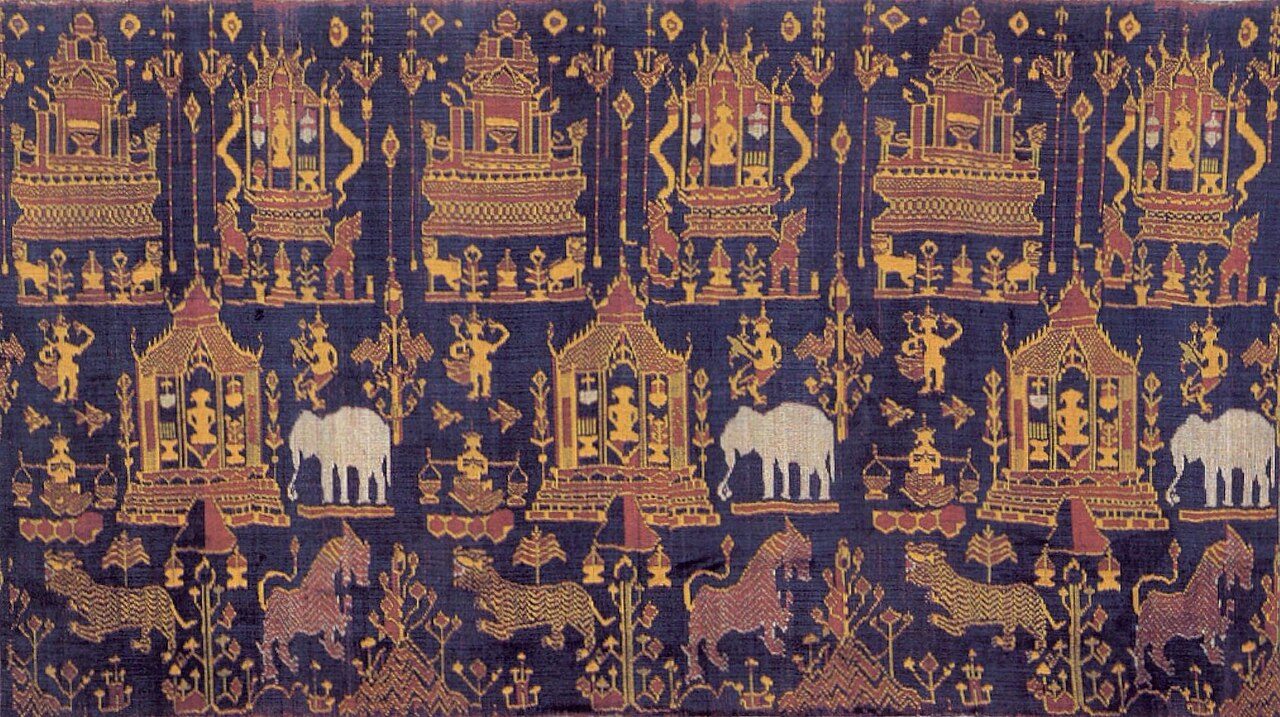
Art in Brunei was not a focus until the early 1950s, Brunei's government then took a stand to support culture. They created a building for artists to sell their works. In 1984, the art market had grown enough that it had to move to a larger space. Weaving skills have been passed across generations. Brunei produces fabric for making gowns and sarongs. "The weaving and decoration of cloth as well as wearing, display, and exchange of it, has been an important part of Bruneian culture for years (Orr 96)." Weaving became significant in the 15th century. Antonio Pigafetta visited Brunei during his travels and observed how the clothes were made. One example was a Jongsarat, a handmade garment used for weddings and special occasions. It typically includes a hint of silver and gold. It can be used for wall coverings. 1
Cambodia
The history of Cambodian art stretches back centuries to ancient times, but the most famous period is undoubtedly the Khmer art of the Khmer Empire (802–1431), especially in the area around Angkor and the mainly 12th-century temple-complex of Angkor Wat, initially Hindu and subsequently Buddhist. Beginning in the mid-20th century, a tradition of modern art began in Cambodia, though in the later 20th century both traditional and modern arts declined for several reasons, including the killing of artists by the Khmer Rouge. 1
East Timor
Art in East Timor began to popularize since the violence during the 2006 East Timorese crisis. Children living in the country began graffiting walls into peace murals. The East Timor Arts Society promotes the art in the area, and house many different artworks produced in the country. 1
Indonesia
Indonesian art and culture has been shaped by long interactions between original indigenous customs and multiple foreign influences. Indonesia is central along ancient trading routes between the Far East and the Middle East, resulting in many cultural practices being strongly influenced by a multitude of religions, including Hinduism, Buddhism, Confucianism and Islam, all strong in the major trading cities. The result is a complex cultural mixture very different from the original indigenous cultures. Indonesian art may include, for example, prehistoric cave paintings and megalithic ancestral statues of Central Sulawesi, tribal wooden carving traditions of Toraja and Asmat people, Hindu-Buddhist art of classical Javanese civilization which produced Borobudur and Prambanan, vivid Balinese paintings and performing arts, Islamic arts of Aceh, to the contemporary art of Indonesian artists today. Also of note are Balinese paintings, which often express natural scenes and themes from the traditional dances. Such Balinese art is art of Hindu-Javanese origin that grew from the work of artisans of the Majapahit Kingdom, with their expansion to Bali in the late 13th century. From the 16th until the 20th centuries, the village of Kamasan, Klungkung (East Bali), was the centre of classical Balinese art. During the first part of the 20th century, new varieties of Balinese art developed. Since the late twentieth century, Ubud and its neighboring villages established a reputation as the center of Balinese art. Eiseman observes that Balinese art is actually carved, painted, woven, and prepared into objects intended for everyday use rather than as object d 'art. 1
The text above is adapted from the Wikipedia article “Southeast Asian arts”, available under the Creative Commons Attribution-ShareAlike 4.0 licence. 1
Southeast Asian arts is art from Southeast Asian countries and cultures, according to the structured record cited below. This entry was generated automatically from that record and has not yet been reviewed by a person familiar with the tradition. 2
The source record links this tradition to 2 external registers, which can be verified through the citation. 2