The tradition & historical record
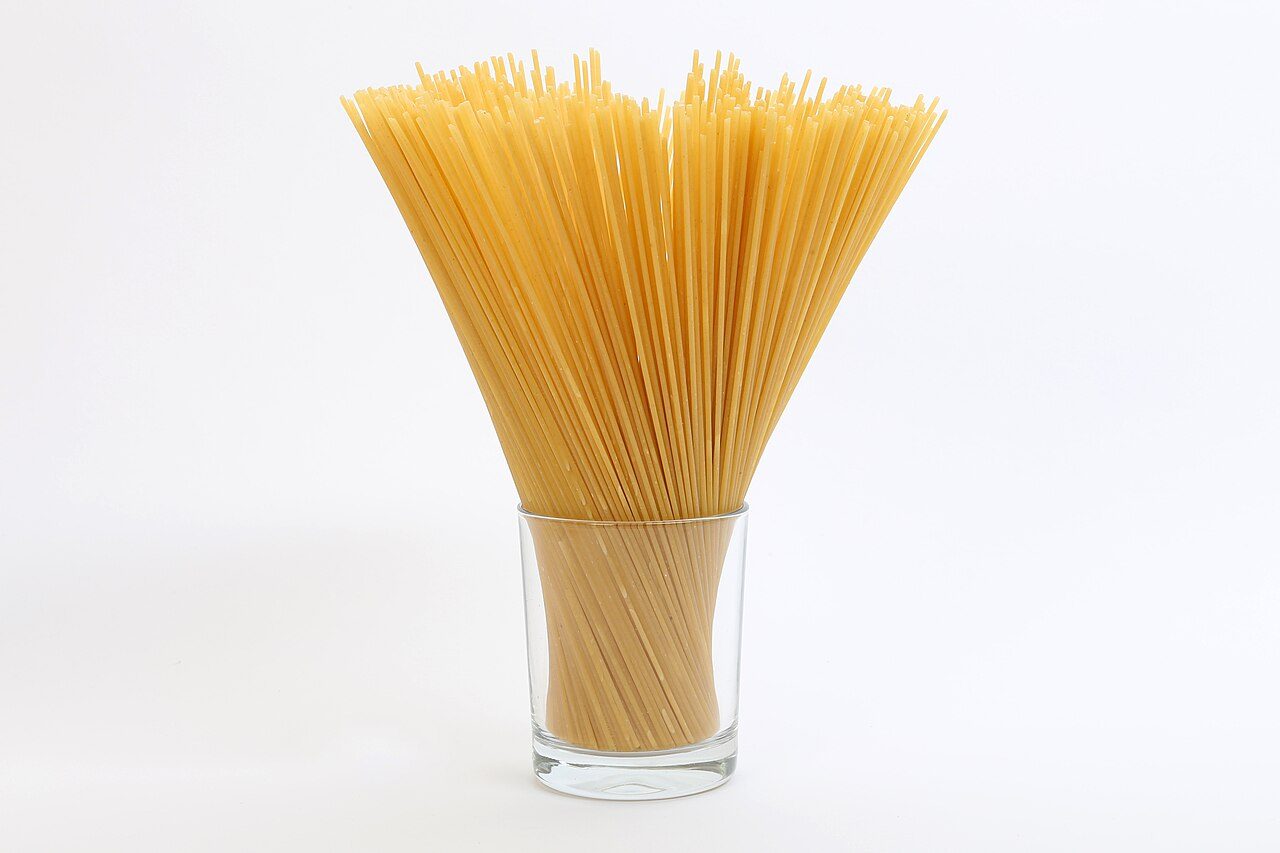
6 min read · 2 sourcesSpaghetti (Italian: [spaˈɡetti] 'little strings' plural diminutive of spago 'string'; similarly spaghetto is a single strand) is a long, thin, solid, cylindrical pasta. It serves as a staple food of Italian cuisine and is made of milled wheat and water (sometimes enriched with vitamins and minerals), with the standard Italian version using durum-wheat semolina. The pasta is usually white because refined flour is used, but whole wheat flour may be added. Spaghettoni is a thicker form of spaghetti, while spaghettini is a thinner form. Capellini is a very thin spaghetti, while vermicelli is intermediate. 1
Originally, spaghetti was notably long, but shorter lengths gained popularity during the second half of the 20th century. Today, it is most commonly available in lengths of 25–30 cm (10–12 in). Various pasta dishes are based on it, and it is frequently served with tomato sauce, meat or vegetables. 1
Early
Spaghetti originated from an ancient, thin, and generally unleavened Middle Eastern bread, known as lakhsha in the Persian Sasanian Empire. Bakers flattened the dough by hand or with a rolling pin, and occasionally dried for preservation. Under the Sasanian Empire, it took on the name rishta when cut into strips or strings before drying —a term possibly derived from the Iranian word risnatu, for which records of use exist as far back as the 2nd millennium BC. While pasta-drying traditions developed in Persia, pasta that was introduced from the Middle East was also consumed in ancient in Roman and Greek societies. In Greece and Rome, the dough was frequently dried into long, stretched shapes. In the 7th century, Arabs conquered Persia, and thereafter spread the dried pasta custom throughout the lands they occupied, which included Sicily from the 9th century. There, the dried pasta practice became associated with the European traditions of making fresh pasta, and the name itriyya entered the language, meaning "long-form dried pasta". The very first recorded appearance of this new type of thin, dried pasta occurred in Trabia, near Palermo, as documented by the geographer Al-Idrisi. 1
Arrival in the Italian peninsula
By the mid-12th century, records exist of several farms in Sicily producing itriyya at scale for local and export markets. Over the following centuries, this pasta appeared in Italian cookbooks, albeit infrequently. A precise description of the manufacture of "Sicilian macaroni" is given by Martino da Como in the late-15th century: a ball of dough, stretched thin, cut with a wire as "thin as spagho (string)", dried under the sun. The duration of this drying process varied with weather and humidity, but twelve days in the summer was typical. In another recipe for a Genoese pasta, Martino employs spagho for the first time in a culinary context when he says pasta ought to be cut "as thin as a spagho". Several tools were employed for this cutting process, including chitarra in areas of southern Italy, which consisted of a wooden frame strung with wires, lowered onto the dough. Pasta at this time was cooked for much longer than it is today; Martino recommends his Sicilian macaroni be boiled in water for two hours to achieve a desired, very soft texture. Contemporary ideas of how this pasta should be served were based on the ideas of physicians, who followed Hippocrates and Galen's principle of contraria contrariis curantur ('opposites cure opposites'). For a very soft pasta, this meant expensive accompaniments of dried spices and pepper. Cheese, particularly the drier, aged varieties, was another common pairing for the same reason, the most popular for the task by the mid-15th century being pecorino and parmigiano. 1
Later
In the 17th century, the region associated with pasta expanded from Sicily to Naples. Initially, Sicilians were depicted as 'macaroni eaters' and Neapolitans as 'leaf eaters' due to their vegetable-heavy diet; later, Neapolitans were also called 'macaroni eaters'. Around 1630, Naples under Spanish rule was experiencing famines with a reduced supply of meat and vegetables due to poor governance. As technology permitting industrial mixing and extrusion dramatically reduced prices of output, pasta became a staple food, no longer the domain of the elite. It is in this century that short cook times and firmer pasta textures emerged, although at first only for fresh pasta; it took until the mid-19th century in Naples for records of cooks taking a short cook time and firm texture for granted. Around this time, pairing tomato sauces with pastas was becoming established among the Naples populace, the first records of the combination having appeared at the end of the previous century. Grated cheese remained an essential element in preparations, although unlike in modern servings, sauces were served over grated cheese. It was not until the 20th century that the inverse became established. By the 1920s, food writer Waverley Root could witness scenes in Naples of "home-made macaroni hung out to dry like the family washing—at the mercy of dust, dirt, insects and the depredations of passing pigeons, children and dogs". By 1955, annual consumption of spaghetti in Italy doubled from 14 kg (31 lb) per person before World War II to 28 kg (62 lb). In that year, Italy produced almost 1.5 million tons of spaghetti, of which approximately 5% was exported. 1
Marco Polo story
Through the end of the 13th century, the Venetian merchant and adventurer Marco Polo travelled into Asia, detailing his expedition in The Travels of Marco Polo. Two centuries later, the geographer Giovanni Battista Ramusio read Polo's accounts in preparation for a new edition. In one of his stories, Polo told of the preparations made by the people of Sumatra with sago flour, likening them to the pastas and lasagnas he was familiar with in Italy, and described how he brought back samples to Venice. Misunderstanding this, in his 1559 publication Ramusio conveyed that Marco Polo had discovered pasta in China and brought it to Italy. This legend persisted, and was developed further in a 1929 article in the American industry newsletter the Macaroni Journal, where the author credited the invention of spaghetti to a member of Polo's crew named Spaghetti. In the story, Spaghetti made landfall in China in search of water. On shore, he encountered a farm woman stirring a batter that hardened in the hot, dry climate. Realising this would store well on long voyages, Spaghetti returned to the boat with some batter, kneaded it, formed it into long strips, and cooked it in the salty seawater. 1
Production
Spaghetti is made from ground grain (flour) and water. Whole wheat and multigrain spaghetti are also sold. Most spaghetti is produced in factories using auger extruders. As the ingredients are mixed and kneaded, attention is paid to prevent air bubbles and ensure a homogenous mix. The forming dies are water-cooled to prevent overheating and spoiling the pasta. 1
The text above is adapted from the Wikipedia article “Spaghetti”, available under the Creative Commons Attribution-ShareAlike 4.0 licence. 1
spaghetti is long, thin, solid, cylindrical pasta, according to the structured record cited below. This entry was generated automatically from that record and has not yet been reviewed by a person familiar with the tradition. 2
The source record links this tradition to 35 external registers, which can be verified through the citation. 2