The tradition & historical record
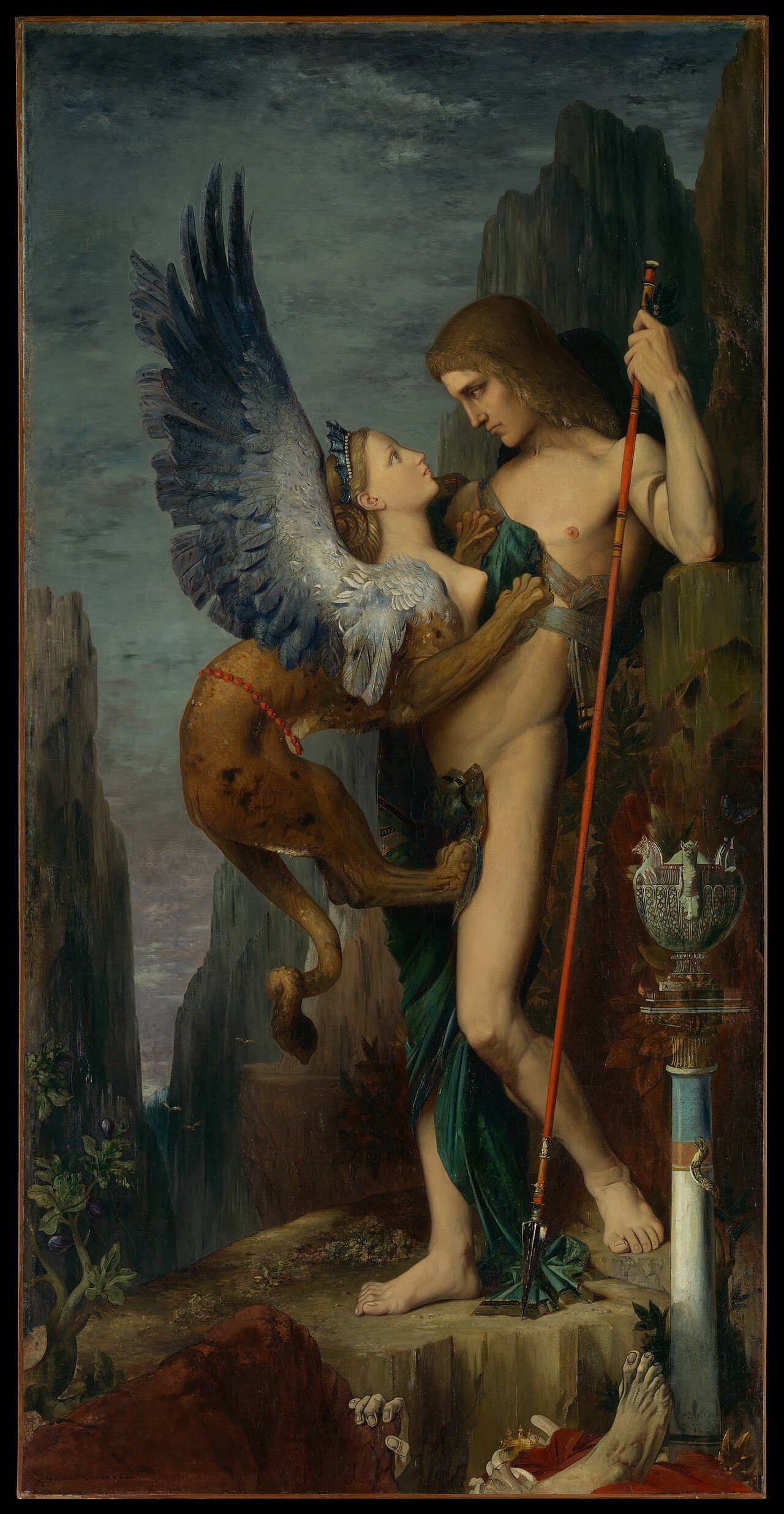
6 min read · 2 sourcesA sphinx ( SFINKS; Ancient Greek: σφίγξ, pronounced [spʰíŋks]; pl. sphinxes or sphinges ) is a mythical creature with the head of a human, the body of a lion, and the wings of an eagle. In Greek tradition, the sphinx is a treacherous and merciless being with the head of a woman, the haunches of a lion, and the wings of a bird. According to Greek myth, she challenges those who encounter her to answer a riddle, and kills and eats them when they fail to solve the riddle. This deadly version of a sphinx appears in the myth and drama of Oedipus. In Egyptian mythology, in contrast, the sphinx is typically depicted as a man (an androsphinx (Ancient Greek: ἀνδρόσφιγξ)), and is seen as a benevolent representation of strength and ferocity, usually of a pharaoh. Unlike Greek or Levantine/Mesopotamian ones, Egyptian sphinxes were not winged. Both the Greek and Egyptian sphinxes were thought of as guardians, and statues of them often flank the entrances to temples. During the Renaissance, the sphinx enjoyed a major revival in European decorative art. 1
Etymology
The word sphinx comes from the Greek Σφίγξ, associated by folk etymology with the verb σφίγγω (sphíngō), meaning "to squeeze", "to tighten up". This name may be derived from the fact that lions kill their prey by strangulation, biting the throat of prey and holding them down until they die. However, the historian Susan Wise Bauer suggests that the word "sphinx" was instead a Greek corruption of the Egyptian name "shesepankh", which meant "living image", and referred rather to the statue of the sphinx, which was carved out of "living rock" (rock that was a contiguous part of the stony body of the Earth, shaped, but not cut away from its original source), than to the beast itself. 1
Egypt
The largest and most famous sphinx is the Great Sphinx of Giza, situated on the Giza Plateau adjacent to the Great Pyramids of Giza on the west bank of the Nile River and facing east (29°58′31″N 31°08′15″E). The sphinx is located southeast of the pyramids. While the date of its construction is not known for certain, the consensus among Egyptologists is that the head of the Great Sphinx bears the likeness of the pharaoh Khafre, dating it to between 2600 and 2500 BC. However, a fringe minority of late 20th century geologists have claimed evidence of water erosion in and around the Sphinx enclosure which would prove that the Sphinx predates Khafre, at around 10,000 to 5000 BC, a claim that is sometimes referred to as the Sphinx water erosion hypothesis but which has little support among Egyptologists and contradicts other evidence. What names their builders gave to these statues is unknown. At the Great Sphinx site, a 1400 BC inscription on a stele belonging to the 18th dynasty pharaoh Thutmose IV lists the names of three aspects of the local sun deity of that period, Khepera–Rê–Atum. Many pharaohs had their heads carved atop the guardian statues for their tombs to show their close relationship with the powerful solar deity Sekhmet, a lioness. Besides the Great Sphinx, other famous Egyptian sphinxes include one bearing the head of the pharaoh Hatshepsut, with her likeness carved in granite, which is now in the Metropolitan Museum of Art in New York, and the alabaster Sphinx of Memphis, currently located within the open-air museum at that site. The theme was expanded to form great avenues of guardian sphinxes lining the approaches to tombs and temples as well as serving as details atop the posts of flights of stairs to very grand complexes. 1
Europe
The revived Mannerist sphinx of the late 15th century is sometimes thought of as the "French sphinx". Her coiffed head is erect and she has the breasts of a young woman. Often she wears ear drops and pearls as ornaments. Her body is naturalistically rendered as a recumbent lioness. Such sphinxes were revived when the grottesche or "grotesque" decorations of the unearthed Domus Aurea of Nero were brought to light in late 15th-century Rome, and she was incorporated into the classical vocabulary of arabesque designs that spread throughout Europe in engravings during the 16th and 17th centuries. Sphinxes were included in the decoration of the loggia of the Vatican Palace by the workshop of Raphael (1515–20), which updated the vocabulary of the Roman grottesche. The first appearances of sphinxes in French art are in the School of Fontainebleau in the 1520s and 1530s and she continues into the Late Baroque style of the French Régence (1715–1723). From France, she spread throughout Europe, becoming a regular feature of the outdoors decorative sculpture of 18th-century palace gardens, as in the Upper Belvedere Palace in Vienna, Sanssouci Park in Potsdam, La Granja in Spain, Branicki Palace in Białystok, or the late Rococo examples in the grounds of the Portuguese Queluz National Palace (of perhaps the 1760s), with ruffs and clothed chests ending with a little cape. 1
Sphinxes are a feature of the neoclassical interior decorations of Robert Adam and his followers, returning closer to the undressed style of the grottesche. They had an equal appeal to artists and designers of the Romanticism and subsequent Symbolism movements in the 19th century. 1
Greece
In the Bronze Age, the Hellenes had trade and cultural contacts with Egypt. Before the time that Alexander the Great occupied Egypt, the Greek name, sphinx, was already applied to these statues. The historians and geographers of Greece such as Herodotus wrote extensively about Egyptian culture. There was a single sphinx in Greek mythology, a unique demon of destruction and bad luck. Apollodorus describes the sphinx as having a woman's face, the body and tail of a lion and the wings of a bird. Pliny the Elder mentions that Ethiopia produces plenty of sphinxes, with brown hair and breasts, corroborated by 20th-century archeologists. Statius describes her as a winged monster, with pallid cheeks, eyes tainted with corruption, plumes clotted with gore and talons on livid hands. John Tzetzes described her as having the front of a lion, the rear of a human, the wings of a griffin and the claws of an eagle. Sometimes, the wings are specified to be those of an eagle, and the tail to be serpent-headed. According to Hesiod, the Sphinx was a daughter of Orthrus and an unknown she—either the Chimera, Echidna, or Ceto. According to Apollodorus and Lasus, she was a daughter of Echidna and Typhon. The sphinx was the emblem of the ancient city-state of Chios, and appeared on seals and the obverse side of coins from the 6th century BC until the 3rd century AD. 1
Riddle of the Sphinx
The Sphinx is said to have guarded the entrance to the Greek city of Thebes, asking a riddle to travellers to allow them passage. 1
The text above is adapted from the Wikipedia article “Sphinx”, available under the Creative Commons Attribution-ShareAlike 4.0 licence. 1
sphinx is mythological creature with the head of a human and the body of a lion, according to the structured record cited below. This entry was generated automatically from that record and has not yet been reviewed by a person familiar with the tradition. 2
The source record links this tradition to 47 external registers, which can be verified through the citation. 2