The tradition & historical record
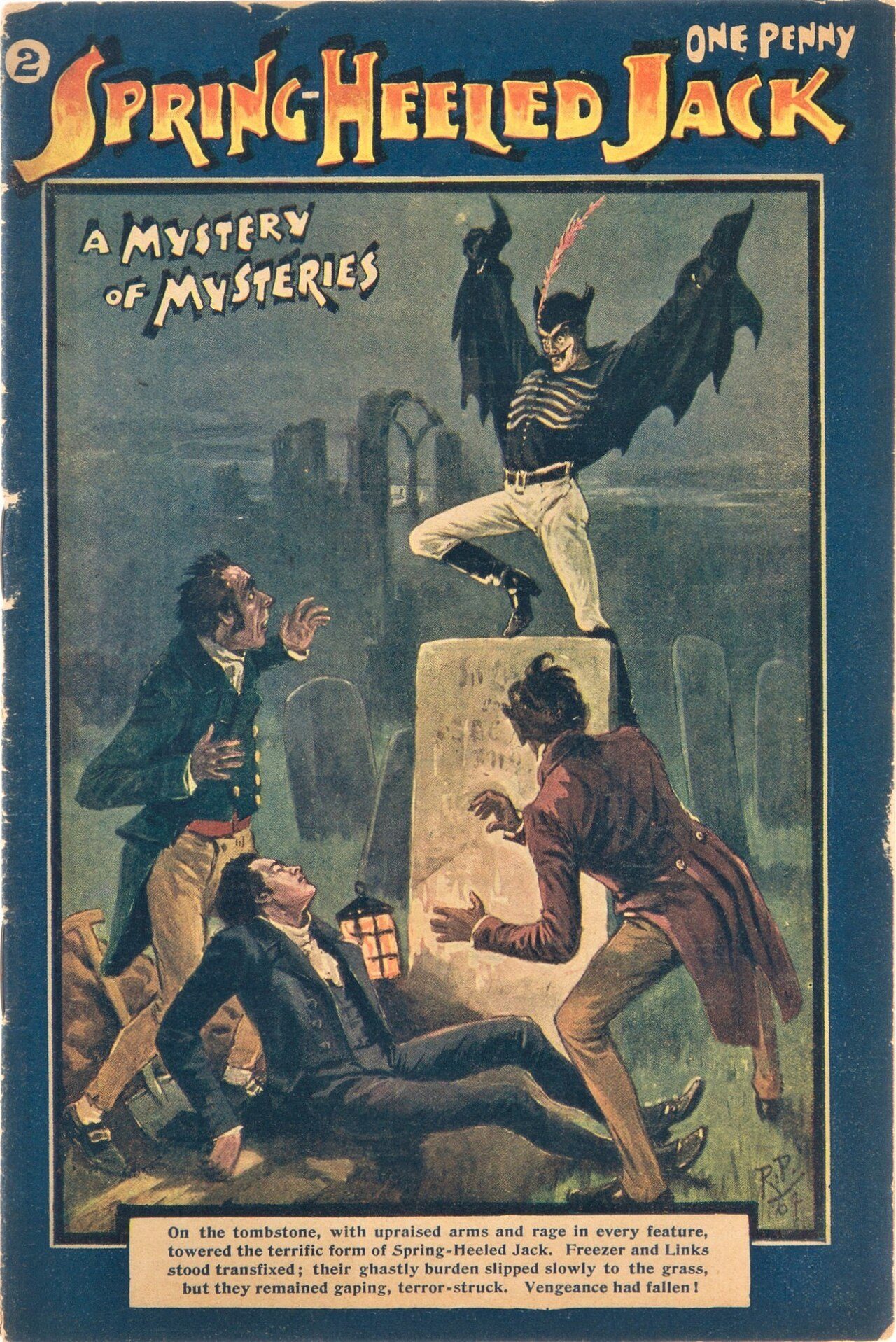
6 min read · 2 sourcesSpring-heeled Jack was an entity in English folklore of the Victorian era. The first claimed sighting of Spring-heeled Jack was in 1837. Later sightings were reported all over the United Kingdom and were especially prevalent in suburban London, the Midlands and Scotland. There are many theories about the nature and identity of Spring-heeled Jack. This urban legend was very popular in its time, due to the tales of his bizarre appearance and ability to make extraordinary leaps, to the point that he became the topic of several works of fiction. Spring-heeled Jack was described by people who claimed to have seen him as having a terrifying and frightful appearance, with diabolical physiognomy, clawed hands, and eyes that "resembled red balls of fire". One report claimed that, beneath a black cloak, he wore a helmet and a tight-fitting white garment like an oilskin. Many stories also mention a "devil-like" aspect. Others said he was tall and thin, with the appearance of a gentleman. Several reports mention that he could breathe out blue and white flames and that he wore sharp metallic claws at his fingertips. At least two people claimed that he was able to speak comprehensible English. 1
Precedents
In the early 19th century, there were reports of ghosts that stalked the streets of London. These human-like figures were described as pale; it was believed that they stalked and preyed on lone pedestrians. The stories told of these figures formed part of a distinct ghost tradition in London which, some writers have argued, formed the foundation of the later legend of Spring-heeled Jack. The most important of these early entities was the Hammersmith Ghost, which in 1803 and 1804 was reported in Hammersmith on the western fringes of London; it would later reappear in 1824. Another apparition, the Southampton ghost, was also reported as assaulting individuals in the night. This particular spirit bore many of the characteristics of Spring-heeled Jack, and was reported as jumping over houses and being over 10 ft (3.0 m) tall. 1
Early reports
The first alleged sightings of Spring-heeled Jack were made in London in 1837 and the last reported sighting is said to have been made in Liverpool in 1904. According to much later accounts, in October 1837 a girl named Mary Stevens was walking to Lavender Hill, where she was working as a servant, after visiting her parents in Battersea. On her way through Clapham Common, a strange figure leapt at her from a dark alley. After immobilising her with a tight grip of his arms, he began to kiss her face, while ripping her clothes and touching her flesh with his claws, which were, according to her deposition, "cold and clammy as those of a corpse". In panic, the girl screamed, making the attacker quickly flee from the scene. The commotion brought several residents who immediately launched a search for the aggressor, but he could not be found. The next day, the leaping character is said to have accosted another victim near Mary Stevens' home, inaugurating a method that would reappear in later reports: he jumped in the way of a passing carriage, causing the coachman to lose control, crash, and severely injure himself. Several witnesses claimed that he escaped by jumping over a 9 ft (2.7 m) high wall while cackling with a high-pitched, ringing laughter. Gradually, the news of the strange character spread; soon, the press and the public gave him the name "Spring-heeled Jack". 1
Official recognition
A few months after these first sightings, on 9 January 1838, the Lord Mayor of London, Sir John Cowan, revealed at a public session held in the Mansion House an anonymous complaint that he had received several days earlier, which he had withheld in the hope of obtaining further information. The correspondent, who signed the letter "a resident of Peckham", wrote: It appears that some individuals (of, as the writer believes, the highest ranks of life) have laid a wager with a mischievous and foolhardy companion, that he durst not take upon himself the task of visiting many of the villages near London in three different disguises—a ghost, a bear, and a devil; and moreover, that he will not enter a gentleman's gardens for the purpose of alarming the inmates of the house. The wager has, however, been accepted, and the unmanly villain has succeeded in depriving seven ladies of their senses, two of whom are not likely to recover, but to become burdens to their families. At one house the man rang the bell, and on the servant coming to open door, this worse than brute stood in no less dreadful figure than a spectre clad most perfectly. The consequence was that the poor girl immediately swooned, and has never from that moment been in her senses. 1
The affair has now been going on for some time, and, strange to say, the papers are still silent on the subject. The writer has reason to believe that they have the whole history at their finger-ends but, through interested motives, are induced to remain silent. Though the Lord Mayor seemed fairly sceptical, a member of the audience confirmed that "servant girls about Kensington, Hammersmith and Ealing, tell dreadful stories of this ghost or devil". 1
Scales and Alsop reports
Perhaps the best known of the alleged incidents involving Spring-heeled Jack were the attacks on two teenage girls, Lucy Scales and Jane Alsop. The Alsop report was widely covered by the newspapers, including a piece in The Times, while fewer reports appeared in relation to the attack on Scales. The press coverage of these two attacks helped to raise the profile of Spring-heeled Jack. 1
Alsop case
Jane Alsop reported that on the night of 19 February 1838, she answered the door of her father's house to a man claiming to be a police officer, who told her to bring a light, claiming "we have caught Spring-heeled Jack here in the lane". She brought the person a candle, and noticed that he wore a large cloak. The moment she had handed him the candle, however, he threw off the cloak and "presented a most hideous and frightful appearance", vomiting blue and white flame from his mouth while his eyes resembled "red balls of fire". Miss Alsop reported that he wore a large helmet and that his clothing, which appeared to be very tight-fitting, resembled white oilskin. Without saying a word he caught hold of her and began tearing her gown with his claws which she was certain were "of some metallic substance". She screamed for help, and managed to get away from him and ran towards the house. He caught her on the steps and tore her neck and arms with his claws. She was rescued by one of her sisters, after which her assailant fled. 1
The text above is adapted from the Wikipedia article “Spring-heeled Jack”, available under the Creative Commons Attribution-ShareAlike 4.0 licence. 1
Spring-heeled Jack is English folklore legendary character, according to the structured record cited below. This entry was generated automatically from that record and has not yet been reviewed by a person familiar with the tradition. 2
The source record links this tradition to 12 external registers, which can be verified through the citation. 2