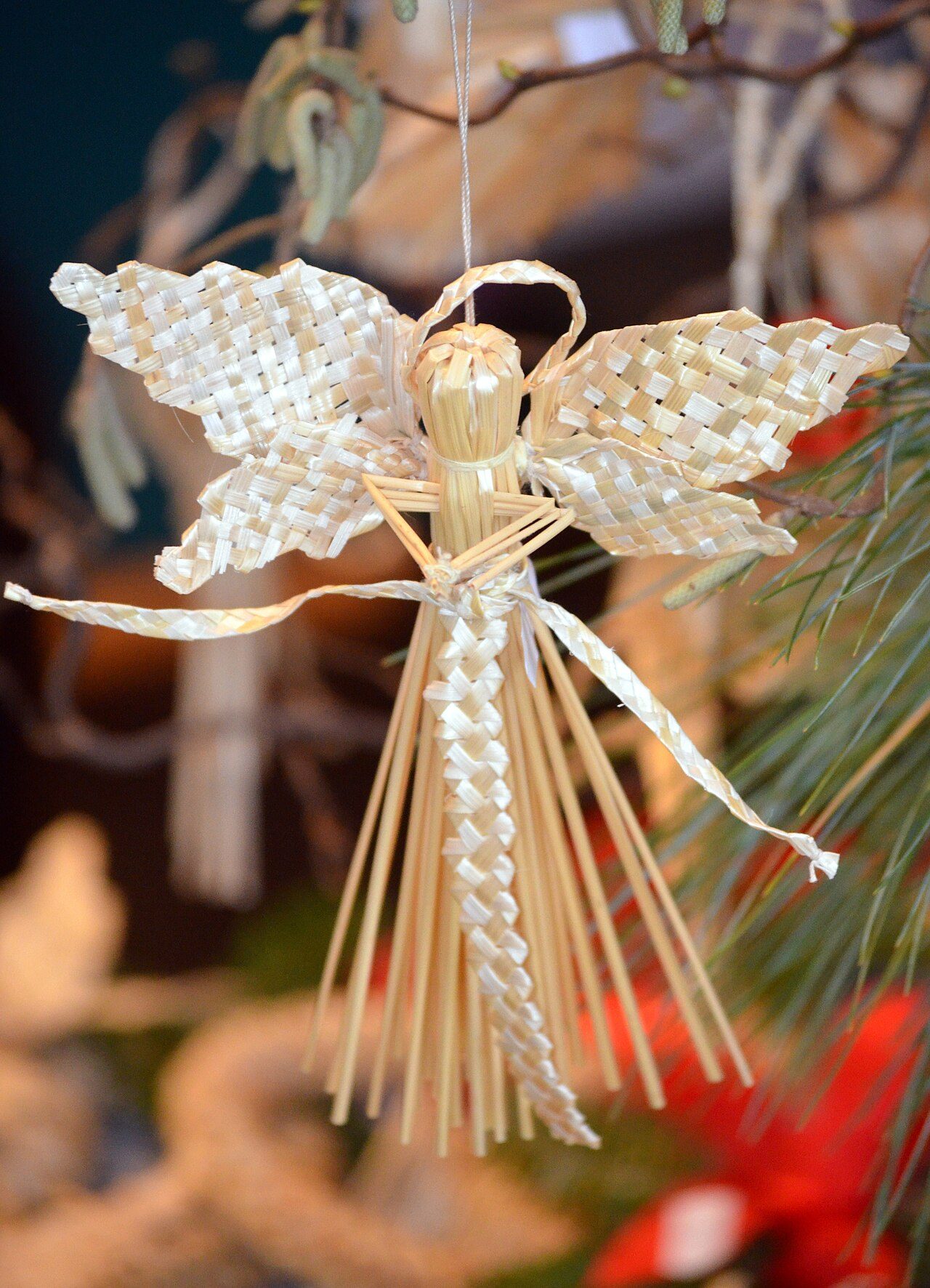
The tradition & historical record
4 min read · 2 sourcesStraw plaiting is a method of manufacturing textiles by braiding straw and the industry that surrounds the craft of producing these straw manufactures. Straw is plaited to produce products including straw hats and ornaments, and the process is undertaken in a number of locations worldwide. 1
Etymology
To plait comes from late 14 century, "to fold, gather in pleats", also "to braid or weave", from Old French pleir "to fold", variant of ploier, ployer "to fold, bend", from Latin plicare "to fold". 1
Applications
Straw can be plaited for a number of purposes, including: the thatching of roofs, to create a paper-making material, for ornamenting small surfaces as a "straw-mosaic", for plaiting into door and table mats, mattresses and for weaving and plaiting into light baskets and to create artificial flowers. Straw is also plaited to produce bonnets and hats. 1
Belarus
Straw weaving is an ancient folk craft of Belarus. In 2022 it was added to a UNESCO Representative List of the Intangible Cultural Heritage of Humanity. 1
England
The plaiting of straw in the counties of Buckinghamshire, Bedfordshire, Berkshire and Hertfordshire formerly gave employment to many thousands of women and young children; but this had largely ended by the beginning of the 20th century: the number of English plaiters, all told, was not more than a few hundreds in 1907, as compared with 30,000 in 1871. The districts around Luton in Bedfordshire and the neighbouring counties were, since the beginning of the 17th century, the British home of the straw-plait industry. The straw of certain varieties of wheat cultivated in that region is, in favourable seasons, possessed of a fine bright colour, tenacity and strength. 1
The straw is cut as in ordinary harvesting, but is allowed to dry in the sun, before binding. Subsequently, straws are selected from the sheaves, and of these the pipes of the two upper joints are taken for plaiting. The pipes are assorted into sizes by passing them through graduated openings in a grilled wire frame, and those of good color are bleached by the fumes of sulphur. Spotted and discoloured straws are dyed either in pipe or in plait. The plaiters work up the material in a damp state, either into whole straw or split straw plaits. Split straws are prepared with the aid of a small instrument having a projecting point which enters the straw pipe, and from which radiate the number of knife-edged cutters into which the straw is to be split. The straws were put through a small mangle to flatten them. They were then braided to produce a woven strip which was sold on to the makers of hats, baskets and other wares. The plaiting was carried out by women and children who were taught the skills in plait schools. 1
Tuscany
Worldwide, the most valuable straw for plaits is grown in Tuscany, and from it the well-known Tuscan plaits and Leghorn hats are made. The straw of Tuscany, specially grown for plaiting, is distinguished into three grades of quality. The highest quality is Pontedera Semone, the second highest is Mazzuolo. The bulk of the plaits are made from this grade of straw. The third grade, Santa Fioro, is only used to plait "Tuscan pedals" and braids. The wheat-seed for these straws is sown very thickly on comparatively elevated and arid land, and it sends up long attenuated stalks. When the grain in the ear is about half developed the straw is pulled up by the roots, dried in the sun, and subsequently spread out for several successive days to be bleached under the influence of alternate sunlight and night-dews. The pipe of the upper joint alone is selected for plaiting, the remainder of the straw being used for other purposes. These pipes are made up in small bundles, bleached in sulfur fumes in a closed chest; assorted into sizes, and so prepared for the plaiters. Straw-plaiting is a domestic industry among the women and young children of Tuscany and some parts of Emilia. Tuscan plaits and hats vary enormously in quality and value; the plait of a hat of good quality may represent the work of four or five days, while hats of the highest quality may each occupy six to nine months in making. The finest work is excessively trying to the eyes of the plaiters, who can at most give to it two or three hours' labor daily. 1
The text above is adapted from the Wikipedia article “Straw plaiting”, available under the Creative Commons Attribution-ShareAlike 4.0 licence. 1
straw plaiting is method of manufacturing textiles by braiding straw and the industry that surrounds the craft, according to the structured record cited below. This entry was generated automatically from that record and has not yet been reviewed by a person familiar with the tradition. 2
The source record links this tradition to 4 external registers, which can be verified through the citation. 2