The tradition & historical record
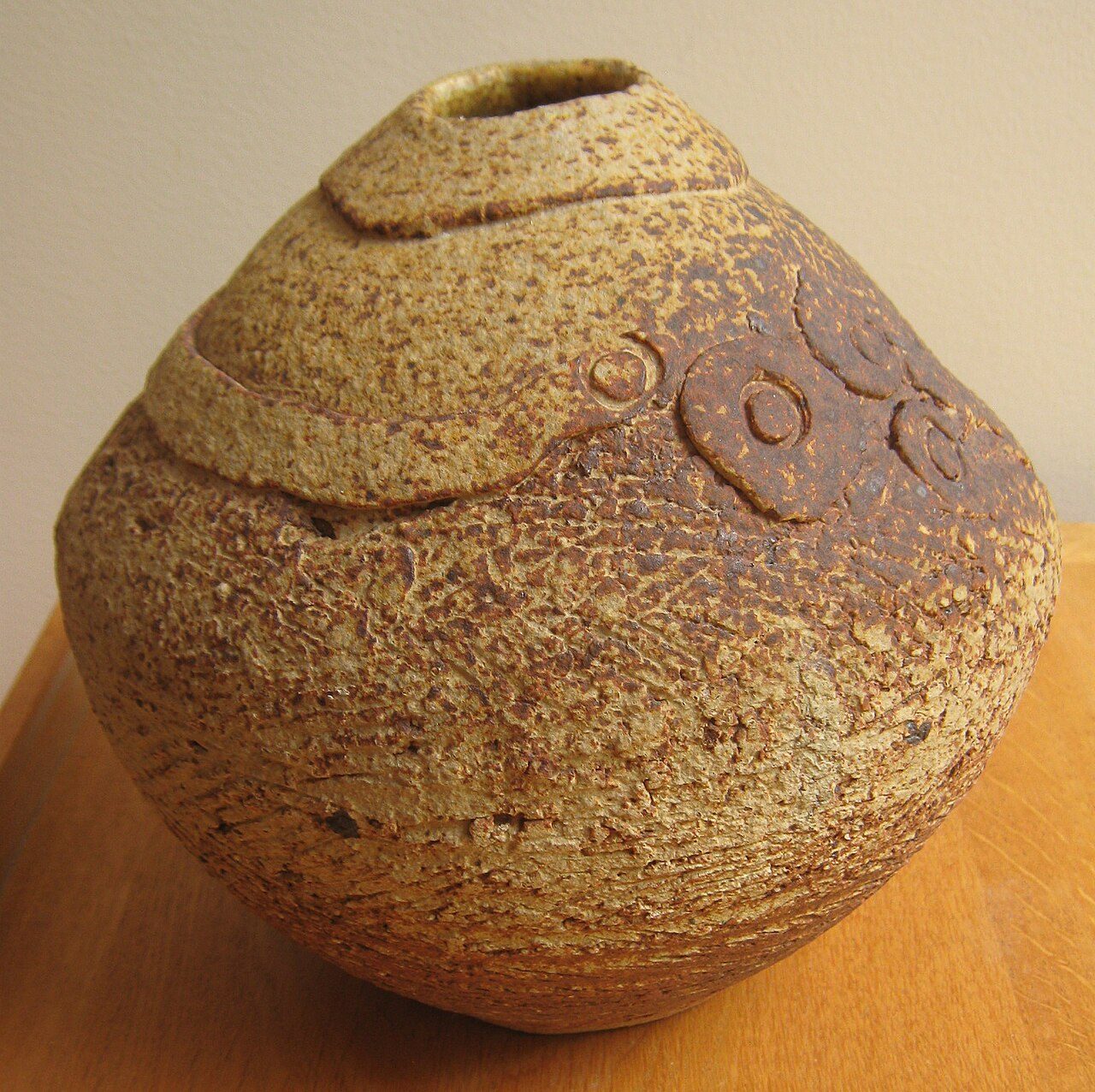
5 min read · 2 sourcesStudio pottery is pottery made by professional and amateur ceramists working alone or in small groups, making unique items or short runs, especially those that are not intended for daily use as crockery. Typically, all stages of manufacture are carried out by the artists themselves. Studio pottery includes functional wares such as tableware and cookware, and non-functional wares such as sculpture, with vases and bowls covering the middle ground, often being used only for display. Studio potters can be referred to as ceramic artists, ceramists, ceramicists, or as an artist who uses clay as a medium. 1
Some studio potters now prefer to call themselves ceramic artists, or simply artists. Studio pottery is represented by potters all over the world and has strong roots in Britain. Art pottery is a related term, used by many potteries from about the 1870s onwards, in Britain and North America; it tends to cover larger workshops, where there is a designer supervising the production of skilled workers who may have input into the pieces made. The heyday of British and American art pottery was about 1880 to 1940. Since the second half of the 20th century ceramics has become more highly valued in the art world. Several large exhibitions worldwide have been held, including the now defunct Sculpture Objects Functional Art and Design (SOFA Chicago and SOFA New York), which included ceramics as an art form. 1
Pre-1900
Notable studios included Brannam Pottery, Castle Hedingham Ware, Martin Brothers and Sir Edmund Harry Elton. 1
1900-1960: Development of contemporary British ceramics
Several influences contributed to the emergence of studio pottery in the early 20th century: art pottery (for example the work of the Martin Brothers and William Moorcroft); the Arts and Crafts movement, the Bauhaus; a rediscovery of traditional artisan pottery and the excavation of large quantities of Song pottery in China. Leading trends in British studio pottery in the 20th century are represented by Bernard Leach, William Staite Murray, Waistel Cooper, Dora Billington, Lucie Rie and Hans Coper. Originally trained as a fine artist, Bernard Leach (1887–1979) established a style of pottery, the ethical pot, strongly influenced by Chinese, Korean, Japanese and medieval English forms. After briefly experimenting with earthenware, he turned to stoneware fired to high temperatures in large oil or wood-burning kilns. This style dominated British studio pottery in the mid-20th century. Leach's influence was disseminated by his writings, in particular A Potter's Book and the apprentice system he ran at his pottery in St Ives, Cornwall, through which many notable studio potters passed. A Potter's Book espoused an anti-industrial, Arts and Crafts ethos, which persists in British studio pottery. Leach taught intermittently at Dartington Hall, Devon from the 1930s. Other ceramic artists exerted an influence through their positions in art schools. William Staite Murray, who was head of the ceramics department of the Royal College of Art, treated his pots as works of art, exhibiting them with titles in galleries. Dora Billington (1890–1968) studied at Hanley School of Art, worked in the pottery industry and was latterly head of pottery at the Central School of Arts and Crafts. She worked in media that Leach did not, e.g. 1
1960s-present: Modern British potters
From the 1960s onwards, a new generation of potters, influenced by Camberwell School of Art and the Central School of Art and Design including Ewen Henderson, Alison Britton, Elizabeth Fritsch, Gordon Baldwin and Ruth Duckworth began to experiment\abstract ceramic objects, varied surface and glaze effects to critical acclaim. Elizabeth Fritsch has work represented in major collections and museums worldwide. The number of potters increased in the mid-1970s the Craft Potters Association had 147 members, and by the mid-1990s it had 306. 1
British organisations
The representative body for studio pottery artists in the United Kingdom is the Craft Potters Association, which has a members' showroom in Great Russell Street, London WC1, and publishes a journal, Ceramic Review. 1
US studio pottery
Pottery had been an integral part of the United States Arts and Crafts movement in the late 19th century and early 20th century. A major figure in the growth of this movement was Charles Fergus Binns, who served as the first director of the New York State School of Clay-Working at Alfred University. Binns was a British potter who had previously worked at the Royal Worcester Porcelain Works. After emigrating to the United States he was recruited to direct the new program at Alfred University, and over the next three decades he helped it grow into one of the most prestigious ceramic arts programs in the nation. Some potters in the United States adopted the approach from emerging studio pottery movements in Britain and Japan. In addition, American folk pottery of the southeastern United States was seen as an American contribution to studio pottery. University programs at Ohio State University, under the direction of Arthur Eugene Baggs in 1928 and under Glen Lukens in 1936 at the University of Southern California, began training ceramic students in presenting clay ware as art. Baggs had been intimately involved in the Arts and Crafts movement and, during the 1930s, he revived interest in the salt glazing method for studio pottery. Karl Martz was a student of Baggs. European artists coming to the United States contributed to the public appreciation of pottery as art, and included Marguerite Wildenhain, Maija Grotell, Susi Singer and Gertrude and Otto Natzler. Significant studio potters in the United States include George E. Ohr, Otto and Vivika Heino, Karl Martz, Warren MacKenzie, Paul Soldner, Peter Voulkos and Beatrice Wood. 1
The text above is adapted from the Wikipedia article “Studio pottery”, available under the Creative Commons Attribution-ShareAlike 4.0 licence. 1
studio pottery is pottery-making niche, according to the structured record cited below. This entry was generated automatically from that record and has not yet been reviewed by a person familiar with the tradition. 2
The source record links this tradition to 3 external registers, which can be verified through the citation. 2