The tradition & historical record
5 min read · 2 sourcesStructure
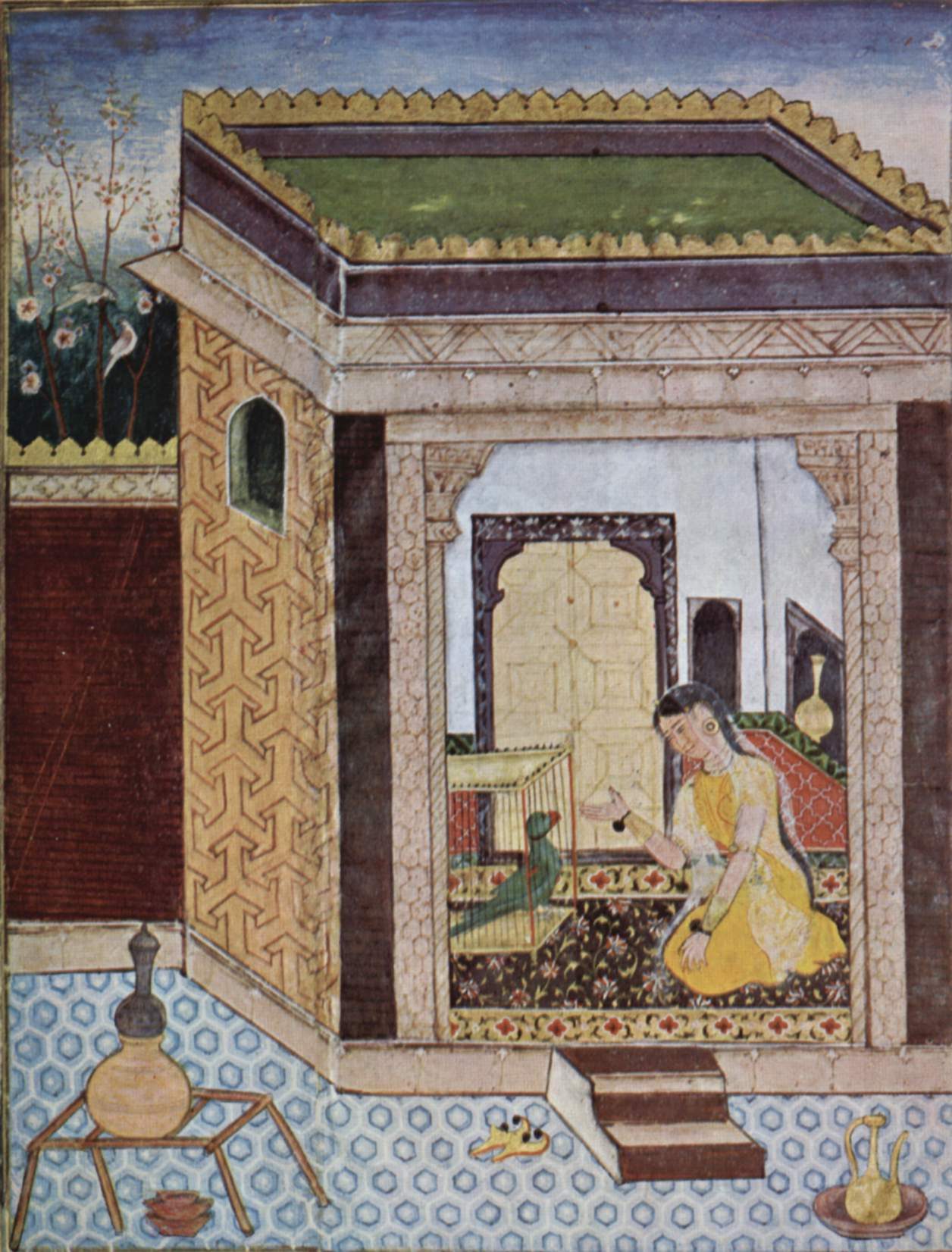
The collection, following the story within a story format to maintain continuity, actually contains 72 stories, of which one story acts as the main narrative. The remaining 71 stories are narrated by the parrot. The main story is that of Madana Vinoda, the wayward son of a merchant, and his wife Prabhāvatī. The merchant's Brahmin friend tries to bring Madana to the path of righteousness by giving him a pet talking parrot. This attempt is successful as the parrot narrates a story that brings Madana to the path of duty. Having learnt his lesson, he sets off on a voyage, presumably on a business venture, leaving his wife alone. Prabhāvatī, though initially dejected by her husband's departure, soon falls into the company of wanton women who suggest that she take on a lover. She agrees, and every night for the next seventy nights, she gets ready to meet him. But she is thwarted in her attempt every single night by the parrot, which adopts the stratagem of telling her a story. The parrot typically expresses approval of its mistress' intention by agreeing that the goal of life was to seek pleasure and acknowledges the strength of sexual desire. Then it excites her interest by asking whether she had the wits to escape if any troublesome situation were to arise, as the protagonist of her next story had. Prabhāvatī naturally wants to know the details of the story and the parrot proceeds to narrate it. At the end of the story, Prabhāvatī decides not to go for her rendezvous that night. On the seventieth night, Madana returns and Prabhāvatī has learnt the errors of her ways. Prompted by the parrot, she makes a full confession to her husband, thanking the parrot for keeping her from physical infidelity. 1
Verses
As with many Sanskrit texts, there are verses interspersed with prose that form part of the narrative. Some are erotic: 1
The best of the lover's couches is higher on the sides sunken at the centre it will also bear the strong poundings of a couple's passion The middling bed is flat of surface so that the night will often pass with rarely any contact between the bodies two. The worst is raised at the centre, and both its sides slope down; even adepts in the art cannot 1
make love on it continuously And some describe profound wisdom: 1
The rich man is wise, he is generous and good, the honoured kin of everyone; but when his money goes, 1
so does his glory. In some cases the verses are part of the story and actually act as part of the conversation between the characters. In others, they are merely regurgitations of earlier works such as the Hitopadesha, the Panchatantra, and even the Puranas. 1
History
Though the collection's oldest known manuscript dates back only to the 15th century, there are references to it in other works much earlier. Current scholarship dates the book in its current form to the 12th century, though the individual stories in it are much older and are often found in the Jataka tales and in the Kathasaritsagara. The Sanskrit Śukasaptati has a more complex textual history than is often recognized. Richard Schmidt identified three recensions: two major forms, the textus simplicior and textus ornatior, each represented by several manuscripts, and a minor textus elegantior, attested only by a single incomplete witness whose diction and grammar fall between the other two. Schmidt edited all three, and he translated the two major ones into German. The Indian printed edition prints the simplicior text—without saying so—and serves as the basis for the best-known English translation. Authorship is uncertain. No surviving simplicior or elegantior colophon names an author, and extant ornatior manuscripts likewise lack such evidence. An ornatior copy once owned by Prof. E. Hultzsch of Halle and now of unknown whereabouts reportedly bore the colophon “śrīcintāmaṇibhaṭṭāṇāṃ śukasaptatiḥ samāptā,” mentioned only by Hertel and never independently verified. Csaba Töttössy later supported this attribution through an internal argument linking a story in the work about a wish-fulfilling jewel (cintāmaṇi) to the author’s creative method. Most modern scholars, following Hertel and Töttössy, accept this otherwise unknown Cintāmaṇi Bhaṭṭa as the author of the ornatior, but not of the simplicior. Chronology remains debated. 1
Translations
There have been many translations of the work into both Indian and non-Indian languages. In the 14th century, Persian scholar Nakhshabi translated it as Tutinama. This in turn was translated into Turkish and formed the basis for the German translation, which was the first one into a Western language. The German translation, "Der textus ornatior der Çukasaptati", translated by Richard Schmidt was published in the year 1896 in Stuttgart by W Kohlhammer. It has been translated into Telugu poetic form by Palavekari Kadiripati. Vavilla Ramaswamy Sastrulu and Sons published the work in 1935 and 1951. It was published by Andhra Pradesh Sahitya Akademi in 1979 under the editorship of B. Ramaraju. A Malayalam translation is available for the work, named as Thatha Paranja Kathakal. In 2000, HarperCollins India published a translation from the original Sanskrit done by Indian diplomat-scholar A N D Haksar. The book claims that this was the first rendition into English that made use of the original Sanskrit, as against the Persian translation. 1
The text above is adapted from the Wikipedia article “Śukasaptati”, available under the Creative Commons Attribution-ShareAlike 4.0 licence. 1
Śukasaptati is collection of stories originally written in Sanskrit, according to the structured record cited below. This entry was generated automatically from that record and has not yet been reviewed by a person familiar with the tradition. 2
The source record links this tradition to 12 external registers, which can be verified through the citation. 2