The tradition & historical record
6 min read · 2 sourcesSuzhou embroidery, Su embroidery or Su xiu (simplified Chinese: 苏绣; traditional Chinese: 蘇繡) is the embroidery created around the city of Suzhou, Jiangsu, China. It is one of the oldest embroidery techniques in the world and is the most representative type of art in Chinese embroidery. One of the well-known "four great embroideries of China" along with Cantonese embroidery, Sichuan embroidery and Xiang embroidery, Suzhou embroidery already has a history more than 2,000 years and is an important form of handicraft in the history of Chinese art and folk custom, representative of Chinese traditional folk arts. It is famous for its variety of stitches, beautiful patterns, elegant colors, and consummate craftsmanship. 1
History
Su Xiu originated in Suzhou, Jiangsu Province. Because of its superior geographical environment, Suzhou is a city which is rich in producing silk. This provides a favorable environment for the development of Su Xiu. Suzhou embroidery has a history of more than two thousand years. It was recorded as early as the era of Three Kingdoms. In Three Kingdoms era (220–280 A.D.), Su Xiu was used as a decoration for clothing. It gradually moved into people's lives. During the Song dynasty (960–1697 A.D.), Su embroidery reached a high level. During the Ming dynasty (1368–1644 A.D.), Suzhou embroidery became a popular avocation for people living in Suzhou. At that time, almost every family was doing embroidery. Not only that, an imperial office was founded to oversee dyeing, weaving and embroidering for court use. At that time, Su Xiu was not only an object for family use, but also loved by the royals. During the ensuing Qing dynasty (1644–1912 A.D.), Su Xiu reached its heyday. At that time, Suzhou had more than 100 embroidery workshops and markets. It was widely used to decorate clothing, costumes, quilts, pillow bags, curtains, cushions, shoes, sachets and other items. At that time, it was the most popular art form for royal clothing and wall decoration. Some ladies from affluent families made embroideries as a pastime. In the later part of the Qing dynasty, Su Xiu was further developed as an embroidery technology. Exquisite "Double-sided Embroidery" appeared. In the early 20th century, between 1912 and 1949, after the Xinhai Revolution, the Su Xiu industry declined. After the founding of new China (after 1949), the government showed great concern for Su Xiu. China set up the Suzhou embroidery institute and opened embroidery training classes. 1
Subjects
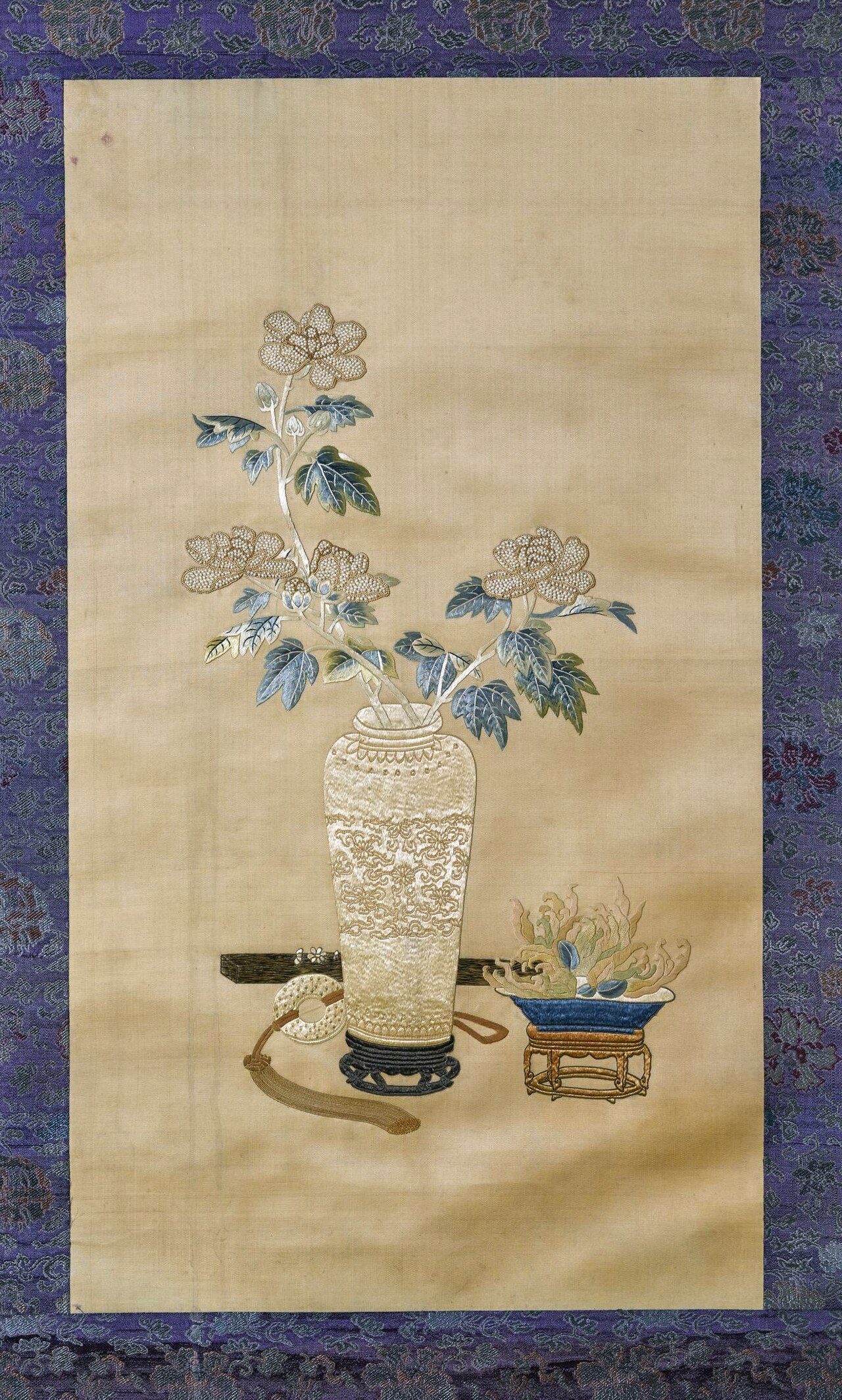
The traditional subjects of Su Xiu embroidery reflect characters and nature environment include figures, animals, mountains, rivers, flowers and birds. Here are some classical Su embroidery works: "Lady Jiong Dances on a Golden Lotus Platform", a masterpiece made by a well-known Qing dynasty embroiderer called Ling Shu, it depicts imperial concubine Lady Jiong dancing for Emperor Li Yu of the Southern Tang dynasty. It is about the subject of figures. The “Golden Belt Apron” is Zhao Huijun's masterpiece. By using different stitching techniques, it shows us delicate peony flower. It is about the subject of animals. “Two Chickens under a Wisteria Branch", is generally recognized a masterpiece of the early 20th century. It shows two chickens under a wisteria tree. 1
Use
Suzhou embroidery is mainly used in costumes and for decorations around the home, adding both decorative and practical value. It could be used to as the decoration for shoes, pillow sides, purses. And can also be the mirror cover. The purse is a kind of pocket with embroidered pattern. In ancient China, it was embroidered by ladies as the tokens of pledging love for their lover. The patterns cover a very wide rage, animals, plants and figures. Ladies always use these patterns to express their good wishes. And was the most emotional expression of love at that time. The mirror cover is used to put woman's mirror in old times. It has many shapes such as circular, square and octagon. 1
Fabrication
First of all, the draft of the embroidery design should be prepared. It can be an original design or a copy of another work. It is popular to copy works selected from famous artists, including traditional Chinese paintings, oil paintings, photographs and so on. Secondly, materials and tools should be prepared. The materials include: draft, silk and filament silk embroidery thread. Tools are: stretch frame, hand board, scissors, embroidery needle and tape measure. Su embroidery has strict requirements for embroidery needles, and the thickness of the needles will affect the shades and the performance of the work. Embroiderers usually split a hair-thin silk thread into two to sixteen thinner threads. Different thread thicknesses are used for different parts of a subject in embroidery. Third, start the embroidery. Su Xiu can be divided into two categories according to its appearance: single-sided embroidery and double-sided embroidery. Single-sided embroidery has a front side and a back side of the fabric, and the design is only displayed on the front side. Double-sided embroidery means the finished product looks exactly the same on both sides of the fabric. The method of making this embroidery is very complicated. All thread ends are skillfully concealed between layers of stitch work. The embroidery process is finished without a second time. As a result, no knots or thread ends are visible in a double sided embroidery. According to different stitches, Su Xiu can be divided into random needlework and plain needlework. Random needlework, as the name implies is the needlework which has a very stochastic embroidery method. 1
Traditional patterns
Dragon 1
Dragon worship has a long history in China. In ancient times, the dragon was a symbol of power. Only the emperor could wear yellow clothes embroidered with dragons. Now, "The descendants of the dragon" is a symbol of the Chinese nation. Phoenix 1
Phoenix is a kind of auspicious bird in myth and legend. It is also a mascot in Chinese traditional culture and gradually becomes the representative of women. In symbolises a happy marriage and good luck in Su Xiu. Mandarin ducks 1
Mandarin ducks are famous ornamental birds in China. Their images are widely used in the embroidery art. It's It symbolizes faithful love and a happy marriage. Bat Bats symbolize luck and wealth. The bat is thus used because the words “bat” and “happiness” have the same sound, although there is a slight difference in tone. 1
Kylin Kylin (Qilin) is a kind of auspicious animal in Chinese mythology, symbolizing rarity and auspiciousness. Peony 1
Peony is the “queen of the flowers”. In traditional Chinese designs, peonies are often used as symbols of great wealth and honor. Lotus Lotus belongs to the aquatic root plant of water lily family, which has a high status in Chinese traditional culture and is called "the gentleman in the flower". It's a symbol of integrity and purity. Because it rises undefiled from the black mud. Not only that, lotus is also the main symbol of Buddhism. 1
The text above is adapted from the Wikipedia article “Suzhou embroidery”, available under the Creative Commons Attribution-ShareAlike 4.0 licence. 1
Suzhou embroidery is embroidery created near Suzhou, one of China's top ten embroideries, according to the structured record cited below. This entry was generated automatically from that record and has not yet been reviewed by a person familiar with the tradition. 2
The source record links this tradition to 4 external registers, which can be verified through the citation. 2