The tradition & historical record
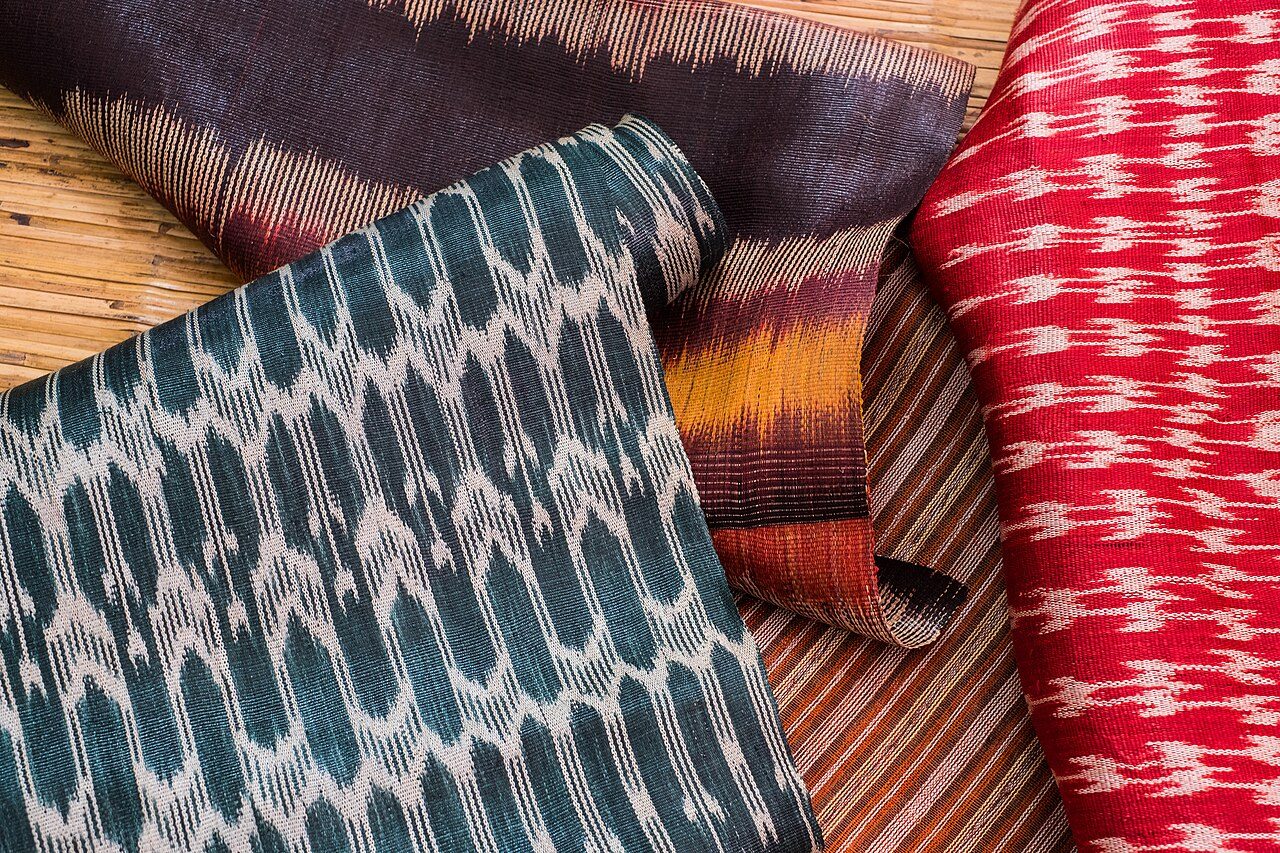
4 min read · 2 sourcesTnalak (also spelled tenalak), is a weaving tradition using resist-dyed threads of the Tboli people of South Cotabato, Philippines. T'nalak cloth is woven exclusively by women who have received the designs for the weave in their dreams, which they believe are a gift from Fu Dalu, the T'boli Goddess of abacá. The rest of the community, including the men, are able to participate in the production of T'nalak by carefully selecting, stripping, and sun-drying the abacá fibers to be used. Once the fibers have been prepared, they are dyed using the dye-resist technique called ikat, based on the pattern dreamt by the weaver; the woman gifted by Fu Dalu with the design then weaves the cloth using a backstrap loom. The fact that the designs are derived from the dreams of the weavers means that traditional t'nalak patterns cannot be mass-produced. Because the patterns are based on dreams, the weavers of t'nalak are popularly referred to as dreamweavers. 1
Production and history
T'nalak weaving is part of the intangible cultural heritage of the Tboli people, an indigenous people group in the Philippines whose ancestral domain is in the province of South Cotabato, on the island of Mindanao in the Philippines. The production of the cloth is particularly associated with the shores of Lake Sebu, which is in the municipality of the same name as the lake. 1
Dreamt designs from Fu Dalu
The weaving of traditional T'nalak cloth begins when a T'boli woman has a kena (dream) in which they encounter Fu Dalu, the T'boli Goddess of abacá and guardian of the T'nalak. During these dreams, Fu Dalu shows the woman the designs that would eventually be woven into the cloth. The dyeing and weaving processes are approached with extra care because the T'boli believe that Fu Dalo comes to inhabit each individual yarn. 1
Selection, stripping
The broader community, including the T'boli men, participate in the production of cloth during the abaca fiber selection and stripping process. The fibers are taken from the stalk of the abacá (Musa textilis), a banana plant species native to the Philippines. To do so, they fix a cowrie shell to one end of an abacá stem pole and link the other end to the roof as a hinge, pushing on the pole to apply pressure on the fibre with the shell. The fibers, which are very thin, are carefully stripped from the stalk with the use of a mounted blade, and then sun-dried. 1
Ikat dyeing
The fibers are then sun-dried, and then dyed using the indigenous dye-resist technique called "ikat." Sections of the abaca thread are coated by the weaver with a wax-resistant substance so that they will resist the dye. The process is repeated several times in order to suit the requirements of the design. T'nalak contains three colours: white symbolises purity, red represents blood and black signifies the soil. In addition to white abacá, the red dye comes from the brownish-red roots of the loko tree, while the black is obtained by boiling the green leaves of the knalum tree for seven days, which turn them dark as ink. 1
Weaving process
The weaver then implements the design on a backstrap loom, a process that can take up to two months, depending on the design revealed in the dream. Offerings, such as woven blouses and jewelry, are traditionally left in the weaving area as tribute to Fu Dalo. During the extensive weaving process, female weavers and their husbands are banned from having sex as a show of respect to Fu Dalu. 1
The text above is adapted from the Wikipedia article “T'nalak”, available under the Creative Commons Attribution-ShareAlike 4.0 licence. 1
T'nalak is Weaving tradition in South Cotabato, Philippines, according to the structured record cited below. This entry was generated automatically from that record and has not yet been reviewed by a person familiar with the tradition. 2
The source record links this tradition to 1 external register, which can be verified through the citation. 2