The tradition & historical record
7 min read · 2 sourcesArtisanal Talavera of Puebla and Tlaxcala is a Mexican pottery tradition with heritage from the Talavera de la Reina pottery of Spain. In 2019, both traditions were included in UNESCO's Representative List of the Intangible Cultural Heritage of Humanity. The Mexican pottery is a type of majolica (faience) or tin-glazed earthenware, with a white base glaze typical of the type. It is made in the town of San Pablo del Monte in the state of Tlaxcala and the cities of Puebla, Atlixco, Cholula, and Tecali in the state of Puebla. Pottery is made in these locations because of the quality of the natural clay found there and the tradition of production which goes back to the 16th century. Much of this pottery was decorated only in blue, but colors such as yellow, black, green, orange and mauve have also been used. Majolica pottery was brought to Mexico by the Spanish in the first century of the colonial period. Production of this ceramic became highly developed in Puebla because of the availability of fine clays and the demand for tiles from the newly established churches and monasteries in the area. The industry had grown sufficiently that by the mid-17th century, standards and guilds had been established which further improved the quality, leading Puebla into what is called the "golden age" of Talavera pottery (from 1650 to 1750). Formally, the tradition that developed there is called Talavera Poblana to distinguish it from the similarly named Talavera pottery of Spain. 1
Definition
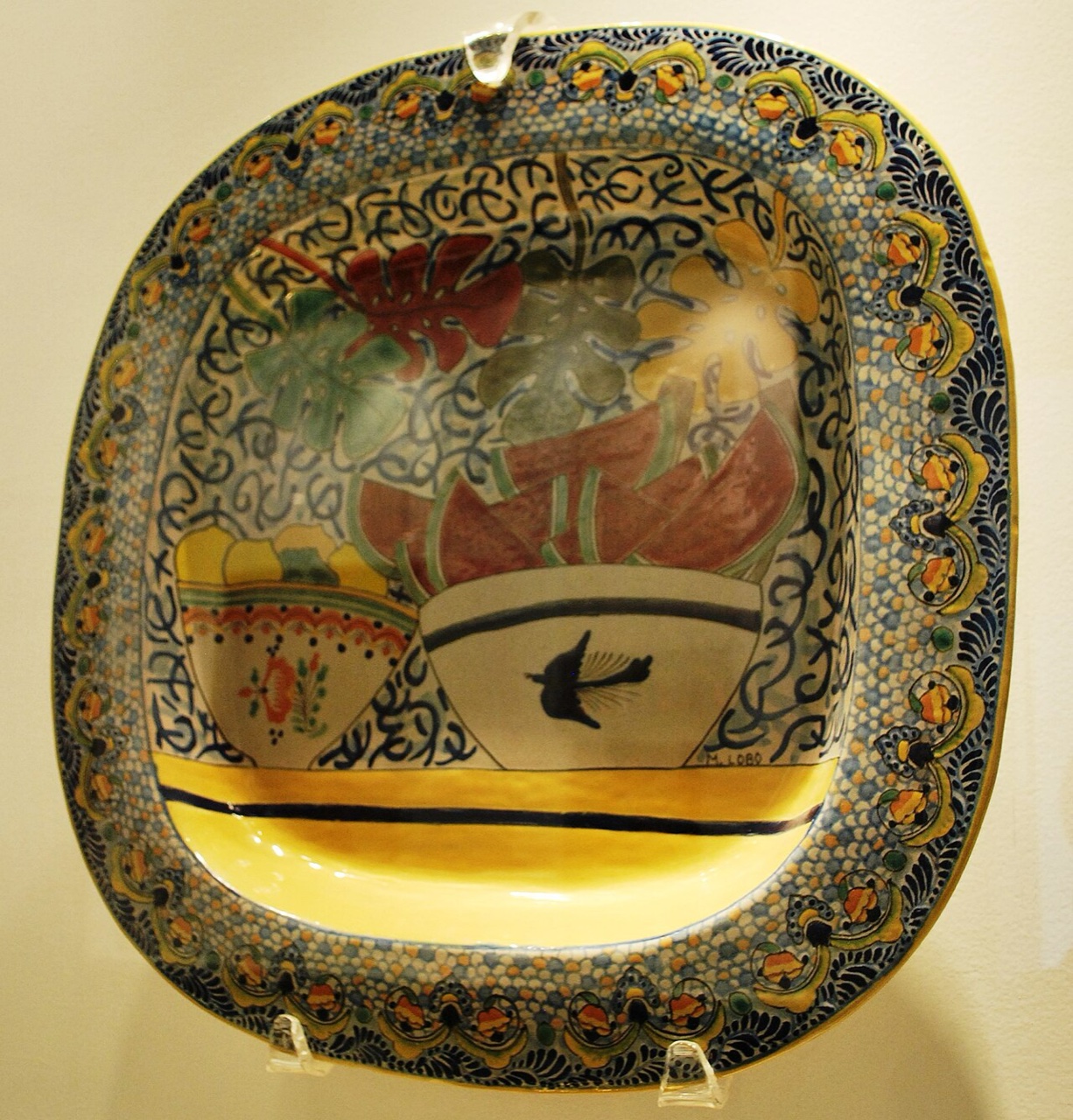
Authentic Talavera pottery mainly comes from Talavera de la Reina in Spain, and the town of San Pablo del Monte (in Tlaxcala) and the cities of Puebla, Atlixco, Cholula and Tecali, in Mexico; as the clays needed and the history of this craft are both centered there. All pieces are hand-thrown on a potter's wheel and the glazes contain tin and lead, as they have since colonial times. This glaze must craze, be slightly porous and milky-white, but not pure white. There are only six permitted colors: blue, yellow, black, green, orange and mauve, and these colors must be made from natural pigments. The painted designs have a blurred appearance as they fuse slightly into the glaze. The base, the part that touches the table, is not glazed but exposes the terra cotta underneath. An inscription is required on the bottom that contains the following information: the logo of the manufacturer, the initials of the artist and the location of the manufacturer in Puebla. 1
The design of the pieces is highly regulated by tradition. The paint ends up slightly raised over the base. In the early days, only a cobalt blue was used, as this was the most expensive pigment, making it highly sought after not only for prestige but also because it ensured the quality of the entire piece. Only natural clays are used, rather than chemically treated and dyed clays and the handcrafting process takes three to four months. The process is risky because a piece can break at any point. This makes Talavera three times more costly than other types of pottery. Because of this, Talavera manufacturers have been under pressure from imitations, commonly from China, and similar ceramics from other parts of Mexico, especially Guanajuato. 1
Production
The process to create Talavera pottery is elaborate and it has basically not changed since the early colonial period when the craft was first introduced. The first step is to mix black sand from Amozoc and white sand from Tecali. It is then washed and filtered to keep only the finest particles. This can reduce the volume by fifty percent. Next the piece is shaped by hand on a potter's wheel, then left to dry for a number of days. Then comes the first firing, done at 850 °C (1,560 °F). The piece is tested to see if there are any cracks in it. The initial glazing, which creates the milky-white background, is applied. After this, the design is hand painted. Finally, a second firing is applied to harden the glaze. This process takes about three months for most pieces, but some pieces can take up to six months. This process is so complicated and plagued with the possibility of irreparable damage that during colonial times, artisans prayed special prayers, especially during the firing process. Some workshops in Puebla offer guided tours and explain the processes involved. The oldest certified, continuously operating workshop is in Uriarte. It was founded in 1824 by Dimas Uriarte, and specialized in traditional colonial-era designs. Another certified workshop, Talavera de la Reina, is known for revitalizing the decoration of the ceramics with the work of 1990s Mexican artists. 1
Usage
Talavera ceramic is mostly used to make utilitarian items such as plates, bowls, jars, flowerpots, sinks, religious items and decorative figures. However, a significant use of the ceramic is for tiles, which are used to decorate both the inside and outside of buildings in Mexico, especially in the city of Puebla. The Puebla kitchen is one of the traditional environments of Talavera pottery, from the tiles that decorate the walls and counters to the dishes and other food containers. It is a very distinct style of kitchen. In monastery kitchens of the area, many of the designs also incorporate the emblem of the religious order. Many of the façades in the historic center of Puebla are decorated with these tiles. These tiles are called azulejos and can be found on fountains, patios, the façades of homes, churches and other buildings, forming an important part of Puebla's Baroque architecture. This use of azulejos attested to the family's or church's wealth. This led to a saying "to never be able to build a house with tiles", which meant to not amount to anything in life. Being able to show this kind of wealth was not restricted to Puebla. In Mexico City, the church of the Convent of La Encarnacion and the church of the Virgin of Valvanera both feature cupolas covered in Talavera. The most famous example of Talavera in the capital city is the Casa de los Azulejos, or House of Tiles, which is an 18th-century palace built by the Count del Valle de Orizaba family. What makes this palace, in the City of Palaces, distinct is that its façade on three sides is completely covered in expensive, blue-and-white tile – sensational at the time the tiles were applied. 1
History
Techniques and designs of Islamic pottery were brought to Spain by the Moors by the end of the 12th century as Hispano-Moresque ware. From there they influenced late medieval pottery in the rest of Spain and Europe, under the name majolica. Spanish craftsmen from Talavera de la Reina (Castile, Spain) adopted and added to the art form. Further Italian influences were incorporated as the craft evolved in Spain, and guilds were formed to regulate the quality. During roughly the same time period, pre-Hispanic cultures had their own tradition of pottery and ceramics, but they did not involve a potter's wheel or glazing. There are several theories as to how majolica pottery was introduced to Mexico. 1
Museum exhibitions
In the early 20th c… 1
The text above is adapted from the Wikipedia article “Artisanal Talavera of Puebla and Tlaxcala”, available under the Creative Commons Attribution-ShareAlike 4.0 licence. 1
Talavera of Puebla is type of Mexican majolica pottery, according to the structured record cited below. This entry was generated automatically from that record and has not yet been reviewed by a person familiar with the tradition. 2
The source record links this tradition to 2 external registers, which can be verified through the citation. 2