The tradition & historical record
5 min read · 2 sourcesTam Lin, also known as Tamas-Lin, Tamlane, Tamlene, Tamlin, Tambling, Tomlin, Tam-Lien, Tam-a-Line, Tam-Lyn or Tam-Lane, is a character in the legendary ballad originating from the Scottish Borders. 1
History
The story of Tam Lin revolves around the rescue of Tam Lin by his true love from the Queen of the Fairies. The motif of winning a person (or subduing an enemy) by holding him through all forms of transformation is found throughout Europe in folktales. The story has been adapted into numerous stories, songs, and films. It is also associated with a reel of the same name, which is also known as the Glasgow Reel. Tam Lin is listed as the 39th Child Ballad and number 35 in the Roud Folk Song Index. 1
Synopsis
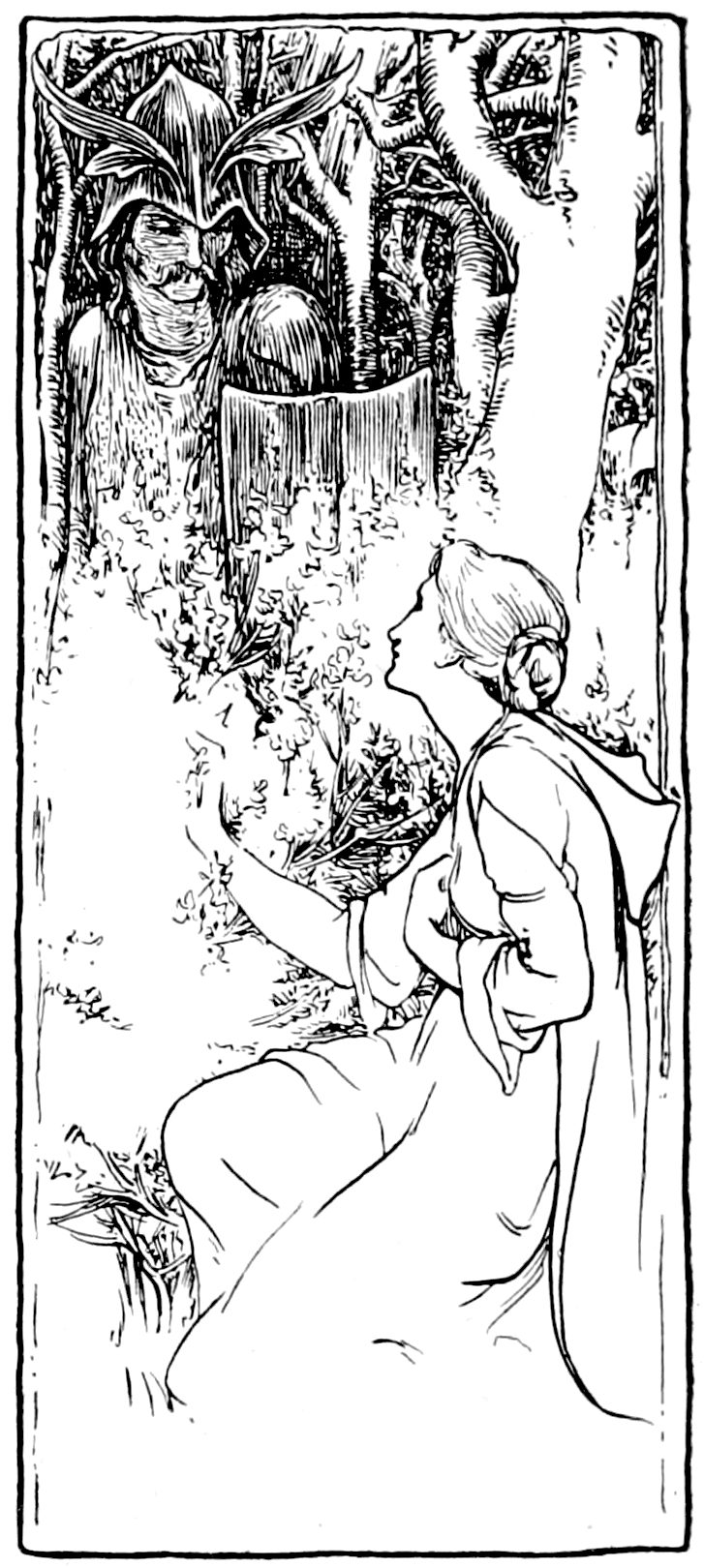
Most variants begin with the warning that Tam Lin collects either a possession or the virginity of any maiden who passes through the forest of Carterhaugh. When a young woman, usually called Janet or Margaret, goes to Carterhaugh and plucks a double rose, Tam Lin appears and asks her why she has come without his leave and taken what is his. She states that she owns Carterhaugh because her father has given it to her. In most variants, Janet then goes home and discovers that she is pregnant; some variants pick up the story at this point. When asked about her condition, she declares that her baby's father is an elf whom she will not forsake. In some versions, she is informed of a herb that will induce abortion; in all the variants, when she returns to Carterhaugh and picks a plant, either the same roses as on her earlier visit or the herb, Tam Lin reappears and challenges her action. She asks him whether he was ever human, either after that reappearance or, in some versions, immediately after their first meeting resulted in her pregnancy. Tam Lin reveals that, though he was once a mortal man, he was imprisoned in Carterhaugh by the Queen of Faeries after she kidnapped him by catching him when he fell from his horse. He goes on to tell Janet that the fairies give one of their people as a teind (tithe) to Hell at midnight on every seventh Hallowe'en. He asks Janet for her help in freeing him, and receives her agreement; he then instructs her to come to the forest at the time of the tithe, during which he'll be in the company of numerous faerie knights -- he tells her that she'll recognize him by his white horse. 1
Early versions
The ballad dates to at least as early as 1549 (the publication date of The Complaynt of Scotland that mentions "The Tayl of the Ȝong Tamlene" ('The Tale of the Young Tamelene') among a long list of medieval romances). Michael Drayton's narrative poem Nimphidia (1627) includes a character called Tomalin who is a vassal and kinsman of Oberon, King of the Fairies. Robert Burns wrote a version of Tam Lin based on older versions of the ballad, which was printed in James Johnson's Scots Musical Museum (1796). The story featured in several nineteenth century books of fairy tales under different titles : 1
"Elphin Irving, the Fairies' Cupbearer" in Traditional Tales of the English and Scottish Peasantry by Allan Cunningham (1822) "Wild Robin" in Little Prudy's Fairy Book by Sophie May (1866). "Tamlane" in More English Fairy Tales by Joseph Jacobs (1893). Francis James Child collected fourteen traditional variants in The English and Scottish Popular Ballads in the nineteenth century. (Another Child ballad, Burd Ellen and Young Tamlane, has no connection with this ballad except for the similarity of the heroes' names.) 1
Motifs
Child took the threat to take out Tam Lin's eyes as a common folklore precaution against mortals who could see fairies, in the tales of fairy ointment. Joseph Jacobs interpreted it as rather a reversal of the usual practice; the Queen of Faeries would have kept him from seeing the human woman who rescued him. In some variants, "Hind Etin" has verses identical to this for the first meeting between the hero and the heroine. 1
Field recordings
The ballad has been recorded several times from Scottish and Northern Irish people who learned it in the oral tradition. Eddie Butcher of Magilligan, County Londonderry knew a fragment of the ballad which can be heard via the Irish Traditional Music Archive, and Paddy Tunney of Mollybreen, County Fermanagh sang a version to Hugh Shields in 1968. In Scotland, Duncan Williamson of Auchtermuchty, Fifeshire, William Whyte of Aberdeen and Betsy Johnston of Glasgow all had traditional versions recorded, the latter two by Hamish Henderson. 1
The text above is adapted from the Wikipedia article “Tam Lin”, available under the Creative Commons Attribution-ShareAlike 4.0 licence. 1
Tam Lin is Scottish border ballad, according to the structured record cited below. This entry was generated automatically from that record and has not yet been reviewed by a person familiar with the tradition. 2
The source record links this tradition to 3 external registers, which can be verified through the citation. 2