The tradition & historical record
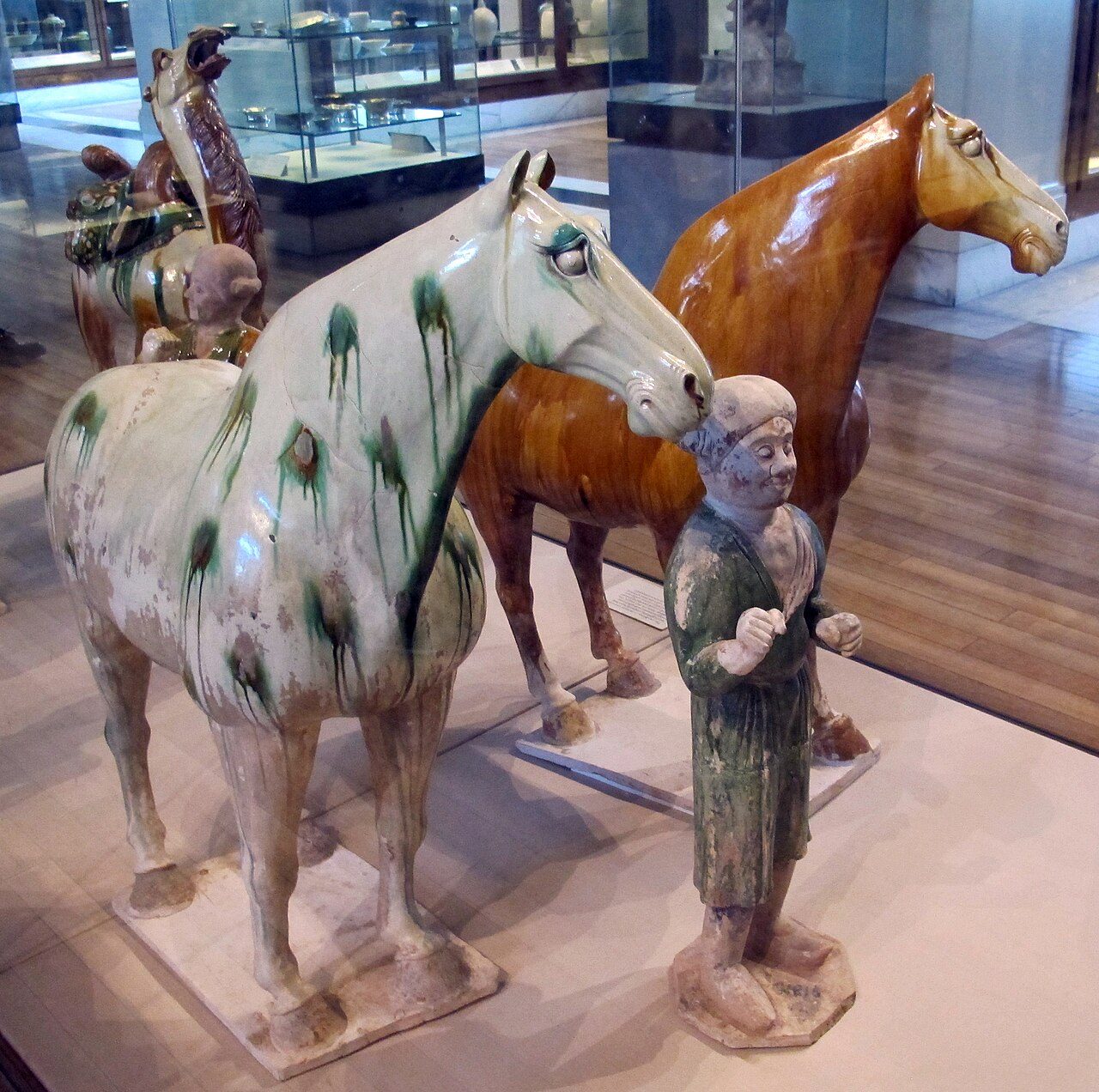
7 min read · 2 sourcesTang dynasty tomb figures are pottery figures of people and animals made in the Tang dynasty of China (618–906) as grave goods to be placed in tombs. There was a belief that the figures represented would become available for the service of the deceased in the afterlife. The figures are made of moulded earthenware with colour generally being added, though often not over the whole figure, or in naturalistic places. Where the colouring was in paint it has often not survived, but in many cases it was in sancai ("three-colour") ceramic glaze, which has generally lasted well. The figures, called mingqi in Chinese, were most often of servants, soldiers (in male tombs) and attendants such as dancers and musicians, with many no doubt representing Gējìs. In burials of people of high rank there may be soldiers and officials as well. The animals are most often horses, but there are surprising numbers of both Bactrian camels and their Central Asian drivers, distinguished by thick beards and hair, and their facial features. The depictions are realistic to a degree unprecedented in Chinese art, and the figures give archaeologists much useful information about life under the Tang. There are also figures of the imaginary monster "earth spirits" and the fearsome human Lokapala (or tian wang), both usually in pairs and acting as tomb guardians to repel attacks by both spirits and humans. 1
Context and meaning
A thousand years before the Tang figures, the Tomb of Marquis Yi of Zeng (d. about 433 BC) contained the bodies of 22 musicians, as well as the instruments they played. Traces of wooden figures wearing textiles are known from similar dates, and the First Emperor's Terracotta Army is famous; his funeral also involved the killing and burial of many servants and animals, including all his childless concubines. Excavated Han dynasty tombs contained bronze or pottery figures of horses, and often groups of soldiers, well below life-size, in the tombs of commanders. Lower down the social scale, pottery models of houses and animals were common, and continued into the Tang. By the time of the Sui dynasty (581–618), the pattern of Tang tomb figures was essentially established, though the polychromy of sancai colours did not appear until the Tang. 1
The size and number of the figures in a grave depended on the rank of the deceased, as did the number that were glazed. Servants and farm animals were often glazed, painted or slip-painted white, or brown in the case of animals. The figures were paraded on carts as part of the funeral procession. They were then lined up outside the tomb before the coffin was taken inside. Once this was in place they were taken inside the tomb and arranged in the tomb, often along the sloping access way to the underground burial chamber, or in an ante-chamber to it. In large tombs there were niches built into the tomb walls for them to occupy. Until recent years most pieces came from excavations that were not done by archaeologists and knowledge of the context of pieces was lacking. 1
Technique
The size of figures varies considerably, from about 10 to 110 centimetres high for a standing human figure, and about 55 to 120 or more for the largest types, the beasts and guardians. Different scales of figures were usually mixed within tombs, depending on the status of the people or animals depicted. There is some indication that glazed and unglazed figures may have been made at different kilns. The figures are low-fired earthenware, since strength and durability were not required. The clay body fires to a "whitish" colour, except for a smaller group of less fine reddish pieces, normally covered in white slip. The figures are moulded, usually from several pieces, with the head always made separately, and the larger animals in the most parts. The various pieces were luted together before firing, with the opportunity taken to vary identical figures by joining the heads at slightly different angles. The clay was often worked by hand, luting on small extra details and textures, and sometimes working on the surface with tools. In earlier figures a joint line running up the side of the body can often be seen. For an unknown reason, the heads of horses either face straight ahead or turn to the left; they almost never turn to the right. When the clay work was complete, a white slip was applied all over, then any glaze was added to the figure before firing. Smaller figures might have a clear or slightly yellow glaze, and in larger ones the glaze was often kept off the face and hands, which were painted after firing. Sui and early Tang figures, before sancai was used, normally have the transparent glaze. 1
Style
The best period for the figures lasted only about 50 years, to the An Lushan Rebellion of 755, a period of innovation, unprecedented realism and an interest in showing psychological types in several media for Chinese art. The figures share with Buddhist monumental sculpture of the period conventions, derived from further west, that show "appropriate detail of muscle which yet departs from reality at many points". The horse figures reflect the same ideal as seen in contemporary paintings, and it is uncertain in which medium the type first arose. With exception of the Zodiac figures, which were also the only type to increase in popularity after the Tang, the figures are "more closely related to the metropolitan and Buddhist attitudes than to the magical aspects of rural beliefs and a pattern of behaviour governed by superstitions or shamanistic beliefs of the local farming communities", which partly accounts for their failure to return after the 750s, along with a preference for new types of grave goods. 1
Types of figures
The group of 13 Tang dynasty tomb figures of Liu Tingxun, a general who died in 728, represent a fine group of the usual major figures, all in sancai. There are four tomb guardians, and pairs of officials (these are all on a similar scale), horses and camels, plus three grooms, this group on a considerably smaller scale. 1
Women
The earliest figures, from the 7th century, are "rather simple and less well-executed than later ones". The women are tall and slim, whereas by the mid-8th century a plumper figure had become the norm, with faces that are "fat, heavily brooding and vacuous". It has been suggested that this change in taste was provoked by the famous imperial concubine Yang Guifei, who had a full figure, although it seems to begin by about 725, when she was a child. There may be groups of women as dancers or small seated orchestras of musicians, and some sitting figures appear to be beautifying themselves. More rarely, there are female riders and polo players, wearing male dress, which was usual for Tang women when riding, and apparently a fashion in the capital on other occasions. The period was one of unusual freedom for wealthy women in China, and the figures reflect this. 1
The text above is adapted from the Wikipedia article “Tang dynasty tomb figures”, available under the Creative Commons Attribution-ShareAlike 4.0 licence. 1
Tang dynasty tomb figures is Tomb figures of the Tang Dynasty, according to the structured record cited below. This entry was generated automatically from that record and has not yet been reviewed by a person familiar with the tradition. 2
The source record links this tradition to 1 external register, which can be verified through the citation. 2