The tradition & historical record
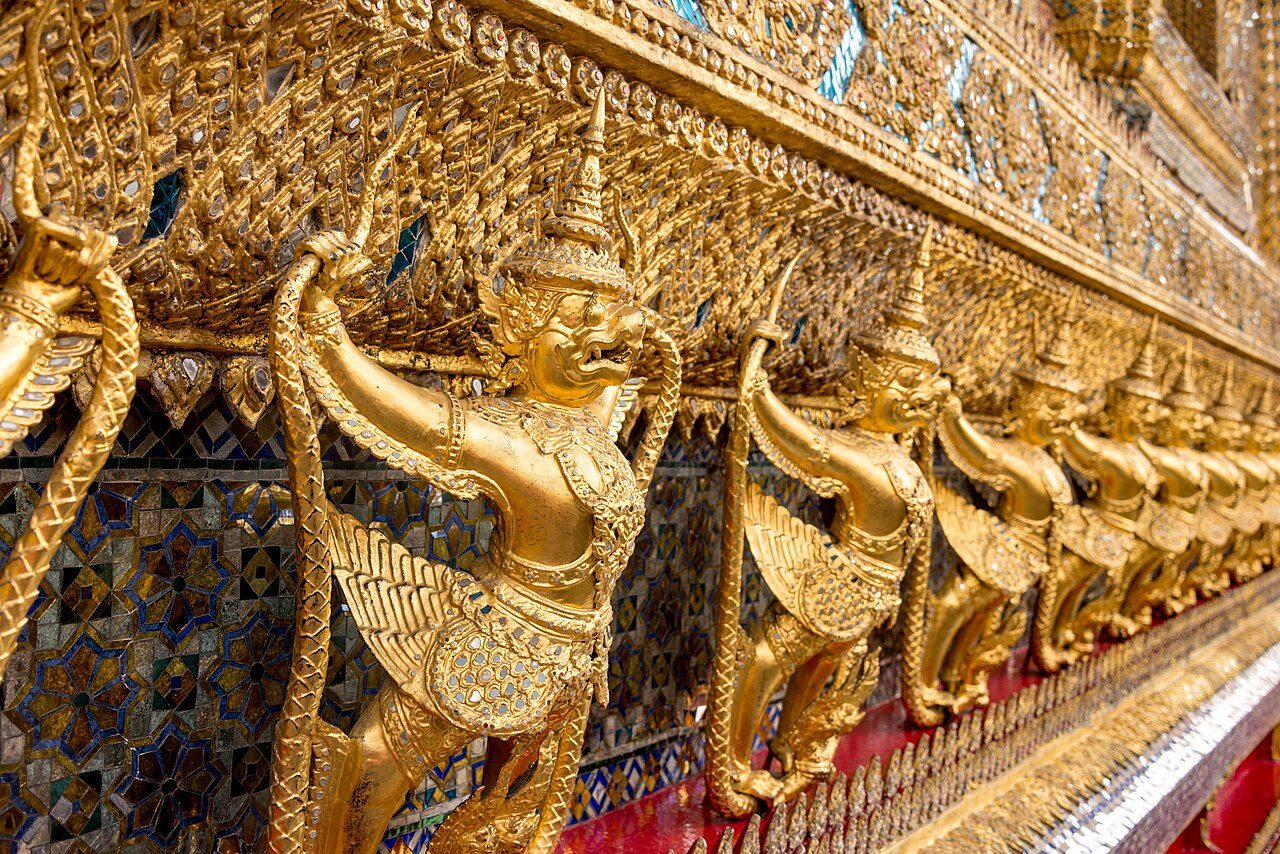
6 min read · 2 sourcesThai art refers to a diverse range of art forms created in Thailand from prehistoric times to the present day, including architecture, sculpture, painting, textiles, decorative arts, crafts, ceramics, and more. While Buddhism has played a significant role in Thai art, with many sculptures and paintings depicting Buddha images and religious themes, nature, including flora and fauna, as well as mythical creatures, has been a major inspiration for Thai art, with colorful motifs appearing in various types of art forms. In contemporary Thai art, traditional works remain significant and continue to influence artists' concepts. 1
Prehistory
One of the earliest examples of artistic expression in Thailand can be found in over 410 documented rock art sites across the country, featuring both prehistoric and historic art. The majority of these sites showcase monochrome red pictograms that depict animals, humans, geometric shapes, and handprints. While the dating of many sites remains unknown, some rock art sites have been estimated to date back 3,000–5,000 years ago. Nong Ratchawat, situated in Suphanburi province, is an important prehistoric site that provides valuable insights into the lifestyles of the people who settled in the area around 2000–500 BCE. Excavations have unearthed evidence of rice cultivation, animal husbandry, hunting, fishing, building construction, the creation of polished stone axes and pottery using locally available materials. The inhabitants were skilled in weaving textiles from plants possessing strong fibers, such as flax, hemp, and ramie. During the Iron Age, Nong Ratchawat became a prominent trading hub in the Mae Klong River Basin and the Tha Chin River Basin, attracting merchants from different parts of the world and leading to cultural and ethnic diversity. The river watersheds surrounding the site have yielded a plethora of artifacts, including pottery, bronze and iron tools, glass beads, ivory dice, Roman coins, and Lingling-o earrings. Ban Chiang is another important archaeological site in Thailand, located in Udon Thani province. It showcases the artistic achievements of a prehistoric culture that existed from about 2000 BCE to 300 CE. The people of Ban Chiang were skilled metalworkers, and evidence of early metallurgy, including copper and bronze artifacts, has been found at the site. 1
Dvaravati art
The Dvaravati period, lasting from the 6th to the 12th centuries CE, witnessed the spread of Theravada Buddhism throughout central, northern, northeastern, and southern Thailand. While Theravada Buddhism was the dominant religion during this time, there is also evidence of other religious influences, including Mahayana Buddhism and Hinduism. Dvaravati art, which employed hard blue limestone or quartzite to produce intricate sculptures, stucco, and terracotta decorations, featured symmetrical Buddha images standing or seated on thrones and the Wheel of the Law. The art style of Dvaravati owed its influence to the art of the Gupta and Post-Gupta periods in northern India, as well as the Buddhist art of Amaravati in southern India. People of Dvaravati were likely the Mons, as evidenced by various inscriptions during this period. The Dvaravati period played a significant role in the dissemination of Buddhism across the region, with noteworthy examples of Dvaravati towns including Nakhon Pathom ancient city in Nakhon Pathom province, U-Thong in Suphanburi province, Chan Sen in Nakhon Sawan province, Si Thep in Phetchabun province, Hariphunchai in Lamphun province, Mueang Fa Daet Song Yang in Kalasin province, Champasi in Maha Sarakham province, Sema in Nakhon Ratchasima province, Baan Dong Lakorn in Nakhon Nayok province, Ku Bua in Ratchaburi province, and Yarang in Pattani province. 1
Srivijaya art
During the 8th-13th centuries CE, Southern Thailand may have been influenced by the Srivijaya Kingdom, which encompassed Sumatra and the Malay Peninsula. This resulted in similarities between Srivijaya art in Southern Thailand and Central Java art in Indonesia, specifically in bronze sculptures and votive tablets. The ancient sites in Chaiya, Southern Thailand, also bear resemblances to Central Java art, with Wat Phra Borommathat Chaiya being the most similar. The majority of sculptures discovered in Southern Thailand are of religious significance, depicting figures such as the Avalokitesvara, Buddha protected by a Nāga, and clay votive tablets with Buddhist iconography. Srivijaya art in Southern Thailand, from Surat Thani to Songkhla, displays the influence of Indian art styles such as Gupta, post-Gupta, and Pala–sena, indicating a strong connection to Mahayana Buddhism. 1
Lavo art in Thailand – Lopburi art
Source: Between the 11th and 13th centuries CE, central and northeastern Thailand was ruled by the Khmers of Cambodia and as a result, Brahmin–Hinduism emerged. It led to the development of artistic styles, sculptures, and architecture similar to the Khmer also known as Khom in Thai language. This artistic expression is known as the Lopburi style, named after the ancient city of Lopburi or Lavo and refers to both the Khmer-influenced and genuinely Khmer artistic movement in Thailand. Lopburi artists were primarily associated with Brahmin-Hinduism, and later, Mahayana Buddhism. Surviving examples of their art are mainly stone and bronze carvings. The Lopburi architectural style used bricks and stones, with the Prang style being the most common, influenced by the Khmer Angkor style. In the 13th century AD, the Sukhothai Kingdom was established, and the Lopburi Kingdom came under its influence. During this time, artistic works aimed to establish a Thai identity. 1
U-Thong art
U-Thong art, also known as Suphannaphum-Ayothaya art, emerged in central Thailand between the 12th and 15th centuries CE, contemporaneously with Chiang Saen and Sukhothai art. This style received its name from the U-Thong Kingdom, which was centered in the U Thong District, although this kingdom's existence is ambiguous. It is characterized by a Buddha image style influenced by Dvaravati, Lopburi, and Sukhothai arts, with the Dvaravati influence being the most prominent. The resulting architecture and fine arts are collectively referred to as U-Thong and can be found in various provinces, including Suphanburi, Nakhon Pathom, Chai Nat, Lopburi, and Ayutthaya. U-Thong architecture is closely related to Theravada Buddhism and features low-roofed ubosot, vihāra, and chedis constructed with wood. A unique style of U-Thong chedi has an octagonal base, eight-sided structure, lotus crystal-adorned roof, and bell. These chedis are commonly found at various temples, such as Sankhaburi in Chai Nat province or some temples in Suphanburi. Another type of U-Thong chedi is found at Wat Phra Borommathat in Chai Nat province and shows similarities to Srivijaya art. Bronze sculptures from the U-Thong period exemplify elaborate casting, inheriting from the earlier Dvaravati art. 1
The text above is adapted from the Wikipedia article “Thai art”, available under the Creative Commons Attribution-ShareAlike 4.0 licence. 1
Thai art is overview of art in Thailand, according to the structured record cited below. This entry was generated automatically from that record and has not yet been reviewed by a person familiar with the tradition. 2
The source record links this tradition to 6 external registers, which can be verified through the citation. 2