The tradition & historical record
6 min read · 2 sourcesThe Battle of the Birds (Scottish Gaelic: Cath Nan Eun) is a Scottish fairy tale collected by John Francis Campbell in his Popular Tales of the West Highlands. He recorded it in 1859 from a fisherman near Inverary, John Mackenzie and was, at the time, building dykes on the Ardkinglas estate. The tale is classified in the Aarne-Thompson-Uther Index as ATU 313, "The Magic Flight" ("Girl Helps the Hero Flee") or "The Devil's (Ogre's/Giant's) Daughter". 1
Publication
Joseph Jacobs took it from there for his Celtic Fairy Tales and added some additional elements. It is also included in The Lilac Fairy Book by Andrew Lang and A Book of British Fairy Tales by Alan Garner. 1
Synopsis
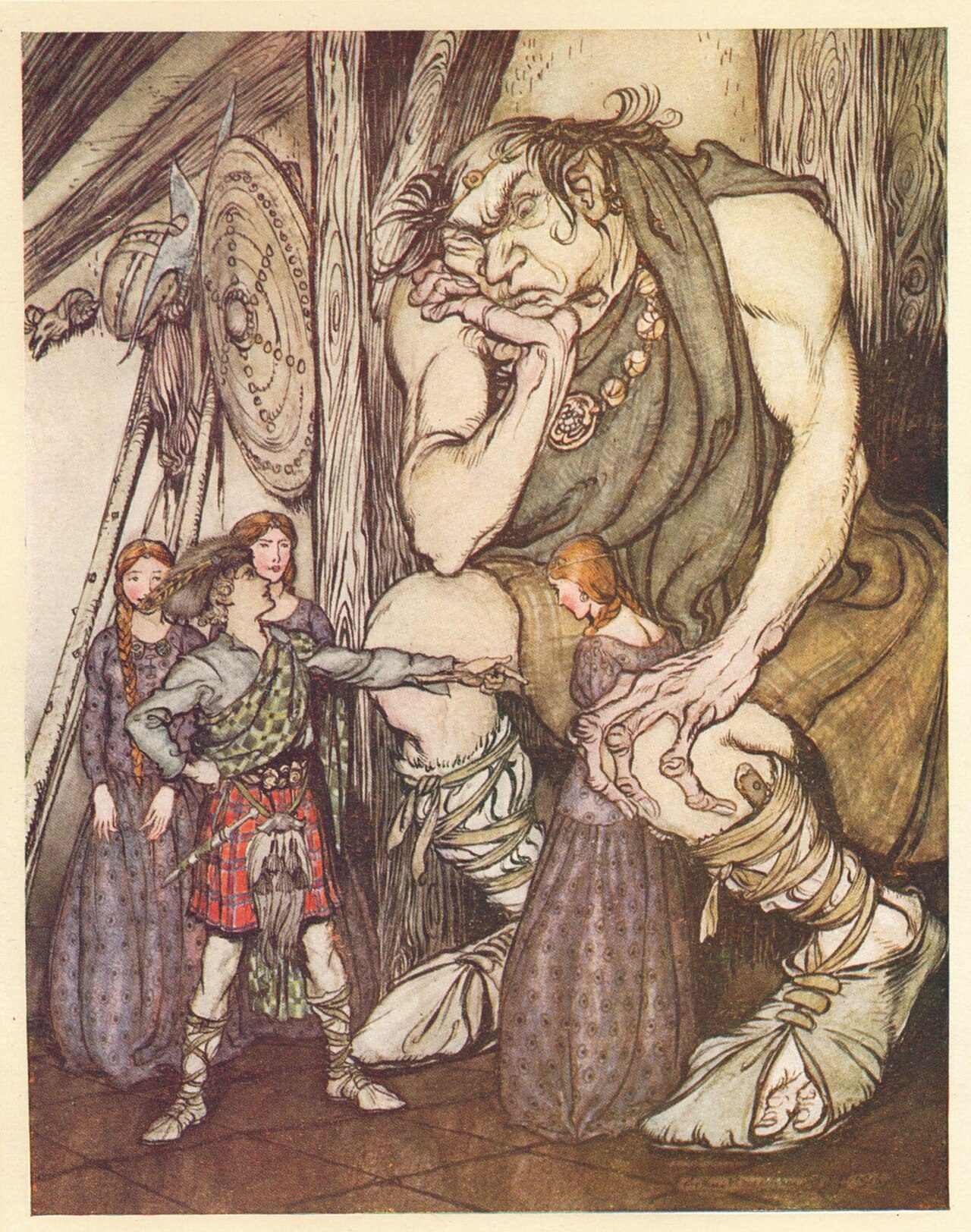
A king's son set out to see a battle, where every animal fought; he promised to bring back to his father the news of who would be the king of the animals that year. He arrived when the fight was almost over, but a snake and a raven still fought. He cut off the head of the snake. The raven, in gratitude, flew him to a castle where his sister lived, and the prince spent the night there. The raven then flew to another castle, where he also spent the night, but the next morning he met a handsome youth, who had been the enchanted raven. The youth gave him a bundle and warned him not to open it until he was in the place where he most wanted to be. When he was nearing his father's house, he opened the bundle. A great castle sprang up, and an irate giant demanded to know why he had put it there. It offered to put it back if the prince gave him his first son, when he reached seven years of age. Then the prince went out, and opened the bundle near his father's lands. He went into the castle, and found a pretty maid who was willing to be his wife. They had a son, and seven years later, they tried to put off the giant with the cook's son, and the butcher's son, but finally had to yield their own. The giant raised him. One day, he heard music and found the giant's daughter. She told him the next day the giant would ask him to marry one of her two older sisters, but she wanted him to insist on her, because she did not like the bridegroom he wanted for her. 1
The prince asked, but the annoyed giant demanded that he clean out the byre, or he would not get his youngest but be killed. He started to clean. The daughter came by at noon, and the prince fell asleep, but the byre was clean when he woke. 1
Tale type
The tale is classified in the international Aarne-Thompson-Uther Index as type ATU 313, "The Magic Flight" (previously, "Girl helps the hero flee"). The beginning of this tale merges the ATU tale type 222, "The Battle of the Birds" or "War of Quadrupeds and Birds", and ATU 537, "The Helpful Eagle (Etana)". This combination usually marks the tale type ATU 313B, "Girl helps in hero's flight" with introduction "The Forbidden Box". The ending of the tale falls under the category ATU 313, "The Magical Flight" with ending ATU 313C, "The Forgotten Fiancée", with motif "Kiss of Oblivion". As noted by professor Dean Fansler, the "Kiss of Oblivion" incident occurs because the hero breaks a taboo that the maiden warns against ("usually a parental kiss"). The hero's true memory only reawakens on the day of the wedding with the new bride. Moreover, Norwegian folklorist Reidar Thoralf Christiansen remarked that this ending motif was "very common". However, German folklorist Hans-Jörg Uther, in his revision of the index, published in 2004, subsumed the sequence and the subtypes back into the more general type, creating new type ATU 313, "The Magic Flight". Slavicist Karel Horálek remarked that the episode of the "Forgotten Bride" "occurs more frequently as the final part in the AaTh 313 type" and, combined with the starting episode of Eastern European and Celtic variants (e.g., the episode of the box and the eagle), would indicate a very old connection. 1
Variants
British scholar William Ralston Shedden-Ralston noted "a very striking ... likeness" between the Scottish tale and the Russian fairy tale The Sea Tsar and Vasilisa the Wise. Similarly, according to Russian folklorist Lev Barag, type 313B, with the starting episode of the quarrel between animals and the hero's father rescuing the bird, only appears in "East Slavic, Serbo-Croatian, Czech, Lithuanian, Estonian, Finnish, Flemish, French, Scottish and Irish" variants. Irish folklorist Séamus Ó Duilearga commented that the tale type ATU 313 was "one of the most popular of all Irish folk-tales". According to him, the Irish Folklore Commission catalogued 66 manuscripts as of 1943, and he supposed that a complete archive should yield "several hundred [variants], at least". 1
Western Europe
Irish folklorist Patrick Kennedy listed Irish tale The Giant and his Royal Servants as a parallel tale to the general narrative of The Battle of the Birds and cited The Master Maid as its Norse counterpart. Joseph Jacobs, in his commentaries on the tale, mentioned that "no less than sixteen variants [have been found] among the Celts", apart from published tales from Scotland and Ireland. Norwegian folklorist Reidar Thoralf Christiansen remarked that the opening motif of The Battle of the Birds "is better known in Scottish-Gaelic versions". François-Marie Luzel collected a variant from informant Marguerite Phillipe, from Lower Brittany, in 1868, and published it with the title L'hiver et le Roitelet ("Winter and the Kinglet"). In this tale, Winter, the season, annoys a kinglet, a little bird, for three nights, until the kinglet is forced to seek shelter in a mousehole. However, a mouse, already living in the mousehole, quarrels with the kinglet and both summon all flying animals and quadrupeds for a war. An eagle joins the fight and is hurt. A prince, who saw the conflict by his window, finds the eagle and restores it to health. After some time, the eagle takes the prince to his mother. The eagle's mother greets her son and, seeing the human, delights at the prospect of having him for dinner, but the eagle assures her he is their guest. The prince also meets the eagle's sister and falls in love with her. After three months, the eagle and his mother impose tasks on the prince, which he performs with guidance from the eagle's sister. Later, the prince takes the eagle's sister as his wife back to his kingdom, and breaks his ring in two to give the maiden one half, to always remember him by. 1
The text above is adapted from the Wikipedia article “The Battle of the Birds”, available under the Creative Commons Attribution-ShareAlike 4.0 licence. 1
The Battle of the Birds is Scottish fairy tale, according to the structured record cited below. This entry was generated automatically from that record and has not yet been reviewed by a person familiar with the tradition. 2
The source record links this tradition to 1 external register, which can be verified through the citation. 2