The tradition & historical record
3 min read · 2 sourcesThe Black Thief and Knight of the Glen is an Irish fairy tale collected in Hibernian Tales. Andrew Lang included it in The Red Fairy Book. It is Aarne-Thompson type 953 ("The Old Robber Relates Three Adventures"). 1
Synopsis
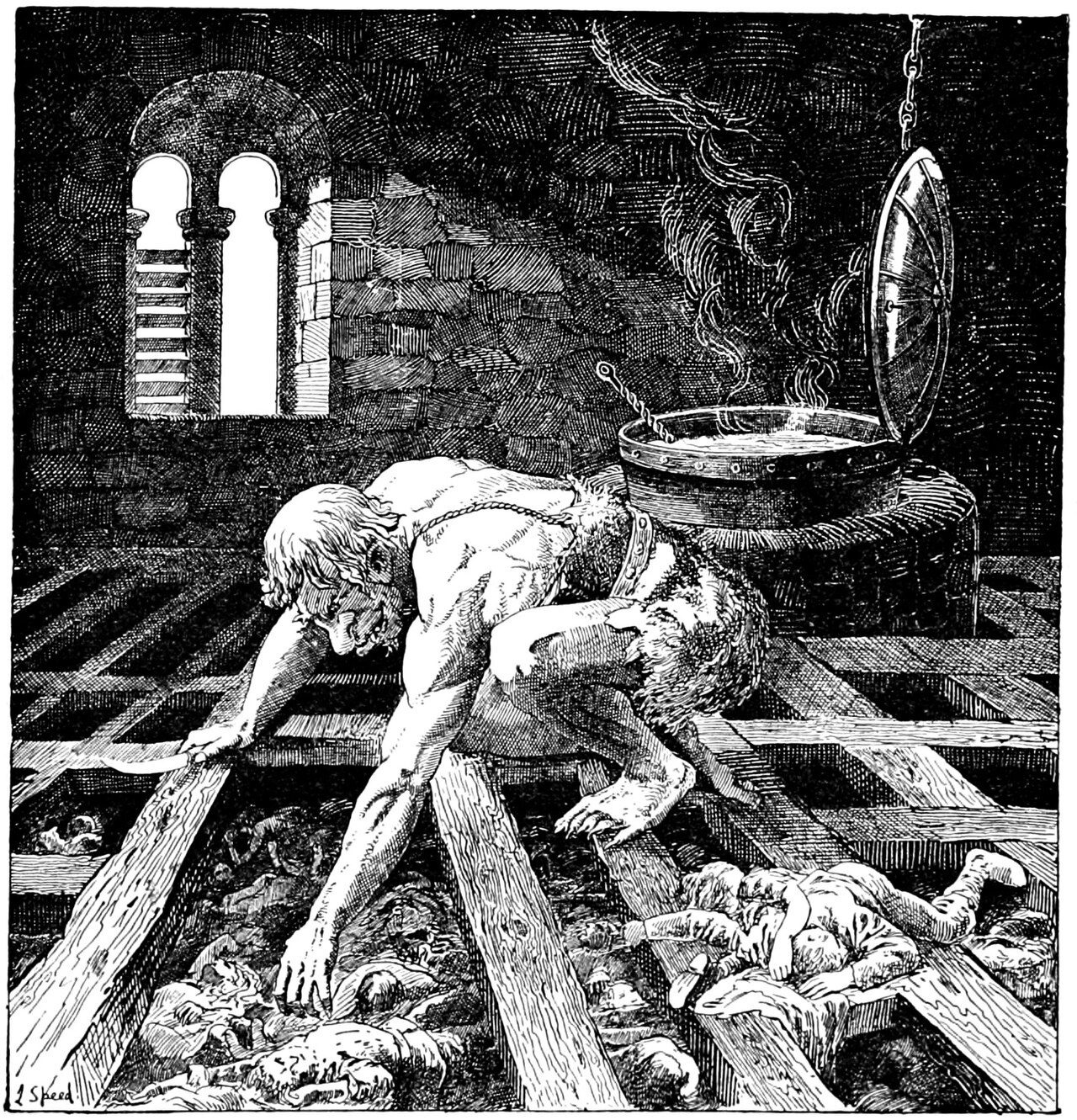
A dying queen made her husband promise to hide her sons from the new queen by raising them in an island on a lake. When the king remarried, a henwife told the stepmother she knew a secret, and when the queen paid her richly, told her of her stepsons, and demanded that they be brought to court. The henwife gave the queen cards and told her to play with the stepsons for a geasa. The queen defeated her older two stepsons, but the youngest won. She set a geasa that the older two must steal: the Knight of the Glen's wild Steed of Bells. The youngest said that he will go with his brother, and set a geasa that she stand on a tower with her face to the wind, with a sheaf of corn to eat and water to drink, until they returned. The princes met the Black Thief of Sloan, who warned them of the danger but came with them. When they tried to steal the horse, it rang the bells so that it warned the Knight and they were caught. The knight took them to a furnace, to boil them, from the oldest to the youngest of the princes, and then the Black Thief. The Black Thief said that he had once been in more danger than the oldest and escaped with his life. The Knight said that if he told him that story, he would pardon the oldest son. The Black Thief told that he had once seen three witches going to sleep with their gold under the heads to keep the Black Thief from stealing it; he had put turf under their heads instead and gone off with the gold. They chased him as a greyhound, a hare, and a hawk. He climbed a tree. They changed themselves into a smith's anvil and a piece of iron, which the third one made a hatchet of, and she started to cut down the tree. 1
Variants
Joseph Jacobs included the Scottish Conall Cra Bhuidhe in Celtic Fairy Tales, with notes that the Irish version was The Black Thief and Knight of the Glen. The Texas Folklore Society included a variant in its thirty-fourth publication, which also mentioned versions published in the writings of Jeremiah Curtin and William Thackery. Three variants were collected in Newfoundland. "The Byzantine Brigand," told by Angus MacLellan, was collected for Stories from South Uist. A variant from Australia, The Witch's Tale, appears in the autobiography of Simon McDonald. A Canadian variant, "The Black Thief" was given by Lauchie MacLellan of Nova Scotia. 1
The text above is adapted from the Wikipedia article “The Black Thief and Knight of the Glen”, available under the Creative Commons Attribution-ShareAlike 4.0 licence. 1
The Black Thief and Knight of the Glen is Irish fairy tale, according to the structured record cited below. This entry was generated automatically from that record and has not yet been reviewed by a person familiar with the tradition. 2
The source record links this tradition to 1 external register, which can be verified through the citation. 2