The tradition & historical record
6 min read · 2 sources"The Blind Man and the Lame" is a fable that recounts how two individuals collaborate in an effort to overcome their respective disabilities. The theme is first attested in Greek about the first century BCE. Stories with this feature occur in Asia, Europe and North America. While visual representations were common in Europe from the 16th century, literary fables incorporating the theme only began to emerge during the 18th century and the story was mistakenly claimed to be one of Aesop's Fables. The adaptation by Jean-Pierre Claris de Florian gave rise to the French idiom, "L'union de l'aveugle et le paralytique" ("the union of the blind man and the lame"), used ironically in reference to any unpromising partnership. 1
Western Asian sources
A group of four epigrams in the Greek Anthology concern a blind man and a lame. Plato the Younger states the situation in two wittily contrasting lines: 1
A blind man carried a lame man on his back, lending him his feet and borrowing from him his eyes. The three others, who include Leonidas of Alexandria and Antiphilus of Byzantium, comment that by combining in this way the two make a perfect whole. A West Asian story based on this trope is found in a pseudo-biblical document, the Apocryphon of Ezekiel, in which the two form a partnership to raid an orchard but claim their innocence by pointing out their disabilities. A variation of the story appears in the Jewish Talmud (Sanhedrin 91) and yet another is told in Islamic tradition as occurring during the boyhood of Jesus. That the basic situation of the two helping each other was still known in Mediaeval times is suggested by its appearance among the Latin stories in the Gesta Romanorum at the turn of the 14th century. There an emperor declares a general feast and the lame man proposes the means of getting there to the blind. In the same century a paralytic boy mounted on a blind man's shoulders appears in a fresco in Lesnovo monastery, seeking a cure for their leprosy and suggesting a similar lesson in co-operation to overcome disabilities. 1
European emblems
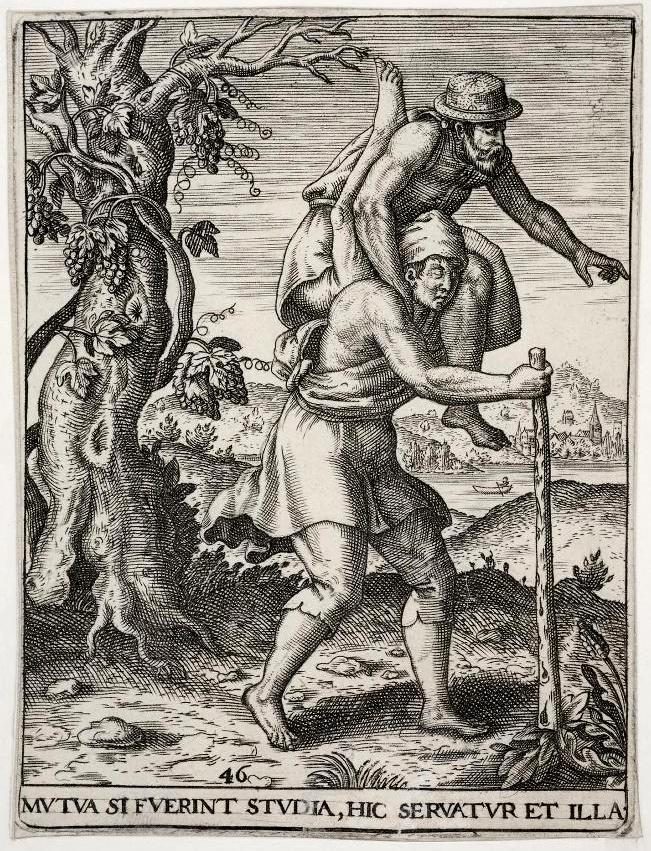
New life was given to the theme in the Renaissance when Andrea Alciato adapted the epigram by Leonidas into Latin and used it in his Book of Emblems (1534) to symbolise the theme of mutual support (mutuum auxilium). Other illustrated emblem books were to give the theme new interpretations. Jan Sadeler's Emblemata evangelica ad XII signa coelestia (Antwerp, 1585) pictures the pair crossing a plank bridge in the lower foreground of a majestic landscape, with Latin epigraphs exhorting charity. In the Emblemata saecularia (Oppenheim, 1596) of Johann Theodor de Bry, the illustration is dependent on Alciato's, particularly in the detail of the deformed leg; it also references the trope of the Elm and the Vine, another of Alciato's emblems. Combining the meaning of both, the print carries the epigraph Mutua si fuerint studia, hic servatur et illa, "Each is served where the objectives are common" (plate 46). The theme of mutual support was also carried forward into an 18th-century Low Countries print titled "The Allegory of Poverty", where the blind man carrying a cripple appears once again in a rural setting, with the addition of a huntsman defending a sleeping man from a feral dog. 1
European fables
Though the theme was common enough in art, it does not appear in fable collections until Christian Fürchtegott Gellert included it in his verse collection Fabeln und Erzählungen (1746–1748). In this a blind man in the street asks a cripple for help and suggests how they can aid each other. The moral he draws is a wider one, that mutual support goes beyond charity to become a model for all of society: 1
The gifts of others thou hast not, While others want what thou hast got; And from this imperfection springs The good that social virtue brings. When Robert Dodsley adapted the story in the "Modern Fables" section of his Select fables of Esop and other fabulists (1754), he gave it a context from which later versions of the story were to develop. In his prose version, the two meet at "a difficult place in the road" and Dodsley follows Gellert in prefacing it with the comment that "the wants and weaknesses of individuals form the connections of society". Dodsley's version was later illustrated by Thomas Bewick and included in his Select Fables of Aesop (1818). Authors up to then had been careful to mention that their collections contained fables by Aesop "and others", but during the 19th century the story was often to be ascribed simply to Aesop. 1
The nature of Dodsley's "difficult place" is redefined as "a dangerous place" in Jefferys Taylor's Aesop in Rhyme (1820), which the illustration reveals to be planks laid over a brook, not unlike the hazard over which the pair are crossing in Sadeler's emblem. 1
Visual interpretations
Though Claris de Florian's version of the fable achieved lasting popularity, its Chinese setting seems to have been largely ignored by illustrators. Notable exceptions include Benjamin Rabier's 1906 broadsheet with the fable accompanied by Chinese-style illustrations and Armand Rapeño's illustration in a 1949 edition of Florian's fables. Even these, however, fall short of picturing an urban setting. The fable was also given a Japanese background in an edition illustrated by traditional woodcuts published from Tokyo in 1895. Two later Belgian treatments are notable for being set in rural locations and compassionate treatment of the subject. Eugene Laermans varies the scene by picturing the pair side by side as they cross a stone bridge, the blind man with a cane in his right hand, the lame with a crutch in his left and his own right hand hooked through the other's arm. The Symbolist Anto Carte's painting of 1926–1930 places the pair in a Brabant landscape with the recognisable spire of the church at Ohain downslope. It was this scene which was subsequently reused on a 1954 set of Belgian charity stamps. 1
Previously there had been several compassionate treatments in French art exhibited over the last quarter of the 19th century. Auguste-Barthélemy Glaize's painting for the 1877 Salon was notable enough to be made part of the French exhibit at the World's Columbian Exposition of 1893 and his own lithograph of it appeared in the programme. A contemporary account describes it as "One of the largest paintings ... and among the best of its kind. 1
Adaptations
Honoré Daumier used Florian's fable for purposes of political satire in a caricature, "Blind system and paralytic diplomacy", published in Le Charivari in 1834. It pictures King Louis Philippe staggering under the weight of Talleyrand. Such treatment contributed to the emergence of the French idiom, "L'union de l'aveugle et le paralytique" ("the union of the blind man and the lame"), that drew on Florian's poem but was used ironically in reference to any unpromising partnership. 1
The text above is adapted from the Wikipedia article “The Blind Man and the Lame”, available under the Creative Commons Attribution-ShareAlike 4.0 licence. 1
The Blind Man and the Lame is fable, according to the structured record cited below. This entry was generated automatically from that record and has not yet been reviewed by a person familiar with the tradition. 2
The source record links this tradition to 1 external register, which can be verified through the citation. 2