The tradition & historical record
5 min read · 2 sources"The Cold Heart" (German: Das kalte Herz) is a fairy tale written by Wilhelm Hauff. It was published in 1827 in a collection of fairy tales that take place within the narrative of The Spessart Inn. It was adapted into film in Germany, including the 1924 and the 1950 films of the same name as the story. 1
Summary
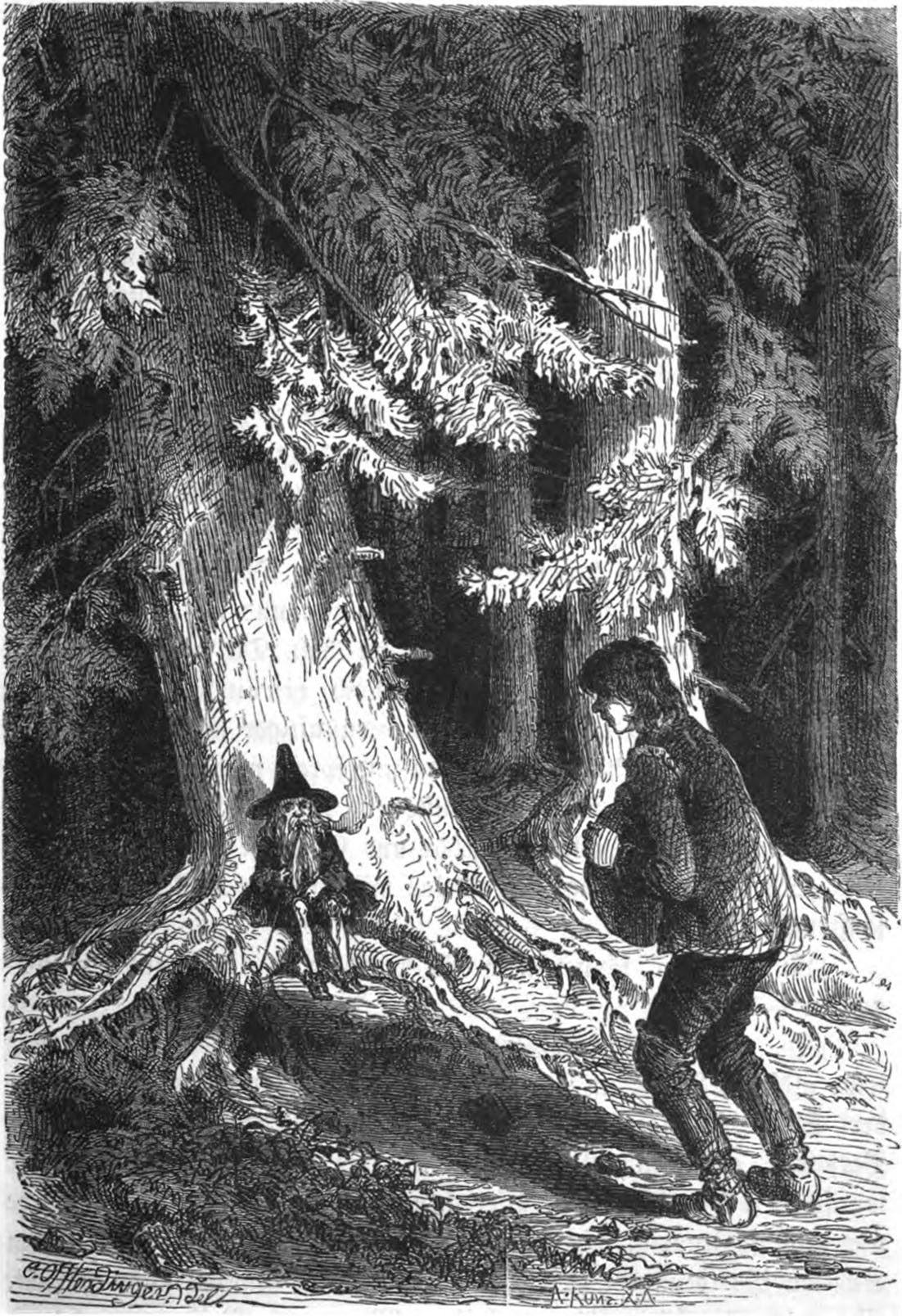
Despite taking over his late father's charcoal business, Peter Marmot, who goes by the name Coal-marmot Peter, is not content with the dirty, exhausting, low-paying and low-status work. He dreams of prosperity and prestige. Then he hears about a forest spirit living in the Black Forest, the little glass-imp, who also goes by the name of Schatzhauser. The glass-imp grants three wishes to every person born on a Sunday between 11 am and 2 pm, just as Peter Marmot was, but he needs to be summoned with a specific poem. During the search for the little glass-imp, Peter comes across another forest spirit, the enormous and dangerous Dutch-Mike, who haunts the forest as an evil sorcerer on stormy nights. Peter, however, is able to escape him. With the poem "Schatzhauser in the green firwood, thou art many hundreds of years old. Yours is the land where the firs stand, thou shalt only be seen by Sunday's children [the German version of Monday's Child]" Peter summons the little glass-imp, who grants him three wishes but with one condition: The third one will not be granted if his first two wishes are foolish. But right off the bat, Peter's first wish is foolish. For Peter wants to be able to dance better than the "dance floor king" and he wants to have just as much money as Ezekiel. Both are questionable role models of Peter's. His second wish is more reasonable. This time he asks for a big glass factory and enough money to run it. The little glass-imp points out that Peter should have wished for the brains necessary for that as well. The little glass-imp refuses to grant the third wish immediately so that Peter has one for later. Peter's two wishes are granted and for a while, luck is on his side. 1
Development
Hauff used Washington Irving's short story "The Devil and Tom Walker" as his source for the second part of this tale, retelling the story as if it were a traditional legend from the Black Forest. 1
Romanticism
Connections of this tale to the Romantic Era can be drawn. During this literary period it was quite common to write prose in fairy tale form. Drawing on the myth of the "glass-imp", Hauff presents the Romantic pursuit of happiness. Other Romantic characteristics include the use of the mystical-eerie, the uncanny and folk tales. The key concept of Romanticism is the longing (Sehnsucht) that Coal-marmot Peter embodies, as he is granted three wishes throughout the story. What results from this longing is, as often seen in protagonists of Romantic works, self-destruction, since the riches Peter wished for crumble into misery and his longing degenerates into stinginess and spite. As the hopeless romantic that he is, Coal-marmot Peter does not give up on his quest for happiness and at the end of the fairy tale eventually finds this happiness with his wife. 1
Psychological analysis
In Das kalte Herz: wie ein Mann die Liebe findet; eine tiefenpsychologische Interpretation nach dem Märchen von Wilhelm Hauff Mathias Jung performs psychological analysis on the in-plot development of Peter, and its relationship to Hauff's own life: In 1809, when Hauff was only seven years old, his father died, possibly resulting in an intense mother fixation. Struggles of the young Hauff might be mirrored in the character of Peter Marmot, who is morally and mentally unstable and plagued by feelings of inferiority. Peter goes to the "wrong father", Dutch-Mike, because he has no trust in his industry (see Erikson's stages of psychosocial development § Competence: industry vs. inferiority). The name Peter was chosen because it used to be very common, allowing everyone to identify with him. The glass-imp apparently represents the conscience or (going with Freud terminology) the super-ego or the positive archetype of the father (as Jung's terminology says). He could also be seen as a moral compass, a daimonion (using Socrates' term). This also stands for "civil trade and morality" whereas Dutch-Mike depicts the unbridled "profit seeking of the commercial in this first third of the nineteenth century". The name Ezekiel goes back to the biblical prophet Ezekiel, who said "I will take the stony hearts out of your body and I will give you one of flesh". According to Jung, Peter Munk remains in a state of self-abuse, in which he plays, dances, drinks and quests after wealth and acknowledgement from others. Peter is middle-aged and he follows the model of Erik Erikson (identity and lifestyle) at the stage of "generativity vs. stagnation". 1
Films
Heart of Stone (1924) Heart of Stone (1950) 1
The text above is adapted from the Wikipedia article “The Cold Heart”, available under the Creative Commons Attribution-ShareAlike 4.0 licence. 1
The Cold Heart is 1828 literary fairy tale by Wilhelm Hauff, according to the structured record cited below. This entry was generated automatically from that record and has not yet been reviewed by a person familiar with the tradition. 2
The source record links this tradition to 4 external registers, which can be verified through the citation. 2