The tradition & historical record
6 min read · 2 sourcesThe story and metaphor of The Dog in the Manger derives from an old Greek fable which has been transmitted in several different versions. Interpreted variously over the centuries, the metaphor is now used to speak of one who spitefully prevents others from having something for which one has no use. Although the story was ascribed to Aesop's Fables in the 15th century, there is no ancient source that does so. 1
Greek origin
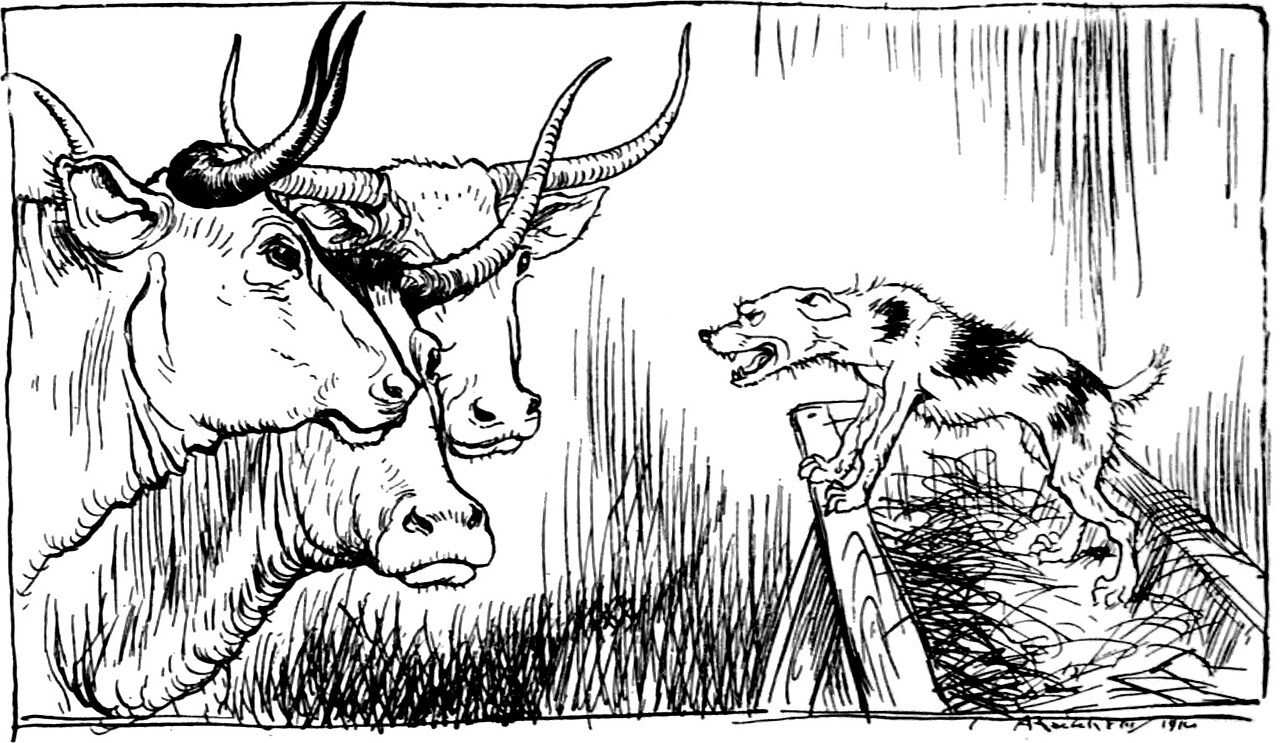
The short form of the fable as cited by Laura Gibbs is: "There was a dog lying in a manger who did not eat the grain, but who nevertheless prevented the horse from being able to eat anything either." The story was first glossed in the 1st century CE lexicon of Diogenianus as "The dog in the manger, concerning those who neither themselves use nor allow others to use: Insofar as the dog neither itself eats the barleycorns, nor allows the horse to". It was twice used in the following century by Greek writer Lucian: in "Remarks addressed to an illiterate book-fancier" and in his play "Timon the Misanthrope". One other contemporary poetic source is a paederastic epigram by Straton of Sardis in the Greek Anthology. At roughly the same time, an alternative version of the fable was alluded to in Saying 102 of the apocryphal Gospel of Thomas. This example involves oxen rather than a horse: "Jesus said, 'Woe to the Pharisees, for they are like a dog sleeping in the manger of oxen, for neither does he eat nor does he let the oxen eat'." The saying seems to be similar to his criticism of the Pharisees in the canonical Gospel of Matthew (23.13): "Woe to you, teachers of the law and Pharisees, you hypocrites! You shut the kingdom of heaven in men's faces; you do not enter yourselves, nor will you let others enter." 1
Later use in Europe
The fable does not appear in any of the traditional collections of Aesop's Fables and is not attributed to him until Heinrich Steinhowel's Esopus (c. 1476). There it is titled "Of the envious dog" (de cane invido) and illustrates a moral proposition: "People frequently begrudge something to others that they themselves cannot enjoy. Even though it does them no good, they won't let others have it." After the cattle that it hinders from eating remonstrate with it, Steinhöwel goes on to mention that "The same thing happened when a dog was holding a bone in his mouth: the dog couldn't chew on the bone that way, but no other dog was able to chew on it either." There were, however, earlier 14th century poetic references to the fable. In John Gower's Confessio Amantis (c. 1390) it is related: 1
Though the next reference in English is in John Lydgate's The Pilgrimage of the Life of Man (1426), where it is applied to a personification of miserliness, the work was written almost a century before in French by Guillaume de Deguileville (1335). While a horse figures in some allusions by later writers, the ox is the preferred beast in Renaissance emblem books. It appears as such in a Latin poem by Hieronymus Osius (1564), although the accompanying illustration shows both an ox and an ass and the dog there, as in Steinhöwel, carries a bone clenched between its teeth. Oxen appear also in the Latin prose version of Arnold Freitag (1579) and in the English poem by Geoffrey Whitney (1586). 1
Sexual interpretation
One of Lucian's allusions to the fable gives it a metaphorically sexual slant: "You used to say that they acted absurdly in that they loved you to excess, yet did not dare to enjoy you when they might, and instead of giving free rein to their passion when it lay in their power to do so, they kept watch and ward, looking fixedly at the seal and the bolt; for they thought it enjoyment enough, not that they were able to enjoy you themselves, but that they were shutting out everyone else from a share in the enjoyment, like the dog in the manger that neither ate the barley herself nor permitted the hungry horse to eat it." (Timon the Misanthrope) In the 1687 Francis Barlow edition of the fables, Aphra Behn similarly sums up the sexual politics of the idiom: "Thus aged lovers with young beautys live, Keepe off the joys they want the power to give." It was of exactly such a situation involving a eunuch and his slaveboys that Straton had complained in the Greek anthology. But the idiom was also applied to occasions of heterosexual jealousy between equals, as for example in Emily Brontë's Wuthering Heights, where it arises during an argument between Catherine Linton and Isabella Linton over Isabella's love for Heathcliff. A Spanish story involving sexual jealousy and selfishness appears in Lope de Vega's play El Perro del Hortelano (English: The Gardener's Dog; 1618). In this case, De Vega's title alludes to the parallel European idiom involving a variant story in which a gardener sets his dog to guard his cabbages (or lettuces). 1
Artistic use
Popular artistic allusions to the fable, or the idiom arising from it, were especially common during the 19th century. Where Lope de Vega had adapted the theme to a problem play in the 17th century, the Belgian composer Albert Grisar used it as the basis for his one-act comic opera of 1855, Le chien du jardinier. The idiom was also taken up in the US by the successful writer of farces, Charles H. Hoyt, where a horse rather than the more common ox figured on the 1899 poster (see left). The title has also been used in various media since then, but without reference to the fable in publicity or on covers. Several well-known artists had illustrated fable collections and their designs were recycled for various purposes. Among these may be mentioned Wenceslaus Hollar's print for the 1666 Ogilby edition of Aesop's fables, in which a dog occupies the manger and barks at a single ox being driven into a wooden barn. Shortly afterwards, Francis Barlow pictured the dog snarling on a pile of hay in a brick-built barn, while the dog does so in a more open farmyard structure in Samuel Howitt's A New Work of Animals (1810). Hollar's design of the ox turning its head to look round at the dog with the barn's brick entrance behind was clearly an influence on later illustrators, including those for the various editions of Samuel Croxall's fable collection and for Thomas Bewick's of 1818. Such illustrations were influential too on those who created designs for crockery. That on a Spode serving dish from 1831 is also related to the Barlow design, although the action takes place outside the barn. A Staffordshire nursery dish of 1835, however, has more in common with Howitt's design. 1
The text above is adapted from the Wikipedia article “The Dog in the Manger”, available under the Creative Commons Attribution-ShareAlike 4.0 licence. 1
The Dog in the Manger is fable falsely ascribed to Aesop, according to the structured record cited below. This entry was generated automatically from that record and has not yet been reviewed by a person familiar with the tradition. 2
The source record links this tradition to 2 external registers, which can be verified through the citation. 2