The tradition & historical record
7 min read · 2 sourcesThe Fox and the Crow is one of Aesop's Fables, numbered 124 in the Perry Index. Early Latin and Greek versions and the fable exist, and it may even have been depicted on an ancient Greek vase. The story serves as a cautionary tale against heeding flattery. 1
The story
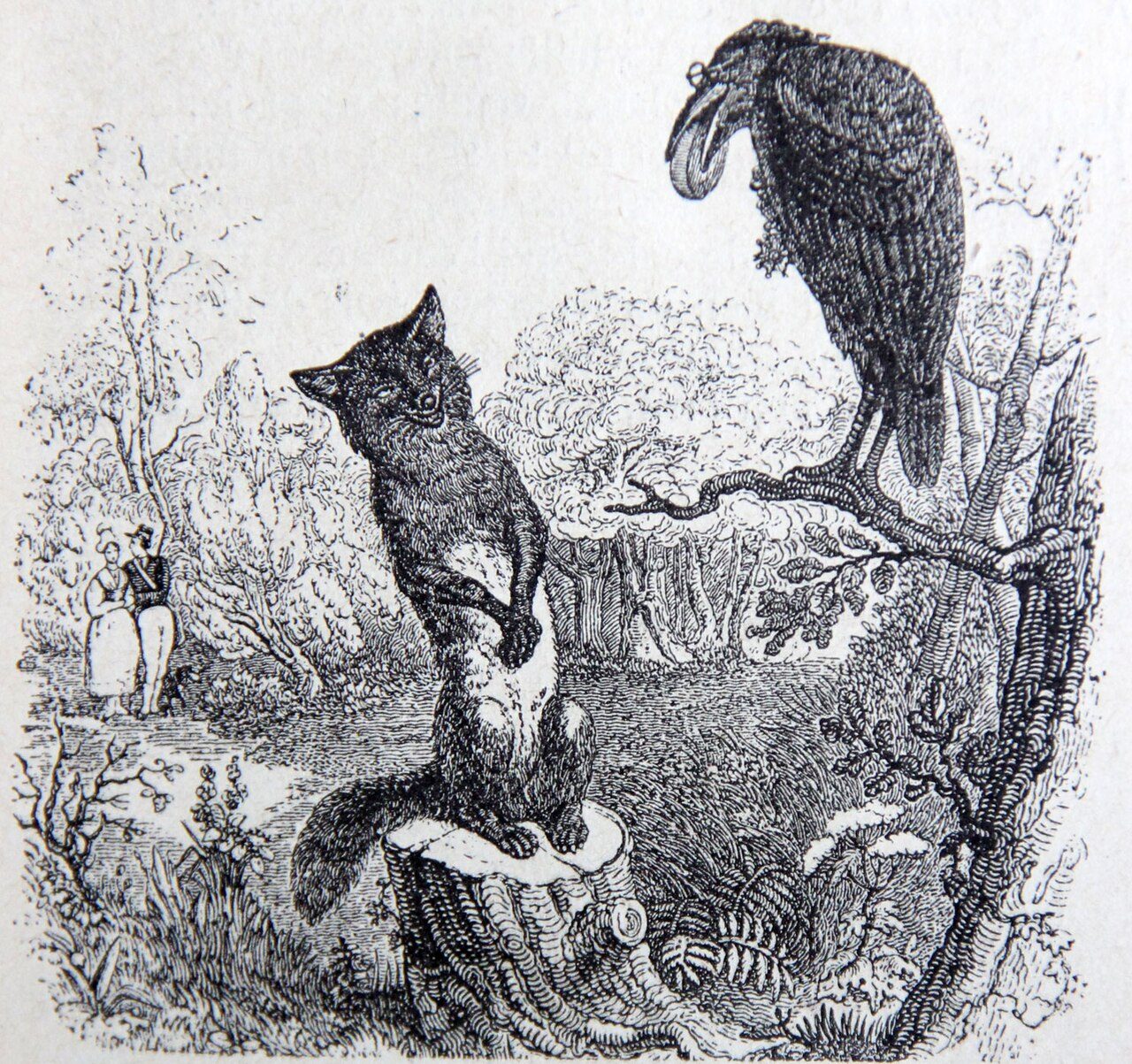
In the fable, a crow has found a piece of cheese and retired to a branch to eat it. A fox, wanting it for himself, flatters the crow, calling her beautiful and wondering whether her voice is as sweet to match. When the crow lets out a caw, the cheese falls and is devoured by the fox. The earliest surviving versions of the fable, in both Greek and Latin, date from the 1st century of the Common Era. Evidence that it was well known before then comes in the poems of the Latin poet Horace, who alludes to it twice. Addressing a maladroit sponger called Scaeva in his Epistles, the poet counsels guarded speech for "if the crow could have fed in silence, he would have had better fare, and much less of quarreling and of envy". The second reference to the fable appears in Horace's satire on legacy hunting (II.5): 1
A season'd Scrivener, bred in Office low, Full often mocks, and dupes the gaping crow. The poem has generally been taken as a caution against listening to flatterers. Phaedrus prefaces his Latin poem with the warning that the one 'who takes delight in treacherous flattery usually pays the penalty by repentance and disgrace'. One of the few who gives it a different interpretation is Odo of Cheriton, whose lesson is that virtue is forgotten in the pursuit of ambition. Babrius has the fox end with a joke at the crow's credulity in his Greek version of the story: 'You were not dumb, it seems, you have indeed a voice; you have everything, Sir Crow, except brains.' In La Fontaine's Fables (I.2), the fox delivers the moral by way of recompense for the tidbit. 1
Musical versions
Since the fable stands at the beginning of La Fontaine's fables, generations of French children commonly learned it by heart. This will explain the many settings by French composers. They include: 1
Louis-Nicolas Clérambault Jacques Offenbach in Six Fables de La Fontaine (1842) for soprano and small orchestra (performance available on YouTube) Charles Gounod in a setting for a cappella voices (1857) Benjamin Godard, the third of Six Fables de La Fontaine for voice and piano, op. 17 (1872/9) Louis Lacombe in a setting dated 1888 Charles Lecocq in Six Fables de Jean de la Fontaine for voice and piano (1900), available on YouTube André Caplet in Trois Fables de Jean de la Fontaine (1919) for voice and piano, in a forcefully dramatised version Maurice Delage in Deux fables de Jean de la Fontaine (1931) Marie-Madeleine Duruflé as the sixth in her 6 Fables de La Fontaine for a cappella female voices (1960) Joseph Noyon in a song setting Jean-René Quignard for 2 children's voices Claude Ballif as the second in his Chansonettes : 5 Fables de La Fontaine for small mixed choir (Op.72, Nº1 1995) Dominique Preschez as the first of his Trois fables en une for small orchestra and soprano (1995) Jacques Frochot made a setting for a cappella choir (1996) Vladimir Cosma, as the fifth piece in Eh bien ! Dansez maintenant (2006), a light-hearted interpretation for narrator and orchestra in the style of an accordion waltz 1
There was also a setting of the French words by the Dutch composer Rudolf Koumans in Vijf fabels van La Fontaine (op. 25, 1968) for school chorus and orchestra. 1
Other artistic applications
The fable is depicted no less than three times in the border of the Bayeux Tapestry and it has been speculated that a political commentary is intended. The picture is that of an ungainly bird sitting in a tree under which an animal is lying. They are looking at each other with their mouths open, and there is some object in the air between them. The reason for pointing to this particular fable is quite clear. Harold's vanity has led him to overreach himself and so lose everything. A later tapestry on which the story is portrayed came from the Gobelins Manufactory and was designed by Jean-Baptiste Oudry. The fable also figured in church architecture, most notably on a column in the Romanesque church of San Martín de Tours in Spain. In later centuries the fable was used on household china, on tiles, on vases, and figured in the series of La Fontaine medals cast in France by Jean Vernon. A less conventional use was the hydraulic statue built for the Versailles Labyrinth that was constructed for Louis XIV, one of thirty nine sets of statues in the maze illustrating Aesop's fables. The fox and the crow eventually figured, among many other beasts, on the grandiose monument to La Fontaine designed by Achille Dumilâtre in 1891. This stood at the angle of the Jardins de Ranelagh between the Avenue Ingres and Avenue du Ranelagh in Paris XVI and was melted down during World War II. It was replaced by Charles Correia's present monument in 1983. This portrays the fabulist standing and looking down at the cheese-bearing crow at his feet, while the fox gazes up at it from the steps to the pedestal. 1
Philately
The fable has been a favourite with stamp designers. Among the countries that have featured it are the following: 1
Albania issued a 1995 set with several fables on each stamp; the fox and the crow is featured on the 3 leke stamp. France commemorated the third centenary of La Fontaine's death in 1995 with a set of six stamps featuring individual fables, of which this was one. Greece issued a 1987 set dedicated to Aesop's fables; the fox and the crow figures on the 32 drachma stamp. Hungary issued sets dedicated to the fables in both 1960 and 1987; in the former the fox and the crow was on the 80 fillér(0.8 forint) stamp and on the 2 forint stamp in the latter. The Maldives issued a set in 1990 in which Walt Disney characters act out the fables; the fox and the crow appears on the 1 rufiyaa stamp. Monaco celebrated the 350th anniversary of the birth of Jean de la Fontaine in 1972 with a 50 centimes composite stamp on which the fox and the crow was one of the fables illustrated. The 3,86 value of 2021 celebrates the author's 400th anniversary with an illustration of this fable alone behind his portrait head. Niger celebrated the author's 350th anniversary with a set of air mail stamps which also incorporated the fable's moral; the fox and the crow figures on the 25 franc stamp and the design adapts elements of Léon Rousseau's panel. Poland issued a set dedicated to folk tales in 1980, designed by Helena Winogradow-Matuszewska and featuring this fable on the 40 groszy stamp. 1
The text above is adapted from the Wikipedia article “The Fox and the Crow (Aesop)”, available under the Creative Commons Attribution-ShareAlike 4.0 licence. 1
The Fox and the Crow is Aesop's fable, according to the structured record cited below. This entry was generated automatically from that record and has not yet been reviewed by a person familiar with the tradition. 2
The source record links this tradition to 4 external registers, which can be verified through the citation. 2