The tradition & historical record
4 min read · 2 sourcesThe Fox and the Sick Lion is one of Aesop's Fables, well known from Classical times and numbered 142 in the Perry Index. There is also an Indian analogue. Interpretations of the story's meaning have differed widely in the course of two and a half millennia. 1
Ancient versions
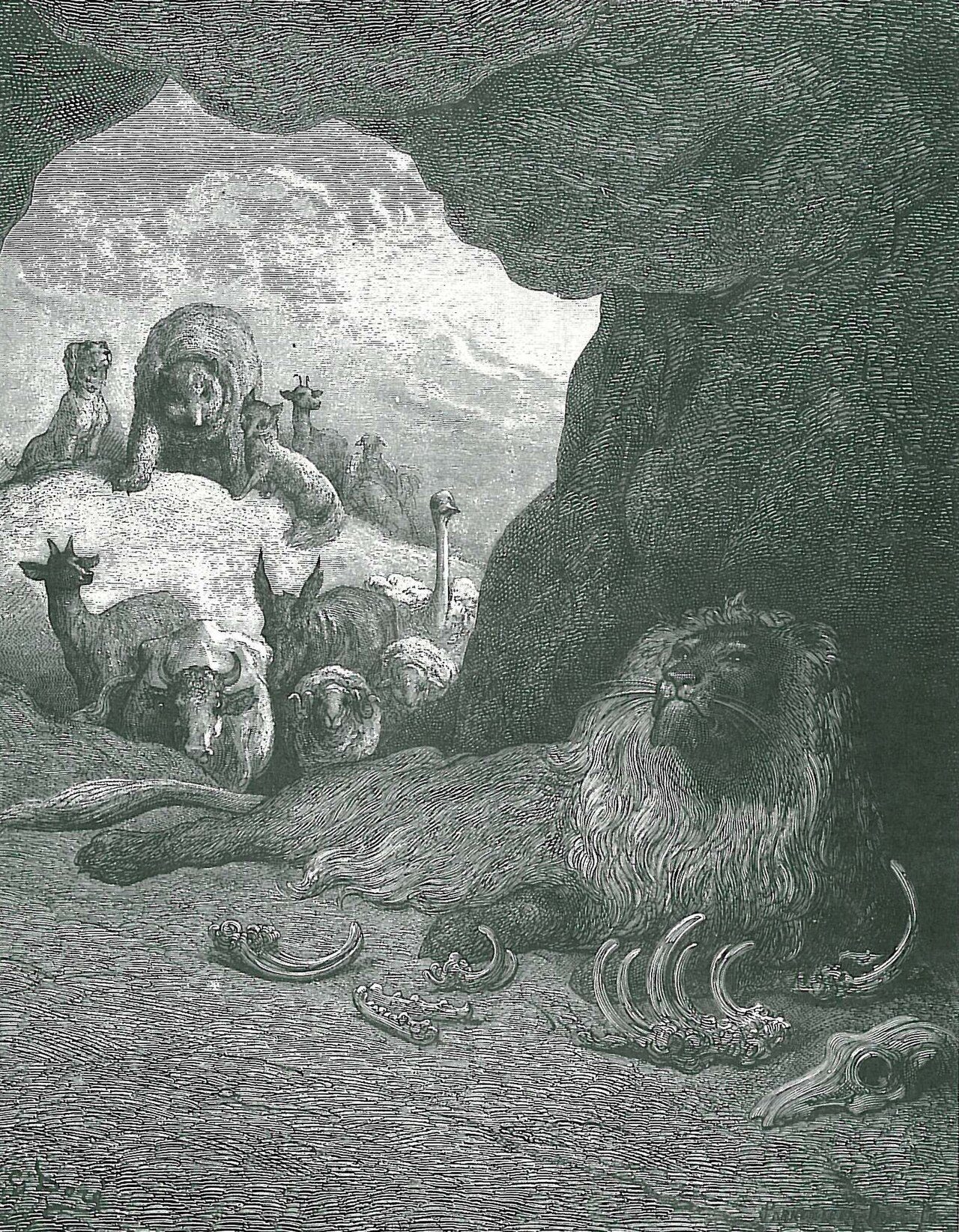
A lion grown too old and weak to hunt pretended to be sick as a ruse and ate the animals that came to visit him in his cave. But the fox only greeted him from outside and, on being asked why it did not enter, replied "Because I can only see tracks going in, but none coming out". The earliest application of the fable is in an economic context in First Alcibiades, a dialogue often ascribed to Plato and dated to the 4th century BCE. There Socrates tries to dissuade a young man from following a political career and, in describing the Spartan economy, says: 1
and as to gold and silver, there is more of them in Lacedaemon than in all the rest of Hellas, for during many generations gold has been always flowing in to them from the whole Hellenic world, and often from the barbarian also, and never going out, as in the fable of Aesop the fox said to the lion, 'The prints of the feet of those going in are distinct enough'- but who ever saw the trace of money going out of Lacedaemon? The fable is also one among several to which the Latin poet Horace alluded in his work, seeing in it the moral lesson that once tainted with vice there is no returning. 1
Reasons for caution
The moral drawn in Mediaeval Latin retellings of the fable such as those of Adémar de Chabannes and Romulus Anglicus was that one should learn from the misfortunes of others, but it was also given a political slant by the additional comment that "it is easier to enter the house of a great lord than to get out of it", as William Caxton expressed it in his English version. Hieronymus Osius, however, confined himself to making the story's lesson that the wise man notes not only signs of danger but also learns from them to be cautious. The necessity of being wary in all one's enterprises, "keeping in view the profit and loss", was also the message of Gilles Corrozet's emblematic use of the fable in his Hecatomographie (1540). 1
During the 17th century the fable was almost always interpreted as a warning against association with rulers. Wenceslas Hollar emphasised the political connection in his illustration of The Fables of Aesop (1673). At the mouth of a cave, a crown and sceptre are laid prominently on rocks as the lion feasts on its slaughtered visitors. The same point is made by Pieter de la Court in his Sinryke Fabulen (Amsterdam, 1685). Above the woodcut illustrating the fable is the Dutch distich Een oud hoveling, een oud schoveling (an old courtier, an old survivor), while below it is the Latin proverb Cum principibus ut cum igne (With princes as with fire, be wary). In Jean de La Fontaine's Fables additional details are drawn from royal practice. The lion issues a safe conduct (passeport) to the deluded animals bidden to visit him. In reply the foxes send back a note that echoes the former Latin conclusion: "While seeing how the beasts get in,/ We do not see how they get out". The inference to be drawn is that the word of the powerful is not to be trusted. 1
The text above is adapted from the Wikipedia article “The Fox and the Sick Lion”, available under the Creative Commons Attribution-ShareAlike 4.0 licence. 1
The Fox and the Sick Lion is Aesop's fable, according to the structured record cited below. This entry was generated automatically from that record and has not yet been reviewed by a person familiar with the tradition. 2
The source record links this tradition to 2 external registers, which can be verified through the citation. 2