The tradition & historical record
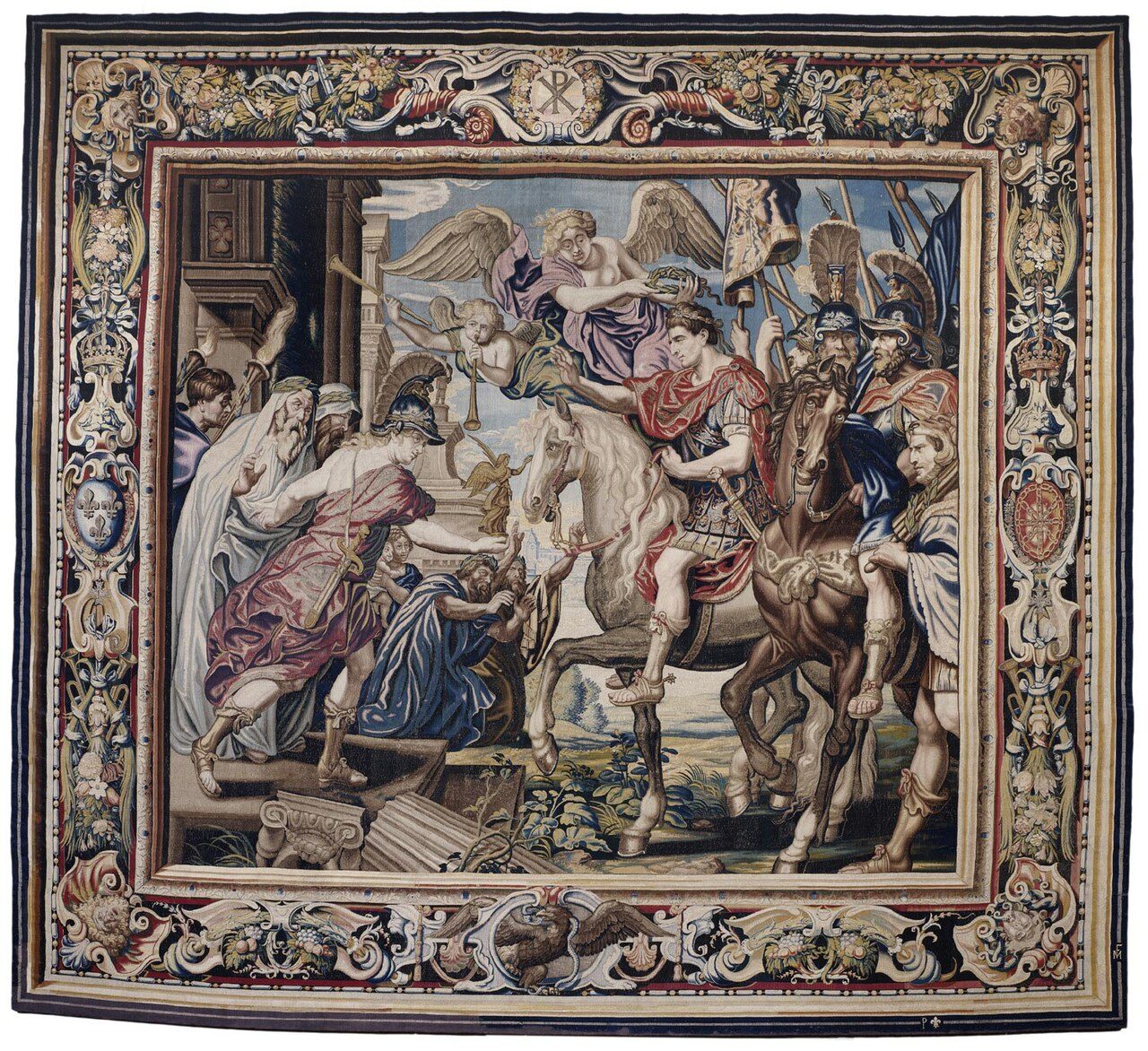
5 min read · 2 sourcesThe History of Constantine is a series of tapestries designed by the Flemish artist Peter Paul Rubens and Italian artist Pietro da Cortona depicting the life of Constantine I, the first Christian Roman emperor. In 1622, Rubens painted the first twelve oil sketches that were used as guides, and the tapestries themselves were woven in the workshop of Marc Comans and François de la Planche in the Faubourg Saint-Marcel in Paris by 1625, transforming each small sketch (perhaps two feet per side) into a sumptuous creation of wool, silk, and gold and silver threads that could easily fill a wall. An additional five designs were painted by Cortona in 1630 and woven in the atelier of Cardinal Francesco Barberini in Rome over the next decade. The tapestries, once separated, are now split between the Philadelphia Museum of Art and Mobilier National, and the oil sketches are widely dispersed, in several countries. 1
History
The series was commissioned in 1622 when Rubens was in Paris discussing the Marie de' Medici cycle of paintings commissioned for the Luxembourg Palace by Marie de Médicis. Although the popular consensus has long been that the tapestries were commissioned by Louis XIII, based upon a 1626 letter by Rubens, art historians have begun to question this conclusion in recent decades. New evidence, such the fact that the designs were listed as the property of de la Planche upon his death, establishing a weak form of copyright, has muddied the issue. One theory is that Rubens only cited the king as the commissioner of the tapestries in the aforementioned letter in order to increase their perceived importance because his payment was overdue. Financial evidence strongly indicates that Rubens himself ordered the cartoons from which the tapestries would be woven at the personal expense of 500 livres, making him a primary mover behind the project. Louis XIII's lack of investment in the project is indicated by the fact that he immediately gave the first seven tapestries completed to the papal legate Cardinal Francesco Barberini in 1625, even though Barberini was at first unwilling to accept so princely a gift. Barberini eventually acquiesced, and commissioned an additional five tapestries from Pietro da Cortona, another Baroque master who happened to be the artistic director of Barberini's newly founded atelier. He repeated only one design from the Rubens set, the apparition of the cross. Cortona also designed several smaller tapestries such as portieres and a baldachin to furnish an entire room, and painted the ceiling of the salon where they were displayed. 1
Constantius appoints Constantine as his successor
sketch: Sydney, Art Gallery of New South Wales, 14.4" x 11.9" (36.576 x 30.226 cm.) tapestry: Paris, Mobilier National Previously thought to be Constantine Investing His Son Crispus with Command of the Fleet, recent research has proved that the identities of those in the panel have been misidentified and that actually the panel represents Emperor Constantius I recognising his son Constantine as his successor. 1
The Marriages of Constantine and Fausta and of Constantia and Licinius
sketch: private collection, 18.625" x 25.375" (47.3 x 64.4 cm.) tapestry: Philadelphia, Philadelphia Museum of Art 15' 11" x 19' 11.5" (485.14 x 608.33 cm.) (all tapestries unless otherwise noted are held by the PMA) Although the weddings depicted actually occurred six years apart, most scholars accept the anachronism as an attempt to create a stronger link between Constantine and Louis XIII, whose own marriage to Anne of Austria was a double wedding also featuring the union of his sister to Anne's brother, Philip IV of Spain. The event occurs in a temple of Jupiter and Juno, who preside in the form of statuary. The main difference between the sketch and the tapestry can be seen in the depiction of Jupiter, who wears a stern countenance and brandishes his thunderbolt in the former, quite suitable considering the conflict that would soon arise between the Constantine and Licinius. However, in the final tapestry, Jupiter wears a more beneficent mien and holds his thunderbolt less threatening, as befits the happy union between the royal houses of France and Spain. 1
The Emblem of Christ Appearing to Constantine
sketch: Philadelphia Museum of Art, 18.186" x 22.063" (46.2 x 56 cm.) tapestry: Paris, Mobilier National In this scene, the Chi-Rho monogram of Christ appears before Constantine in the sky at noon just prior to his battle with Maxentius. In a dream, he learns that placing this emblem on his banner assures him of triumph over Maxentius, his co-emperor. Rubens follows Eusebius quite closely, but replaces the flaming cross he described with the monogram in Lactantius' chronicle. One soldier, looking at Constantine rather than the vision, points with the labarum, or military standard, to the next scene. 1
The Labarum
sketch: private collection, 13.9" x 10.8" (35.4 x 27.5 cm.) tapestry: Paris, Mobilier National This episode depicts the moments just before the Battle of Milvian Bridge, as Constantine (already crowned with a victor's laurels) presents his labarum. This has been emblazoned with Christ's symbol, as he was instructed. The monogram of Rubens' usual panel maker, Michiel Vrient, is impressed on the back of the panel, along with a branded "A" that indicates the panel was prepared about 1621-22. 1
The text above is adapted from the Wikipedia article “The History of Constantine”, available under the Creative Commons Attribution-ShareAlike 4.0 licence. 1
The History of Constantine is series of tapestries designed by Peter Paul Rubens and Pietro da Cortona, extant in several editions, according to the structured record cited below. This entry was generated automatically from that record and has not yet been reviewed by a person familiar with the tradition. 2
The source record links this tradition to 1 external register, which can be verified through the citation. 2