The tradition & historical record
6 min read · 2 sourcesThe Unicorn Tapestries or the Hunt of the Unicorn (French: La Chasse à la licorne) is a series of seven tapestries made in the Southern Netherlands around 1495–1505, and now in The Cloisters in New York City. They were possibly designed in Paris and woven in Brussels. They depict a group of noblemen and hunters in pursuit of a unicorn through an idealised French landscape. The tapestries were woven in wool, metallic threads, and silk. The vibrant colours, still evident today, were produced from dye plants: weld (yellow), madder (red), and woad (blue). First recorded in 1680 in the Paris home of the Rochefoucauld family, the tapestries were looted during the French Revolution. Rediscovered in a barn in the 1850s, they were hung at the family's Château de Verteuil. Since then they have been the subject of intense scholarly debate about the meaning of their iconography, the identity of the artists who designed them, and the sequence in which they were meant to be hung. Although various theories have been put forward, currently nothing is known of their early history or provenance. Their dramatic but conflicting narratives have inspired multiple readings, from chivalric to Christological. Variations in size, style, and composition suggest they come from more than one set, linked by their subject matter, provenance, and the mysterious AE monogram which appears in each. One of the panels, "The Mystic Capture of the Unicorn", survives as just two fragments. 1
Construction
Questions about the original workmanship of the tapestries remain unanswered. The design of the tapestries is rich in figurative elements, similar to those found in oil painting. They appear to be influenced by the French style, as the elements in the tapestries reflect the style of woodcuts and metalcuts made in Paris in the late fifteenth century. The garden backgrounds of the tapestries are rich in floral imagery, featuring the "millefleurs" background style of a variety of small botanic elements. Invented by the weavers of the Gothic age, it became popular during the late medieval era and declined after the early Renaissance. There are more than a hundred plants represented in the tapestries, scattered across the green backgrounds of the panels, eighty-five of which have been identified by botanists. The particular flowers featured in the tapestries reflect the tapestries' major themes. In the unicorn series, the hunt takes place within a Hortus conclusus, literally meaning "enclosed garden", which was not only a representation of a secular, physical garden, but a connection with the Annunciation. The tapestries were very probably woven in Brussels, which was an important center of the tapestry industry in medieval Europe. An example of the remarkable work of the Brussels looms, the tapestries' mixture of silk and metallic thread with wool gave them a fine quality and brilliant color. The wool was widely produced in the rural areas around Brussels, and a common primary material in tapestry weaving. The silk, however, was costly and hard to obtain, indicating the wealth and social status of the tapestry owner. 1
Provenance
The tapestries were owned by the La Rochefoucauld family of France for several centuries, with first mention of them showing up in the family's 1728 inventory. At that time five of the tapestries were hanging in a bedroom in the family's Château de Verteuil, Charente and two were stored in a hall adjacent to the chapel. The tapestries were highly believed woven for François, the son of Jean II de La Rochefoucauld and Marguerite de Barbezieux. There is a possible connection between the letters A and E and the La Rochefoucauld, which are interpreted as the first and last of Antoine's name, who was the son of François, and his wife, Antoinette of Amboise. During the French Revolution the tapestries were looted from the château and reportedly were used to cover potatoes – a period during which they apparently sustained damage. By the end of the 1880s they were again in the possession of the family. A visitor to the château described them as quaint 15th century wall hangings, yet showing "incomparable freshness and grace". The same visitor records the set as consisting of seven pieces, though one was by that time in fragments and being used as bed curtains. John D. Rockefeller Jr. bought them in 1922 for about one million US dollars (equivalent to $19.2 million in 2025). Six of the tapestries hung in Rockefeller's house until The Cloisters was built when he donated them to the Metropolitan Museum of Art in 1938 and at the same time secured for the collection the two fragments the La Rochefauld family had retained. The set now hangs in The Cloisters, which houses the museum's medieval collection. 1
Restoration
In 1998 the tapestries were cleaned and restored. In the process, the linen backing was removed, the tapestries were bathed in water, and it was discovered that the colours on the back were in even better condition than those on the front (which are also quite vivid). A series of high resolution digital photographs were taken of both sides using a customised scanning device suspending a linear array scan camera and lighting over the delicate textile. The front and back of the tapestries were photographed in approximately three-by-three-foot square segments. The largest tapestry required up to 24 individual 5000 × 5000 pixel images. Merging the massive data stored in these photos required the efforts of two mathematicians, the Chudnovsky brothers. 1
Subjects
The Metropolitan Museum of Art, which owns the tapestries, has titled and ordered them as follows: 1
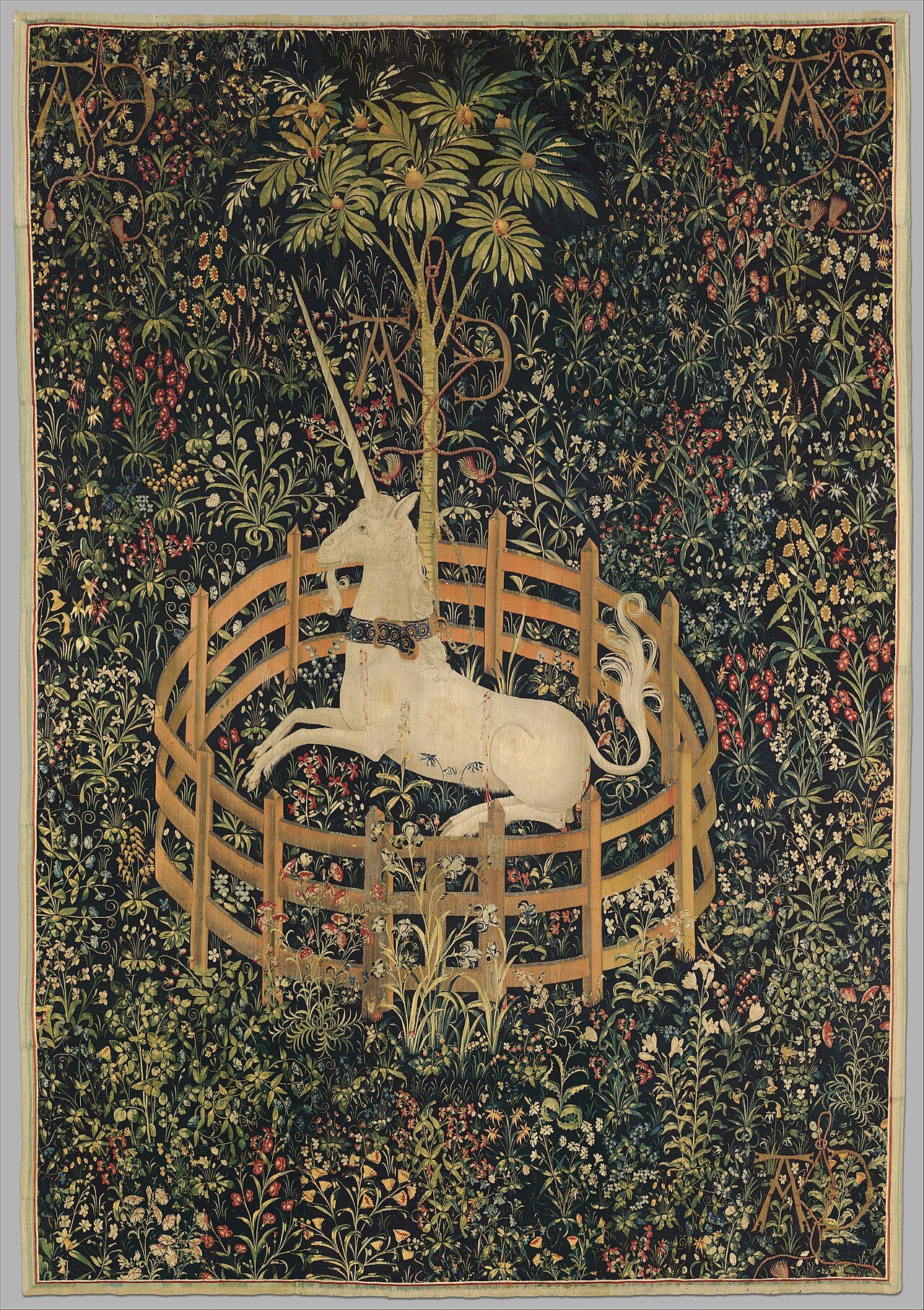
"The Hunters Enter the Woods" "The Unicorn Purifies Water" "The Unicorn Crosses a Stream" "The Unicorn Defends Himself" "The Unicorn Surrenders to a Maiden" (two fragments) "The Hunters Return to the Castle" "The Unicorn Rests in a Garden" The tapestries comprise five large pieces, one small piece, and two fragments. The mobility associated with the size formed an essential consideration of the function of the tapestry in the medieval age. Different sizes of Gothic tapestries served as the decoration to fit chosen walls in the middle age. In modern-day research, based on the possibility that the unicorn tapestries were designed for use as a bedroom ensemble, the five large pieces fit the back area of a wall, while the other two pieces serve as the coverlet, or overhead canopy. Other sources give slightly different titles and different sequences. The sequence of the tapestries is based on three main factors. The first is construction of the tapestries themselves, which exhibit differences of manufacture and size, may suggest that the first and last are independent works or form a different series. Secondly is the story of the classic stag hunt, usually cited to Livre de la Chasse by Gaston III, Count of Foix. 1
Interpretation of themes
The entrapment of a unicorn by a virgin was a common theme in medieval folklore. 1
The text above is adapted from the Wikipedia article “The Unicorn Tapestries”, available under the Creative Commons Attribution-ShareAlike 4.0 licence. 1
The Hunt of the Unicorn is tapestry series of the late Middle Ages, according to the structured record cited below. This entry was generated automatically from that record and has not yet been reviewed by a person familiar with the tradition. 2
The source record links this tradition to 8 external registers, which can be verified through the citation. 2