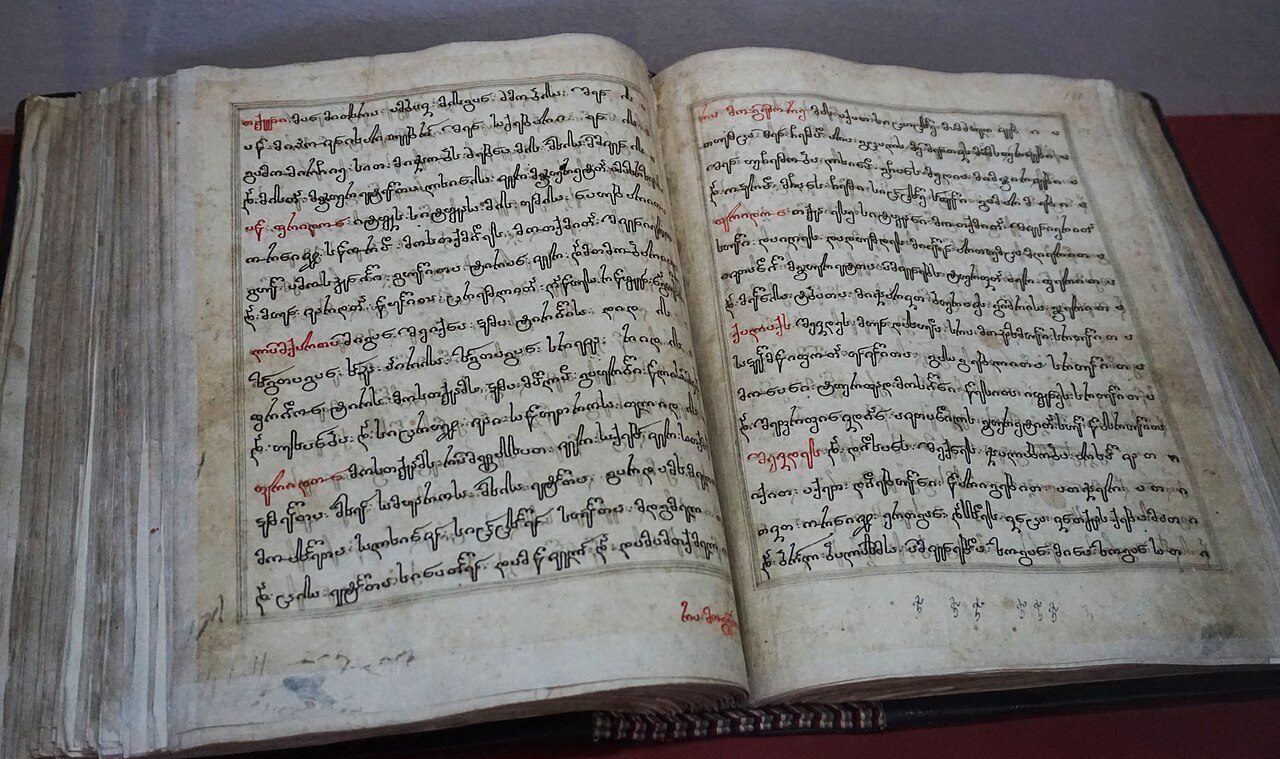
The tradition & historical record
6 min read · 2 sourcesThe Knight in the Panther's Skin (Georgian: ვეფხისტყაოსანი, romanized: vepkhist'q'aosani pronounced [vepʰχistʼqʼaosani] literally "the one with the skin of a tiger") is a Georgian medieval epic poem, written in the 12th or 13th century by Georgia's national poet Shota Rustaveli. A definitive work of the Georgian Golden Age, the poem consists of over 1600 Rustavelian Quatrains and is considered to be a "masterpiece of Georgian literature". Until the early 20th century, a copy of this poem was part of the dowry of every bride. Although the poem takes place in the fictional settings of "India" and "Arabia", events in these distant lands are but a colorful allegory of the rule of Queen Tamar of Georgia, and the size and glory of the Kingdom of Georgia in its Golden Age. It tells of the friendship of two heroes, Avtandil and Tariel, and their quest to find the object of love, Nestan-Darejan, an allegorical embodiment of Queen Tamar. These idealized heroes and devoted friends are united by courtly love, generosity, sincerity, and dedication. The poem is regarded as the "coronation of thought, poetic and philosophical art of medieval Georgia", a complex work with rich and transcending genres. It has been described as "epic", "chivalric romance", "epic romance" and "epic poem of lyric poetry." Despite its formal complexity, it bears to this day "the Georgian vision of the world." 1
Context and time
The poem was written during the Golden Age of the Kingdom of Georgia and the reign of Queen Tamar, who was enthroned by her father King George III of Georgia. Tamar was celebrated by poets for her beauty, intelligence, and diplomatic skills. She expanded the Georgian kingdom to its historical maximum, repulsed invasions, and established protectorates over many area Muslim and Christian lands. Under her reign, the economy prospered. Georgian trading caravans reached Ayyubid Egypt, the Kievan Rus, and the Byzantine Empire. Medieval science developed, and the largest monasteries and churches in Georgia were built. Secular literature developed to the point of equaling the greatest religious texts. Against the backdrop of this "remarkable growth", Shota Rustaveli composed his poem. Rustaveli, born in Rustavi, a Meskhetian village, was close to Queen Tamar and possibly served as her treasurer. He likely participated in many military campaigns. The stories in his poem are set in faraway lands, but his allegorical representations of contemporaneous Georgia are recognizable. For instance, he refers to wine culture and a female king who became an heir of her father. In the prologue, Rustaveli says that he wrote this poem to praise the "King" Tamar. 1
And in the epilogue (given here with a formal paraphrase), he praises the queen's king consort David Soslan. 1
Genre and style
Though written in Georgian at the height of the pan-Caucasian empire of the Georgian Bagratids, according to the modern historian Stephen H. Rapp, The Knight in the Panther's Skin "was an expression of the Iranian/Iranic epic and not some genre of Byzantine literature". Rustaveli used a Persian model for writing The Knight in the Panther's Skin. In the work's prologue, the modern historian Nile Green explains, Rustaveli publicly declares his 1,600-quatrain epic, written in the shairi verse form, as a "Persian tale, translated into Georgian / Like an orphaned pearl, like a toy passed from hand to hand". 1
Title
Georgian title ვეფხისტყაოსანი (vepkhistqaosani) literally means "one with a skin of vepkhi". The identity of the animal that it refers to is not certain and it can be a tiger, panther or leopard. In modern Georgian, it refers to the tiger. However, according to more modern research it would rather mean a panther. Similarly, the qualification of "knight" is not derived from the original title and its alternative translations exist, such as the "valiant" or simply a "man." The alternative English titles of the poem also are "Lord of the Panther Skin" and "The Man in the Panther's Skin". 1
Story
The story can be divided into two parts: the first part is Avtandil's quest for Tariel, the titular "knight in the panther's skin", and the second part is Avtandil's quest for Nestan-Darejan, Tariel's love. 1
Search for Tariel
The King of Arabia, Rostevan, has no sons and confers the kingship on his only daughter, the beautiful and wise Tinatin. She has a tender affection for Avtandil, the knight and commander-in-chief of Rostevan's armies. One day, Avtandil challenges King Rostevan to a hunting competition. After three days of shooting game, they encounter a knight crying by a river. He is dressed in a panther's skin, and kills the slaves sent by the king to contact him, then disappears. Rostevan sends parties across the world to search for the mysterious knight, but becomes disheartened when he fails. Tinatin asks Avtandil to find the strange knight within three years, promising him her hand in marriage in return. After two years and nine months of searching, Avtandil finds the knight in the panther's skin hiding in a cave, with only a maiden for company. His name is Tariel, son of King Saridan, who has the seventh kingdom of India. He had served as heir to King Pharsadan, king of the other six kingdoms, for many years before falling in love with Pharsadan's daughter, Nestan-Darejan. Tariel wages war with the Khatavians to earn the favor of Nestan, but is dismayed to learn that she has already been promised to the Khwarezmian prince. Tariel could not bear the idea of her marriage, and at Nestan's request, he killed the suitor. The princess was placed on a boat and set adrift on the seas. Despite Tariel's lengthy search for his love, he could not find her. Later he met Nuradin-Phridon, ruler of Mulgazanzar, who told him that Nestan was alive but trapped on a distant boat. Tariel retired to a cave to live in the wilderness with Asmat, the former servant and messenger of Nestan. 1
The text above is adapted from the Wikipedia article “The Knight in the Panther's Skin”, available under the Creative Commons Attribution-ShareAlike 4.0 licence. 1
The Knight in the Panther's Skin is Georgia's national epic poem, according to the structured record cited below. This entry was generated automatically from that record and has not yet been reviewed by a person familiar with the tradition. 2
The source record links this tradition to 14 external registers, which can be verified through the citation. 2